Aditi Raina
There is something more quietly heart-breaking about Dr Abdul Kalam than the fact of his passing itself: he never truly succeeded in changing the system he lived within. Before you take offense or reach for an angry retort, understand this isn’t a criticism of the man — it was never his failing that he found himself out of step with a polity and society that placed little premium on the values he embodied and articulated. What set him apart, what made him a rare gem in a landscape of mediocrity, was that he stayed warm and optimistic regardless.
Consider the irony: the nation today is flooded with tributes and his memorable sayings, all genuinely moving and uplifting — yet in his final living moments, what troubled him most was not his legacy but the gridlock in Parliament. We will, naturally, soon place this remarkable man on a pedestal, offer ritual respects on designated occasions, and then move on — continuing meanwhile to hand power to small-minded opportunists and habitual plunderers. Dr Kalam had a front-row seat to this theatre of hypocrisy and was far too clear-eyed to be deceived by the contradiction; and still, he met it all with a smile and kind words. He was the embodiment of hope itself.
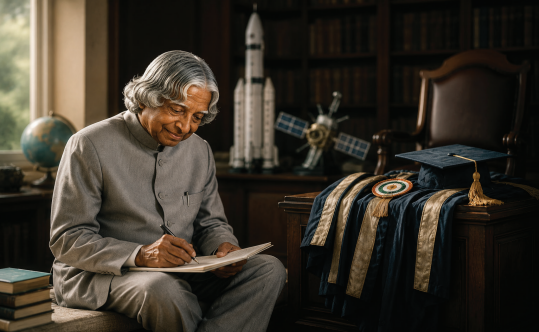
His greatness reveals itself best through paradox. A lifelong bachelor untouched by scandal. A teacher without equal, who never stopped being a student himself until his final days. A technologist with a futuristic vision who held deep faith in ancient wisdom. A rare mind who fused science with spirituality while remaining fully both — a compassionate human being and a rigorous scientist. He could recite India’s scriptures from memory just as easily as he could discuss the newest research paper. He drew the names for his projects from cultural and traditional roots. He made India’s old wisdom feel modern and cool, turning him — improbably — into an icon for the young. Beyond the missiles he built, his real launches were the countless young minds he set on course toward possibilities they hadn’t known existed within themselves.
Dr Kalam proved that living simply requires no special genius. He left Rashtrapati Bhavan with the very same two suitcases he had carried in with him. (We’ll leave aside any comparison to successors and their considerably heavier baggage, literal or otherwise.) He even personally reimbursed the state for expenses incurred by his private visitors — a rare figure of integrity amid a class more accustomed to helping itself to public resources. Across a distinguished career, he earned every honour that came his way, yet never once wore the entitlement that the honours-and-ego culture around him would have readily excused. Though he stayed above politics, it was under his watch as President that a looming constitutional crisis was quietly headed off — though we needn’t name names there either. And perhaps the final irony: we now pause our work each year to honour a man who essentially never stopped working. One wonders whether Dr Kalam himself would have approved of the gesture.
His record carries a credibility and sincerity that stand in sharp contrast to the corrupt, indifferent, and small-minded figures who so often dominate public discourse, shape our daily lives, and erode democratic institutions. It is precisely this contrast that stirs the quiet frustration many feel — that a leader and mentor of such authenticity spent his years largely confined to seminar podiums and largely ceremonial offices, when far more consequential roles could have benefited from what he had to offer.
What we’ve lost belongs to generations yet to come — because it increasingly seems the world has run short of the rare material from which men like him are made.
(The writer is post-graduate in Mass Communication and a budding journalist)