
By Colonel Dev Anand Lohamaror
The greatest strength of a democracy is the trust of its people, and its greatest challenge is distinguishing between genuine public sentiment and well-planned chaotic campaigns. In any democratic nation, protest, dissent, and agitation are constitutional rights of citizens. However, when violence, destruction of public property, organized digital propaganda, psychological warfare, structured crowd management, and fears of political instability become attached to a movement, it ceases to be merely a political issue and directly becomes a matter of national security.
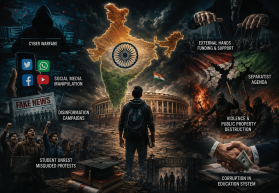
Recent events have posed this crucial question before the entire nation—was this merely the natural outrage of students against the education system, or was that genuine anger exploited by elements seeking to turn it into a broader political confrontation? The ultimate answer will be provided by investigative agencies, judicial processes, and time; yet asking whether India today faces a new era of ‘hybrid warfare’ and ‘hybrid destabilization campaigns’ is entirely legitimate.
Over the past decade, India has witnessed several major public movements. Whether it was the farmers’ protest, the Shaheen Bagh demonstration, or other large-scale agitations—alongside genuine public sentiments, a debate persisted regarding whether organized political, ideological, or separatist elements were attempting to take undue advantage. While opinions on these debates may differ, it is certain that in the era of modern information warfare, derailing any public movement from its original purpose has become far easier than before.
It is in this context that the recent student movement must also be viewed. It is indisputable that incidents like ‘paper leaks’ are a direct injustice to millions of students and their families. The years of hard work of any student should not fall prey to a few mafias and a corrupt system. Therefore, the outrage among students and parents was entirely natural. Denying this genuine pain would be neither just nor democratic.
However, the question arises when violence, vandalism, damage to public property, attacks on the police, and strategic political slogans enter a movement. At such a time, drawing a clear line between peaceful candidates and violent elements becomes imperative. The protection of democracy is possible only when innocent citizens and lawbreakers are not placed in the same category.
If security agencies acted preemptively based on the anticipation of potential violence or organized disturbance, it falls under their constitutional duty. Wherever public property has been damaged, a fair investigation must be conducted, and compensation should be recovered from the guilty as per the law. The right to protest is democratic, but violence can never be a democratic right.
It must also be understood that modern hybrid warfare is not fought on borders alone. Today, destabilizing a nation from within does not require tanks and missiles. Democratic systems can be challenged through social media, disinformation, rumors, emotional triggers, cyber networks, and psychological operations. Therefore, if signs of an attempt to create widespread political instability under the guise of a genuine issue emerge, it is natural and necessary for the government to remain vigilant.
However, the other side of the coin is equally important. Viewing the concerns of students and parents solely through the lens of law and order will not provide a lasting solution. The frequency of paper leaks has made it clear that deep structural reforms are urgently needed in our education and examination systems. It is a positive sign that discussions on making the examination system more secure and transparent have accelerated, but this is only the first step.
The scope of reforms should not remain limited to entrance or competitive examinations. Comprehensive changes are also needed in India’s university system. Today, a belief has taken root among many researchers, PhD candidates, and young academics that there is a lack of adequate transparency in appointments to crucial positions like Assistant Professor, Professor, and Vice-Chancellor in higher educational institutions. While accusing all institutions uniformly would be unfair, the persistent questions regarding the fairness of the current selection system are concerning.
When the culmination of an applicant’s years of dedication, research papers, academic achievements, and merit depends entirely on an interview lasting a few minutes, the scope for bias naturally increases. An interview may be necessary, but its objective should be limited to evaluating communication ability and personality, rather than serving as the decisive basis for the entire selection process.
The time has come to develop a transparent framework for appointments in higher education, where a standardized national examination, research work, teaching experience, and objective evaluation form the primary criteria. The weightage of the interview should be strictly limited to minimize subjectivity and influence. Just as institutions like the Union Public Service Commission (UPSC) have established a benchmark for transparency, serious thought must be given to a fair national institutional framework for higher education recruitments.
The nation’s youth do not merely want employment; they want justice. They need the confidence that their success will be determined by their merit, not by network, influence, or personal bias. When this confidence weakens, public discontent takes root. And this very discontent can later serve as the foundation for exploitation by external or subversion-minded elements.
Therefore, viewing national security and educational reform in separate silos would be a mistake. If the government succeeds in thwarting a potential chaotic campaign, its next responsibility is to address the root causes that give rise to discontent. Maintaining law and order alone is not sufficient; justice must also be seen to be done within the system.
The true strength of Indian democracy lies in the credibility of its institutions. If violence occurred, the perpetrators must be severely punished; if destructive elements were active in the movement, they must be exposed; and if the students’ grievances were genuine, they must be addressed not with hollow assurances, but through institutional reforms.
Ultimately, this entire episode delivers a vital message—in a democracy, the success of any government is measured not merely by controlling dissent, but by how sensitively it listens to the pain of genuine citizens and brings about permanent systemic reforms. If a potential hybrid destabilization campaign has been foiled in time, the next step must be to make the education and selection system so transparent and reliable that no student ever doubts their hard work, and corruption is never given the opportunity to breed discontent.
This will be the true victory of India’s democracy, and this is the path of paramount national interest.