
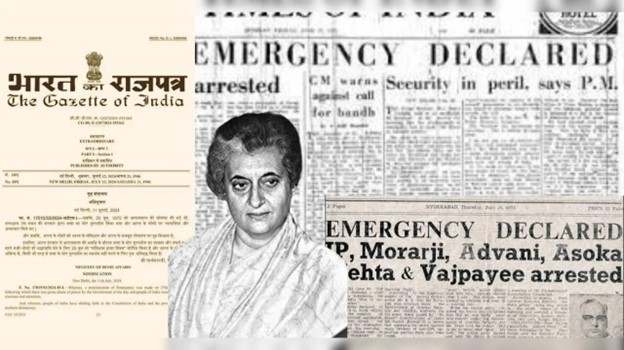
“The President has proclaimed an Emergency. There is no need to panic,”—this is what Indira Gandhi said on All India Radio on June 25, 1975. Her words left the citizens of India in shock and, at the same time, marked one of the most significant moments in the country’s democratic history. Today marks 50 years since one of the darkest chapters in Indian politics.
The then-President, Fakhruddin Ali Ahmed, imposed the Emergency across the country under Article 352, acting on the advice of Prime Minister Indira Gandhi. The period lasted for 21 months, until 21 March 1977.
The Government of India, led by Prime Minister Narendra Modi, decided to observe the day as ‘Samvidhan Hatya Diwas’ (Constitution Murder Day)—the reason being the events that transpired during the Emergency period.
Citizens were stripped of their rights; politicians and protestors were jailed; the press was no longer free, and all power rested with one person—Indira Gandhi. Rules were altered at her discretion. Mass protests erupted across the country, and hundreds of prominent leaders such as Jayaprakash Narayan, Morarji Desai, Atal Bihari Vajpayee, LK Advani, Madhu Dandavate, and George Fernandes, among others were imprisoned.
Major Events During the Emergency
Media Censorship
Everything that appeared in newspapers had to pass through the Prime Minister’s Office. In protest, the media published blank editorials. Any publication critical of the government or the Emergency was banned.
Forced Sterilisation Programme
Indira Gandhi’s younger son, Sanjay Gandhi, launched a hasty family planning campaign. Men were forcibly taken for sterilisation. In 1976 alone, millions of sterilisation procedures were carried out across the country.
Turkman Gate Violence
In Delhi’s Turkman Gate area, residents were forcibly evicted from their homes. Overnight, officials demolished houses as part of a beautification drive, and many men were taken for sterilisation.
“They did not give us any warning… My husband tried to stop them but he was shot in the leg. He collapsed right in front of our house as they brought it down,”
—74-year-old Mehru Nisha, recalling the horrors of that night, as reported by The Week.
People were left without homes, medicine, toilets, and other basic necessities—a memory that haunts many to this day.
Judicial CrisisIn a significant decision, the Supreme Court of India, by a 4–1 majority, ruled that the right to approach any court for enforcement of fundamental rights could be suspended during a national emergency—including the right to habeas corpus.
This was the ADM Jabalpur v. Shivkant Shukla case (1976).
Mini-Constitution: The 42nd Amendment
The Indira Gandhi government introduced the 42nd Constitutional Amendment, making sweeping changes to the law. The changes were so extensive that it was dubbed the ‘Mini-Constitution’.
Changes to the Preamble
Indira Gandhi altered the heart of the Constitution—the Preamble—adding the words “Socialist”, “Secular”, and “Integrity”.
Fundamental Duties
Based on recommendations from the Sardar Swaran Singh Committee, ten Fundamental Duties were added to the Constitution in 1976. During the Emergency, these duties were placed above Fundamental Rights.
Judicial Review Curtailed
Several amendments limited the powers of the judiciary, elevating Parliament’s supremacy—contradicting the founding fathers’ vision of checks and balances between the Parliament and the Judiciary.
Factors Leading to the Emergency
While announcing the Emergency, Indira Gandhi urged citizens not to panic:
“I am sure you are all aware of the deep and widespread conspiracy, which has been brewing ever since I began to introduce certain progressive measures to benefit the common man and woman in India,” — said Indira Gandhi, hinting at possible reasons behind her decision.
From being called a “Goongi Gudiya” (dumb doll) to winning elections by record margins, Indira Gandhi’s political journey was transformative. However, the Emergency remains a dark blot on India’s democratic fabric and her party, the Indian National Congress.
Many events and decisions led to the Emergency. After the death of India’s second Prime Minister, Lal Bahadur Shastri, senior Congress leaders appointed Indira Gandhi as PM with the expectation she would remain consultative and pliable.
Indira Becomes PM
Leaders, particularly from southern India, avoided selecting one of their own, fearing rivalry. They chose Indira Gandhi—believing she would seek guidance. However, she soon began taking major decisions unilaterally. For instance, she nationalised banks without consulting then Finance Minister Morarji Desai, who resigned in protest.
1969 Presidential Election & Indira’s Expulsion
Indira Gandhi backed V.V. Giri over the official Congress nominee Neelam Sanjeeva Reddy. Giri won, demonstrating Indira’s control over the party. This led to a split in the party, and on 12 November 1969, Congress President S. Nijalingappa expelled her.
Formation of Congress (R)
Expelled from the party, Indira Gandhi formed Congress (Requisitionists), later known as Congress (R). Her campaign slogan “Garibi Hatao” (Remove Poverty) defeated the “Indira Hatao” (Remove Indira) slogan of the Congress (Organisation) in the 1971 elections, winning 352 seats while the rival faction was reduced to just 16.
Indira’s tenure also saw India’s victory in the Bangladesh Liberation War, bolstering her popularity.
Five Major Events Leading to the Emergency
- Gujarat Unrest
In 1973, fee hikes led to widespread student protests across Gujarat. Chief Minister Chimanbhai Patel was labelled “Chiman Chor” (Chiman the thief). In February 1974, Indira Gandhi dismissed his government and imposed President’s Rule.
- JP Movement in Bihar
Gandhian leader Jayaprakash Narayan (JP) joined student-led protests against CM Abdul Ghafoor. The movement drew in future leaders like Lalu Prasad Yadav and Nitish Kumar. JP called for Sampoorna Kranti (Total Revolution) and Indira’s removal.
- George Fernandes-led Railway Strike
Trade unionist George Fernandes led a massive railway strike in 1974, disrupting the nation’s transport network. Around the same time, Railway Minister and Bihar MP L.N. Mishra was killed in a bombing, escalating tensions.
- Case Against Indira Gandhi
Raj Narain, a socialist leader, challenged Indira’s 1971 election win in the Allahabad High Court, accusing her of electoral fraud.
On 12 June 1975, Justice Jagmohanlal Sinha found her guilty, nullifying her election.
Coincidentally, Congress also lost the Gujarat assembly elections that day to a five-party opposition coalition.
On 24 June, the Supreme Court granted a conditional stay, allowing Indira to remain PM without voting rights.
- Declaration of Emergency
On 25 June 1975, JP Narayan, Morarji Desai, and others held a rally at Ramlila Maidan, urging police and army to disobey “unconstitutional orders”.
Morarji Desai declared: “The lady won’t survive our movement.”
That night, Indira Gandhi, along with her son Sanjay Gandhi, decided to impose the Emergency. Before sunrise on June 26, the Emergency was in effect and it lasted for the next 21 months.


