Colonel Dev Anand Lohamaror
Democracy is the greatest strength of any nation, but this very democracy comes under scrutiny when the line between peaceful protest and planned violence begins to blur. The events that unfolded during the Parliament March not only raised questions about law and order, but also forced us to reflect on whether genuine feelings of discontent within India are being exploited by elements whose objective is not merely to register protest, but to generate instability by pressuring national institutions.
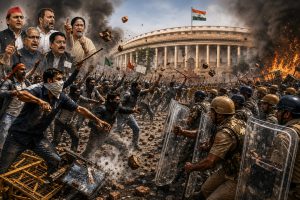
In my view, peaceful demonstration is the right of every citizen in any democratic system. However, when an agitation involves stone-pelting at the police, damage to public property, injuries to security personnel, and an unauthorized crowd advancing toward a constitutional institution like Parliament, it ceases to be a mere movement and becomes a matter of national security and public order. At such a time, the role of the government, police, and intelligence agencies cannot remain limited to crowd control alone; they must also investigate whether a well-planned strategy is at work behind these incidents.
In my opinion, this is not the first instance where serious questions regarding national security and public order have arisen under the guise of a mass movement. Previously, similar conditions emerged during the Shaheen Bagh movement, the violence at the Red Fort on January 26, 2021, the Bhima Koregaon case, and the infiltration of disruptive elements during ethnic unrest in Manipur. Whether it was the attempt at social polarization during anti-CAA protests, digital disinformation through international ‘toolkits’ centered around the Red Fort, or the targeting of Indian embassies abroad—a consistent pattern is visible in all these instances. This reinforces the apprehension that certain anti-social, separatist, or hostile elements are attempting to achieve their objectives by exploiting legitimate mass movements and local discontent to challenge India’s unity and stability.
If a trend of targeting national symbols, constitutional institutions, security forces, and public property is observed across different movements from time to time, these events cannot be dismissed as isolated law-and-order problems. What is required is a comprehensive analysis of all such incidents through the broader lens of national security, alongside an impartial inquiry into whether a systematic attempt is underway to weaken India’s internal stability under the cover of democratic rights. If such elements are identified, the strictest action under the law must be taken against them, because the preservation of democracy is possible only when a clear distinction is maintained between peaceful protest and deliberate anarchy.
The application of so-called “Hybrid Warfare” has been observed in several countries across the world, where genuine public dissatisfaction is combined with organized disinformation, digital campaigns, political polarization, and the infiltration of violent elements to destabilize the state. A vast democracy like India must take this possibility with utmost seriousness. If anti-social or violent elements enter any movement, it is essential to isolate them from peaceful protesters and deal with them strictly according to the law.
This entire sequence of events has also raised several critical questions. If a procession was not permitted to move toward Parliament, how did the situation reach that point? If the crowd size was continuously swelling, could adequate preventive measures have been taken in time? If violence was anticipated, were the precautionary steps sufficient? The answers to these questions must come not from political debate, but from an impartial administrative review.
In the national capital, modern technology should be utilized more effectively during any major demonstration. Drone surveillance, video analytics, digital forensics, CCTV networks, real-time crowd monitoring, and the scientific identification of individuals involved in violent activities are the needs of the future. This will enable a clear distinction between peaceful protesters and violent rioters, ensuring that innocent citizens are spared unnecessary action.
Another critical dimension is that of financial resources. When extensive arrangements for food, transport, stages, publicity material, and other resources are visibly mobilized during a large movement, the question naturally arises as to where the funding originated. If any illegal or foreign financial network is found to be active, a thorough investigation is in the national interest. On the other hand, if everything is legitimate and transparent, that too should be brought clearly into the public domain. Transparency in a democracy is equally essential for all sides.
Social media has fundamentally altered the nature of mass movements. Mobilizing thousands of people within a few hours, disseminating emotional messages, and directing a crowd in a specific direction has become far easier today than ever before. Therefore, the timely identification of and legal action against misleading information, rumors, and content inciting violence on digital platforms have become a vital component of national security.
Political parties must also engage in introspection. The role of the opposition is crucial in any democracy, but attempting to support or justify violence, damage to public property, or attacks on the police during a protest weakens democratic culture. Similarly, it is the responsibility of the government to provide space for legitimate dissent while projecting a clear message of Zero Tolerance toward violence.
Regarding the policing system, several lessons emerge for the future. Crowd management is not merely a matter of lathi-charges or the use of force; it is equally about advance intelligence, preventive action, securing sensitive zones, identifying crowd leadership, monitoring potential troublemakers, and ensuring better coordination with local administration. If effective action is taken on all these fronts in a timely manner, numerous incidents can be nipped in the bud.
Today, Bharat is not facing conventional security challenges alone. Information warfare, psychological operations, digital disinformation, social polarization, and crowd-based instability are becoming equally formidable challenges. Therefore, the concept of national security must be expanded accordingly. We must recognize that democracy is defended not only by soldiers deployed on the borders, but also by strong institutions, an impartial law-and-order mechanism, an aware peasantry and citizenry, and responsible politics.
Parliament is not merely a building; it is the supreme constitutional institution of Indian democracy. Every incident occurring in its proximity sends a national and international signal. Hence, any future demonstration must be conducted in a manner that safeguards democratic rights while preserving the dignity and sanctity of national institutions.
Ultimately, I believe Bharat needs neither to be fearful of legitimate public voices nor to bow before violent elements. What is required is a clear distinction between peaceful citizens and deliberate agitators, an impartial investigation into every violent incident, transparent scrutiny of financial and digital networks, and strict legal action against offenders regardless of their ideology, organization, or influential affiliation. This is the true path to safeguarding democracy, the foremost condition for national security, and the strongest foundation for moving toward a Developed India (Viksit Bharat).