By Chander Mohan Sharma
Agriculture remains the backbone of India’s economy—providing livelihood to nearly half of the population and contributing about 18 percent to the national GDP. Yet, in an age of global competition, erratic climates, and technological disruption, it is not land alone that sustains this sector—it is knowledge. The strength of Indian agriculture increasingly depends on education, research, and skill-building. Together, they form the foundation for realizing the national vision of “Viksit Krishi aur Samruddh Kisan”—Developed Agriculture and Prosperous Farmers—anchored in the guiding idea of “One Nation – One Agriculture – One Team.”
ICAR: The Nerve Centre of Agricultural Knowledge
At the heart of India’s agricultural education and research network stands the Indian Council of Agricultural Research (ICAR), established in 1929. As the apex body under the Ministry of Agriculture and Farmers Welfare, ICAR coordinates the world’s largest network of agricultural research and higher education.
With 113 national research institutes and 74 agricultural universities, ICAR’s reach is unmatched globally. It spearheaded the Green Revolution, and today it continues to drive innovation in high-yield, climate-resilient crops and advanced farming systems.
Through its 731 Krishi Vigyan Kendras (KVKs), ICAR ensures that scientific knowledge reaches the grassroots. These centers have become the interface between laboratories and farms, transforming farmers into practitioners of science-based agriculture. Between 2021 and 2025, KVKs trained over 76 lakh farmers, with the numbers increasing annually.
(Farmers Trained by KVKs (2021–2025)” – showing steady rise from 2021–22 to 2024–25)
ICAR has also modernized academic governance through the ICAR Model Act (Revised 2023) and the National Agricultural Education Accreditation Board, ensuring quality and uniformity across institutions.
Expanding Horizons: Universities Leading the Growth
India’s agricultural education network is a blend of state, central, and deemed universities. Today, the country boasts 63 State Agricultural Universities (SAUs), 3 Central Agricultural Universities (CAUs), 4 Deemed-to-be Universities, and 4 Central Universities with agriculture faculties. Together, they offer multi-disciplinary programs in agriculture, horticulture, fisheries, dairy science, food technology, and agribusiness.
Dr. Rajendra Prasad Central Agricultural University (RPCAU), Pusa
Once a state university, RPCAU was converted into a Central Agricultural University in 2016 to serve the eastern region. With eight constituent colleges and 18 Krishi Vigyan Kendras, RPCAU integrates research, teaching, and outreach. Its innovative certificate and diploma programs—aligned with the National Education Policy (NEP)—aim to produce industry-ready graduates.
Central Agricultural University, Imphal
Established in 1993, CAU-Imphal caters to the seven northeastern hill states, running 13 constituent colleges across the region. Offering 10 undergraduate, 48 master’s, and 34 Ph.D. programs, the university plays a pivotal role in developing sustainable hill agriculture through local research and community-based projects.
Rani Lakshmi Bai Central Agricultural University, Jhansi
Founded in 2014, RLBCAU is emerging as a hub for agri-innovation in central India. It operates colleges in both Uttar Pradesh and Madhya Pradesh, focusing on agronomy, veterinary sciences, horticulture, and agricultural engineering.
The growth of private agricultural colleges has also been noteworthy—rising from 5 ICAR-accredited institutions in 2020–21 to 22 by 2024–25—indicating growing interest from non-government sectors in agricultural education.
The Tech Turn: AI and IoT in Modern Farming
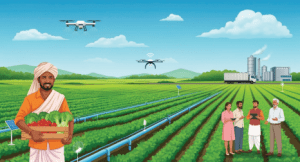
A striking transformation in Indian agriculture is the integration of digital technologies—from the Internet of Things (IoT) to Artificial Intelligence (AI). Precision agriculture, drones for imaging and spraying, automated irrigation systems, and AI-based pest and yield prediction tools are redefining how farmers operate.
Under the National Mission on Interdisciplinary Cyber-Physical Systems (NM-ICPS), 25 Technology Innovation Hubs (TIHs) have been set up—three dedicated specifically to agricultural applications. Among them, IIT Ropar’s Agri/Water TIH has made notable progress in deploying IoT sensors for saffron production and water monitoring. Similarly, IIT Kharagpur’s AI4ICPS initiative works on machine-learning-based solutions for crop forecasting.
The government’s Centres of Excellence on IoT in Bengaluru, Gurugram, Gandhinagar, and Visakhapatnam have strengthened the digital backbone for agri-tech start-ups. Visakhapatnam’s CoE, for instance, serves as a collaborative platform linking industry, academia, and entrepreneurs to build scalable digital solutions for farmers.
Empowering Farmers through Skilling
India’s agricultural transformation goes beyond technology—it is about people. Recognizing that modern farming requires technical knowledge, the government has prioritized farmer skilling and training through various flagship programs.
- Krishi Vigyan Kendras (KVKs):The frontline for farmer education, covering improved agronomy, livestock management, soil health, and post-harvest practices.
- Agricultural Technology Management Agency (ATMA):Between 2021 and 2025, ATMA trained 27 crore farmers across India, emphasizing local innovations and participatory learning.
- Skill Training of Rural Youth (STRY):Focused on short vocational courses in horticulture, dairy, fisheries, and allied trades, STRY trained over 51,000 rural youth since 2021, promoting self-employment and agri-entrepreneurship.
- Sub-Mission on Agricultural Mechanization (SMAM):Introduced mechanization awareness and trained 57,000 farmers in the operation of modern farm machinery.
- Soil Health Card Scheme:By mid-2025, more than 25 crore soil health cards had been distributed nationwide, backed by 93,000 training sessions and 6.8 lakh field demonstrations to encourage balanced fertilization.
The rise of Farmer Producer Organizations (FPOs) has added a new dimension to rural skilling. Over 10,000 FPOs now function as cooperative business models, training farmers in value addition, agri-marketing, and digital commerce.
Start-Ups and Innovation: A New Green Revolution
Agriculture is no longer just about ploughs and seeds—it is also about innovation and entrepreneurship. Under the Rashtriya Krishi Vikas Yojana (RKVY)’s “Innovation and Agri-Entrepreneurship Development” program, start-ups are now active in AI-based crop diagnostics, blockchain-based supply chains, and smart irrigation systems. This new breed of agri-tech entrepreneurs is opening fresh avenues for rural employment and sustainable business.
Conclusion: Toward a Knowledge-Driven Rural India
India’s agricultural education and training framework now stands at a defining moment. Guided by the principle of “One Nation – One Agriculture – One Team”, it integrates classroom learning, scientific research, and grassroots extension into a cohesive system.
From the Green Revolution to the Digital Revolution, Indian agriculture has evolved through science and policy synergy. The next leap lies in ensuring that every farmer—whether in Bihar’s plains, the hills of Manipur, or the drylands of Bundelkhand—has access to this knowledge ecosystem.
By investing in education, technology, and farmer empowerment, India is sowing the seeds of a future where agriculture is not just a livelihood but a high-skill, high-tech enterprise—one that feeds, sustains, and uplifts the nation.
(Compiled from the Explainer “Agricultural Education & Training in India” PIB, Jammu)