
Col (Dr) Dev Anand Lohamaror
In a democracy, governments are accountable to the people. Equally true, however, is that democratic governance must be guided by the Constitution, the rule of law, and institutional processes—not by the pressure of the streets. If political decisions begin to be shaped by disruptive protests, damage to public property, attacks on law enforcement personnel, and the paralysis of public life in the national capital, the issue extends far beyond the fate of a government. It becomes a question of the credibility and resilience of the democratic system itself.
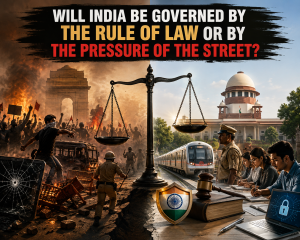
The recent developments, in which the government accepted the resignation of the Education Minister while conceding key demands raised by the protesters, may well have been a political decision. Yet they inevitably raise a larger concern: does this create the impression that if sufficient pressure is applied, if enough disruption is caused, and if the capital is brought to a standstill, the government will eventually yield? If such a perception takes root, every organised pressure group may be tempted to adopt the same strategy in the future.
The central issue is one of accountability. If irregularities occurred in a national examination, they must be investigated thoroughly, and every individual responsible should face stringent legal consequences. At the same time, equal scrutiny must be applied to the performance of the security apparatus, intelligence agencies, and administrative machinery if they failed to anticipate or manage the resulting law-and-order situation. A ministerial resignation alone cannot be regarded as a complete answer. Citizens are entitled to know why such a situation arose in the first place and what concrete safeguards have been established to prevent its recurrence.
The right to peaceful protest is an essential pillar of any democracy. Violence is not. When roads are blocked, access to hospitals is disrupted, metro services are suspended, police personnel are injured, and public infrastructure is damaged, the issue is no longer confined to political dissent. It becomes an infringement upon the rights of millions of ordinary citizens. The foremost responsibility of a democratic state is to protect law-abiding citizens—not to allow violent elements to hold public life hostage.
Wherever public property has been damaged, those responsible should be identified through due legal process and held financially accountable. The principle that perpetrators should compensate for damage to public assets has repeatedly found support in judicial reasoning. Recovering the cost of destruction from proven offenders is not an act of retaliation; it is an affirmation of accountability and the rule of law.
Another important question concerns the composition of large public movements. How many participants are genuinely affected stakeholders, and to what extent do unrelated political, ideological, or organised interest groups become involved? Any movement should ultimately be assessed not merely by its slogans but by its leadership, funding patterns, organisational structure, and declared objectives. If unrelated agendas become attached to a protest, it is the responsibility of investigative agencies to examine these linkages objectively and strictly within the framework of the law.
The greatest concern today is the sense of security among ordinary citizens. They want to know whether tomorrow another issue will once again paralyse the national capital. Will public transport be disrupted again? Will police officers again come under attack? Will national institutions once more become the targets of violent demonstrations? In a democracy, the government’s responsibility extends beyond resolving an immediate crisis; it must also reassure citizens that such crises will not become recurring features of public life.
Political parties, too, must engage in serious introspection. The opposition has every democratic right to question the government, but it has no moral or constitutional justification for condoning violence. Likewise, the ruling establishment must ensure that the law is enforced fairly, impartially, and consistently. If legal action appears selective or politically motivated, public confidence in the justice system will inevitably weaken.
The examination system itself requires comprehensive reform. Stronger digital security, multi-layered encryption of examination papers, greater institutional accountability, decisive action against organised examination fraud, and the treatment of paper leaks as serious organised crimes are essential reforms. Those who manipulate examination systems do not merely compromise one examination—they rob millions of deserving young people of fair opportunities and undermine public confidence in meritocracy.
Ultimately, the future of India’s democracy will be determined by one fundamental question: Will Bharat be governed by the rule of law or by the pressure of organised street mobilisation? Governments change, political movements come and go, but if the supremacy of law is weakened, the consequences will extend far beyond any single administration or political party. The damage will be borne by the nation as a whole.
What Bharat needs today is not merely the resignation of a minister. It needs a clear national assurance that no future agitation—regardless of its cause—will be allowed to disrupt the lives of ordinary citizens; that those responsible for damaging public property will face impartial legal consequences; that attacks on police and security personnel will not go unpunished; and that democratic governance in Bharat will continue to be guided by constitutional institutions and the rule of law, rather than by the coercive pressure of the streets. That is the true test of democracy—and ultimately, its greatest strength