High Energy costs and food shortage also contributing to outrage against Army
By Tirthankar Mitra
A month ahead of scheduled local elections, peoples’ protests have erupted in the streets of
Pakistan occupied Kashmir (PoK).At least, 15 persons have been killed after security forces fired on protestors at Rawalkot.
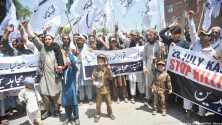
The firing triggered fresh protests in several towns, including Khai Gala in PoK’s Poonch district. Shops downed shutters in local markets and women, elderly persons and children joined demonstrations demanding justice for those killed.
A recent Pakistan Supreme Court verdict on reservation of seats in the PoK Assembly has sent sparks flying raising tempers and tension amidst the coolness of the valley. It turned out to be the latest flashpoint.
In all, 12 seats were reserved for Jammu and Kashmir migrants settled in different parts in the Pakistan. Resenting it, the local people demanded its abolition while the authorities stated that this was a long process requiring constitutional amendment.
Things came to boil post a Pak Supreme Court judgement. It was stated that an amendment in region’s constitution “was not a concession to be wrested” from the government. The PoK constitution lays down that the 12 seats are “divided among the refugees settled in Pakistan”; some of the seats going to Punjab, some to Sindh and other provinces. The election of these members happens outside PoK geographically and operationally. The local Election Commission does not control the polling.
,
Reading between the lines, the local people have their own version. These seats, according to them, are used by the federal government to get their people into the PoK Assembly. Other than these 12 seats, five seats are reserved for women, one for religious scholars or ulemas, one for technocrats and one for Kashmiris living overseas. Thus PoK people elect only 33 representatives in a House of 53 members. It boils down to people not connected with Kashmir getting elected in some of these seats. These representatives are unlikely to be alive to the problems of PoK.
The economic angle cannot be ruled out. Out of 53 seats, 20 are controlled by the Centre under various reservations. The Pak army controls these seats. But the funds for these representatives flow out of PoK exchequer. This is resented by the local people.
The protests are organised by Joint Awami Action Committee (JAAC). It is founded by civil society activists, professionals and traders. The JAAC has been banned by the government. Stringent charges, which include terror and sedition have been slapped on its leaders. PoK populace going on an agitation mode is not a novelty. JAAC spearheaded the 2023 agitation.
Economic grievances have been sharpened by the sizzling issue of political representation. Many people being displaced by the coming up of the Mangla dam remains a sore point with the PoK residents. UK is home to sizeable section of PoK diaspora. It has. been calling attention to the atrocities and the last thing Pak government wants is an repressive image abroad.
Since 2023, PoK have witnessed widespread protests. But the severity of the past agitation has dimmed in the backdrop of the ongoing one.
Enhanced electricity bills and shortages of subsidized wheat were the sources of the 2023 protests. The protestors had reasoned that they should be exempted from the high electricity as considerable quantum of hydro-electricity is generated from Mangla project of this region.
The region is underdeveloped. There is heavy army presence which is sometimes roped in to stifle protests. In sum, the PoK is on a boil. It is weighed down by the twin weights of past agitation on bread and butter issues and constitutional grievances of the present. (IPA Service)