By Omkar Dattatray
The recent protest organised by the National Conference (NC) in the national capital has once again brought the political aspirations and concerns of Jammu and Kashmir into the national spotlight. The demonstration was not merely a political gathering but a symbolic assertion of the party’s long-standing demands regarding the restoration of statehood, protection of democratic rights, and safeguarding of the unique political identity of the people of the Union Territory.
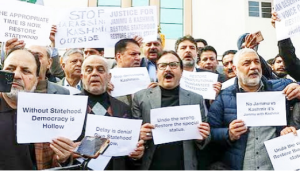
The protest reflected the growing impatience among regional political forces over what they perceive as delays in fulfilling commitments made by the Central Government. It also highlighted the continuing relevance of Jammu and Kashmir in India’s political discourse.
The National Conference, one of the oldest and most influential political parties in Jammu and Kashmir, has consistently advocated the restoration of statehood since the reorganisation of the erstwhile state in August 2019. The abrogation of Article 370 and the bifurcation of the state into two Union Territories fundamentally altered the political landscape of the region. While the Central Government defended the move as necessary for national integration, development, and security, regional parties viewed it as a dilution of the constitutional and political rights enjoyed by the people for decades.
The protest in New Delhi, therefore, represented not only a political campaign but also an attempt to remind the nation of promises and expectations that, in the eyes of many, remain unfulfilled.
Political demonstrations in the national capital have always carried symbolic significance. By choosing New Delhi as the venue, the National Conference sought to convey its message directly to the country’s political leadership, policymakers, media establishments, and civil society. Such protests are designed to attract national attention and generate wider debate on issues that might otherwise remain confined to regional politics.
The gathering witnessed participation from party leaders, workers, supporters, and sympathisers who reiterated their demand for the restoration of full democratic governance in Jammu and Kashmir. At the heart of the protest was the demand for the restoration of statehood. Although the Central Government has repeatedly stated that statehood would be restored at an appropriate time, the absence of a clear timeline has generated uncertainty and frustration among political stakeholders.
For many residents of Jammu and Kashmir, statehood is not merely an administrative arrangement but a symbol of political dignity, democratic representation, and regional empowerment. The National Conference argues that elected governments functioning within a state framework possess greater authority and accountability than those operating under the constraints of a Union Territory administration.
The protest also reflected concerns regarding democratic participation and political empowerment. Although elections have been conducted and democratic institutions continue to function, many regional leaders believe that the political aspirations of the people can only be fully realised through the restoration of statehood and greater devolution of powers. They contend that effective governance requires local leadership to have adequate authority over developmental priorities, resource allocation, and public welfare initiatives.
Another significant aspect of the demonstration was its effort to mobilise public opinion beyond Jammu and Kashmir. National Conference leaders sought to frame their demands within the broader context of federalism and democratic values. They argued that India’s strength lies in accommodating regional aspirations while maintaining national unity. By presenting their demands as consistent with constitutional principles and democratic traditions, the party attempted to build wider support among political observers, intellectuals, and civil society groups across the country.
The protest also carried electoral and political implications. In a competitive political environment, regional parties must continuously engage with their support base and demonstrate commitment to core issues. Public demonstrations provide opportunities to reinforce political narratives, energise party workers, and showcase leadership. For the National Conference, the protest served as a reminder to its supporters that the party remains committed to pursuing its stated objectives through democratic and constitutional means. It also helped distinguish the party’s political agenda from those of its rivals.
Critics, however, have questioned the effectiveness of such protests. Some argue that demonstrations alone may not yield tangible outcomes unless accompanied by sustained dialogue and constructive engagement with the Central Government. Others believe that political parties should focus more on pressing developmental challenges such as unemployment, infrastructure, education, healthcare, and investment. These critics contend that while constitutional and political issues are important, governance and economic progress deserve equal attention.
Supporters of the protest, on the other hand, maintain that political rights and development are interconnected and that meaningful progress requires both democratic empowerment and economic advancement.
The demonstration also highlighted the enduring emotional dimension of politics in Jammu and Kashmir. Questions of identity, representation, and constitutional status continue to evoke strong sentiments among different sections of society. Political leaders often draw upon these sentiments to articulate public concerns and mobilise support. The National Conference’s protest underscored the reality that the events of 2019 continue to shape political debates and public discourse in the region.
From a broader national perspective, the protest reflects the vitality of democratic politics in India. In a democracy, public demonstrations, political campaigns, and peaceful expressions of dissent are legitimate instruments through which citizens and political organisations communicate their views. Such activities contribute to public debate and encourage policymakers to remain attentive to diverse perspectives.
Whether one agrees or disagrees with the demands being raised, the ability of political parties to organise protests and advocate their positions remains an essential feature of democratic governance.
The National Conference’s protest in the capital, therefore, carries significance beyond immediate political calculations. It represents an ongoing dialogue about the future of Jammu and Kashmir, the nature of federalism, and the balance between national objectives and regional aspirations. The protest serves as a reminder that political questions often persist long after major policy decisions have been implemented. Addressing these questions requires patience, dialogue, and a willingness to engage with differing viewpoints.
As the political landscape continues to evolve, the demands articulated during the protest are likely to remain part of national discussions. Whether through negotiations, parliamentary debates, judicial processes, or future political developments, the issues raised by the National Conference will continue to influence the discourse surrounding Jammu and Kashmir.
However, the crucial question remains: Will the NC’s protest in the national capital make a meaningful difference and pave the way for the restoration of statehood to Jammu and Kashmir?
Many in the Union Territory hope that New Delhi will recognise the growing demand and acknowledge that the time may be ripe for restoring statehood. The BJP-led Central Government has repeatedly stated that statehood will be restored at an “appropriate time.” Whether that moment has arrived remains a matter of political judgment and national debate.
Will the capital protest help convince the Central Government that the appropriate time has indeed come? Only the unfolding political developments in the months ahead will provide the answer.
The author is a columnist, social activist, Kashmiri Pandit activist, and freelance writer.