126 Years of a Legend: Saluting the Saviour of Kashmir
By Ravi Rohmetra
This is the saga of a man who thwarted Pakistan’s plan to annex Jammu and Kashmir in 1947. With a force of just 100 soldiers under his command, he put up a heroic resistance against thousands of invading raiders. That man was Brigadier Rajinder Singh, the first war hero of Independent India.
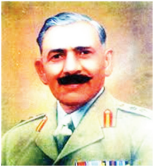
Brigadier Rajinder Singh was born on June 14, 1899, in the small village of Bagoona (later renamed Rajinderpura in his honour), about 35 kilometres east of Jammu. He belonged to the Dalpatia clan of the Jamwal Rajputs. Bravery and sacrifice ran deep in his family. His illustrious ancestor, General Baj Singh, had sacrificed his life in the defence of Chitral nearly a century earlier. His grandfather was a war veteran who carried seven battle scars on his body.
His father, Subedar Lakha Singh, a junior officer in the State Forces, passed away when Rajinder Singh was only six months old. He was thereafter brought up by his affectionate uncle, Lt. Col. Govind Singh. Rajinder Singh received his education in Jammu and graduated from the Prince of Wales College, now Government Gandhi Memorial Science College, in 1921. During his student days, he was remembered as an unassuming, disciplined, and diligent young man who excelled in his studies.
Immediately after graduation, in June 1921, he joined the Jammu and Kashmir State Forces as a commissioned officer. Being highly educated, hardworking, and dedicated to his profession, his rise through the ranks was rapid. He was promoted to Captain in April 1925, Major in July 1927, Colonel in 1935, and Brigadier in May 1942. He was later approved for promotion to the rank of Major General. On September 24, 1947, he assumed charge as Chief of Staff of the Jammu and Kashmir State Forces, succeeding Major General H. L. Scott, a British officer.
As the professional head of the State Forces, Brigadier Rajinder Singh responded to the call of duty and laid down his life while fighting with a company-sized force virtually to the last man—an extraordinary feat in military history. Between October 23 and 27, 1947, he delayed an invading force of nearly 6,000 Pakistani-backed raiders with only about 100 gallant soldiers on the Uri front. His heroic stand enabled Maharaja Hari Singh to complete the accession of Jammu and Kashmir to India and facilitated the arrival of Indian military reinforcements. It also gave Sheikh Mohammad Abdullah valuable time to mobilise the people in defence of the State.
For his exceptional courage, leadership, and supreme sacrifice, Brigadier Rajinder Singh was posthumously awarded the Maha Vir Chakra, becoming the first recipient of a gallantry award in Independent India. The grateful nation will forever remember his contribution. On his birth anniversary, we pay homage to him and his brave comrades who sacrificed their lives in defence of the State.
Independence often demands immense sacrifice. While India attained freedom under the leadership of Mahatma Gandhi, the nation paid a heavy price through the Partition. The consequences of that division continue to affect the subcontinent. Jammu and Kashmir suffered particularly grievously.
The State had not acceded to either India or Pakistan on August 15, 1947. Soon thereafter, Pakistan began hostile actions against the State, culminating in a large-scale invasion through the Muzaffarabad–Uri sector on the night of October 21–22, 1947. The situation worsened when two Muslim companies of 4 J&K Infantry stationed at Muzaffarabad collapsed without offering significant resistance. This proved a severe setback to the State’s defence and had far-reaching consequences for the battle that followed.
When Maharaja Hari Singh was informed of the fall of Muzaffarabad, he initially decided to proceed to the front himself. However, Brigadier Rajinder Singh volunteered to lead the defence, recognising that the Maharaja needed to remain engaged in accession negotiations and efforts to secure military assistance from India.
On October 22, 1947, Brigadier Rajinder Singh assembled whatever troops were available in Srinagar Cantonment and moved towards Uri with a force of barely 100 men. He reached Uri around midnight amidst heavy rain. The first major engagement took place at Garhi on October 23, where his men inflicted heavy casualties on the enemy, although they lost an entire platoon in the fierce battle.
This determined resistance forced the invaders to proceed cautiously, enabling Brigadier Rajinder Singh to organise stronger defences at Uri and receive limited reinforcements. Recognising the gravity of the situation, Maharaja Hari Singh issued the historic order to “hold the enemy at Uri at all costs and to the last man.”
Understanding the strategic importance of the Uri Bridge, Brigadier Rajinder Singh ordered its demolition on October 24, 1947. This masterstroke significantly delayed the enemy’s advance and played a decisive role in saving the Kashmir Valley. Since the invaders depended heavily on vehicular movement, the destruction of the bridge severely disrupted their plans.
The enemy, however, continued advancing on foot. Brigadier Rajinder Singh then commenced a fighting withdrawal towards Baramulla. After delaying the invaders at Mahura on October 25, he established another defensive position at Rampur-Buniyar, where his men continued to inflict casualties until the early hours of October 26. Facing overwhelming odds and mounting losses, the force was eventually compelled to withdraw.
During this withdrawal, Brigadier Rajinder Singh was seriously wounded in his right arm and legs. Despite his injuries and continuous bleeding, he refused to abandon the fight and continued inspiring his soldiers to resist the enemy. His courage and leadership under fire remain a shining example of military valour.
Today, the memory of Brigadier Rajinder Singh is preserved across Jammu. Brigadier Rajinder Singh Chowk, located behind the Civil Secretariat, houses a beautiful park and his statue. The Brigadier Rajinder Singh Auditorium at the University of Jammu also commemorates his legacy. A market in Jammu named after him serves as yet another reminder of the immense debt the people of Jammu and Kashmir owe to the man rightly remembered as the “Saviour of Kashmir.”
(Ravi Rohmetra is a Social Worker & Freelance Writer)