Energy situation may go out of control if the Iran war continues for long
By T N Ashok
The flames have been burning for weeks now, but for India, the real crisis is not military — it is mathematical.
Every day that the Strait of Hormuz remains contested, every tanker that turns back or delays, every cargo rerouted around the Cape of Good Hope adds hours to supply chains that India’s 1.4 billion people depend upon with an intimacy that is hard to overstate. Fuel powers the trucks that move grain. It lights the cold storage that keeps vegetables from rotting. It runs the pumps that push water uphill. When oil becomes uncertain, everything becomes uncertain.
Prime Minister Narendra Modi addressed Parliament on March 23 with characteristic authority, urging the nation not to panic. India, he said, had 50 million metric tonnes of oil supplies to buffer against disruption. The markets steadied. The headlines softened. But behind that reassuring number lies a more complicated truth — one that senior energy officials, petroleum ministry insiders, and independent analysts are privately far less sanguine about.
India’s dedicated strategic petroleum reserve system — operated by Indian Strategic Petroleum Reserves Limited, or ISPRL — is a relatively young institution. The first underground rock cavern at Visakhapatnam came online only in 2016, followed by facilities at Mangaluru and Padur in Karnataka. Together, the three sites hold approximately 5.3 million metric tonnes of crude oil. A fourth site, at Chandikhol in Odisha, is under development with a target to push total strategic capacity to over 6.5 million metric tonnes.
On their own, the strategic reserves cover roughly nine to ten days of national consumption. That is not a comforting number. Factor in the commercial inventories held by state refiners — Indian Oil, Bharat Petroleum, Hindustan Petroleum — and the combined buffer extends to perhaps 60 to 70 days. That sounds more reassuring until you consider what the International Energy Agency recommends: 90 days, minimum, for any economy exposed to global supply disruptions. India has never crossed that threshold.
The 90-day benchmark is not arbitrary. It was established after the 1973 Arab oil embargo left industrialised nations scrambling. The United States, Japan, Germany — all built strategic stockpiles precisely because they learned the hard lesson of dependency. India, despite building ISPRL with considerable fanfare, has lagged behind that standard. The current crisis is the first real test of whether a 60-to-70-day buffer is enough — or whether it is simply a slower route to the same crisis.
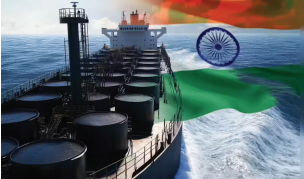
The geography is punishing. Nearly 60 to 65 percent of India’s crude imports transit the Persian Gulf, with the Strait of Hormuz as the single irreplaceable passage. Roughly 21 million barrels of oil move through that 33-kilometre-wide choke point every day globally — about a fifth of worldwide consumption. For India, there is no viable alternative at scale. The Cape of Good Hope route adds two to three weeks of sailing time and drives up insurance premiums that ultimately translate into fuel price inflation at home.
Iran has historically threatened to close the Strait in moments of maximum pressure, and with conflict now active in the region, those threats carry new weight. More than 200 ships were reported stranded or delayed in Gulf waters earlier this month, according to shipping industry trackers — a number that signals not a hypothetical disruption, but a live one.
Modi confirmed he has spoken directly with multiple West Asian leaders, including Iranian counterparts, in what diplomats describe as a sustained back-channel effort to secure exemptions for commercial energy shipping. India’s argument to Tehran is both economic and humanitarian: blocking energy flows to major Asian economies like India punishes nations that have maintained studied neutrality in the conflict. New Delhi’s leverage is real — India is one of Iran’s largest crude customers historically, and that relationship carries weight even in wartime.
If crude is the macro crisis, LPG is where the pressure reaches ordinary households. Within days of the conflict intensifying, reports of panic buying and distribution disruptions triggered queues at dealerships and a spike in cylinder black-market prices. The government moved quickly, prioritising domestic household supply, deploying monitoring teams across distribution networks, and threatening stringent action against hoarders.
The political sensitivity of cooking gas in India cannot be overstated. The Ujjwala Yojana programme has brought LPG connections to over 100 million rural households since 2016 — transforming it from an urban middle-class convenience into a near-universal expectation. Any sustained shortage would not merely be an economic shock; it would be a political earthquake felt most acutely by the voters Modi’s government can least afford to alienate.
India imports a significant share of its LPG from Gulf producers. Alternative sourcing from the United States and elsewhere exists but cannot be scaled rapidly enough to cover a major Gulf disruption without price consequences.
To its credit, India did not arrive at this crisis unprepared. Over the past decade, the government pursued a systematic energy diversification strategy that is now proving its worth. India’s crude import basket expanded from roughly 27 supplier nations to over 40. Post-Ukraine war realignment opened a significant new channel: deeply discounted Russian crude, which India began importing in volumes that would have been politically unthinkable five years ago and now accounts for a meaningful share of total imports. Purchases from the United States, Africa, and Latin America have also grown.
Ethanol blending — now approaching 20 percent in the petrol supply mix — has quietly reduced crude demand by millions of barrels annually. The domestic push, inspired by Brazil’s pioneering programme from the early 1990s, has made India meaningfully less oil-dependent than its growth trajectory would otherwise suggest. Coal production crossed 1 billion tonnes last year. Renewable capacity has scaled from 3 gigawatts of solar to over 140 gigawatts — reducing the pressure on oil for power generation, though transport remains stubbornly fossil-fuel dependent.
Here is the honest assessment that officials will not say publicly: India’s current buffer is sufficient for a short, sharp disruption — four to six weeks of serious supply constraint. If the conflict resolved or stabilises within that window, the strategic reserves serve their purpose and are gradually replenished. If it does not — if Hormuz remains partially closed or under threat through the second quarter of 2026 — India enters increasingly difficult arithmetic.
Drawdowns from strategic reserves are one-way in the short term. Once released, crude must be processed and consumed. Replenishment requires the very shipping lanes that are disrupted. The underground caverns at Visakhapatnam and Padur are not infinitely refillable on a crisis timeline.
The government’s medium-term strategy — accelerate rail electrification, expand metro networks, push electric buses, deepen renewable penetration — is sound policy. It is also measured in years, not weeks.
Modi’s message to Parliament was calibrated to prevent the one thing that could accelerate the crisis faster than any military escalation: panic-driven hoarding and demand spikes. He is right to send that signal. Calm is itself a strategic resource.
But calm should not be confused with comfort. India is burning through an insurance policy it spent twenty years constructing, at a rate determined by events in a conflict it cannot control, over a chokepoint it cannot bypass. The clock is running. The question is not whether India has reserves — it does. The question is whether the war ends before the reserves do.
That answer lies not in New Delhi, but in the corridors of Tehran, Riyadh, Washington, and whatever backroom negotiations are quietly reshaping the map of West Asia. India is watching, talking, and waiting — and hoping, with considerable urgency, that it does not have to find out just how thin its margin truly is. (IPA Service)