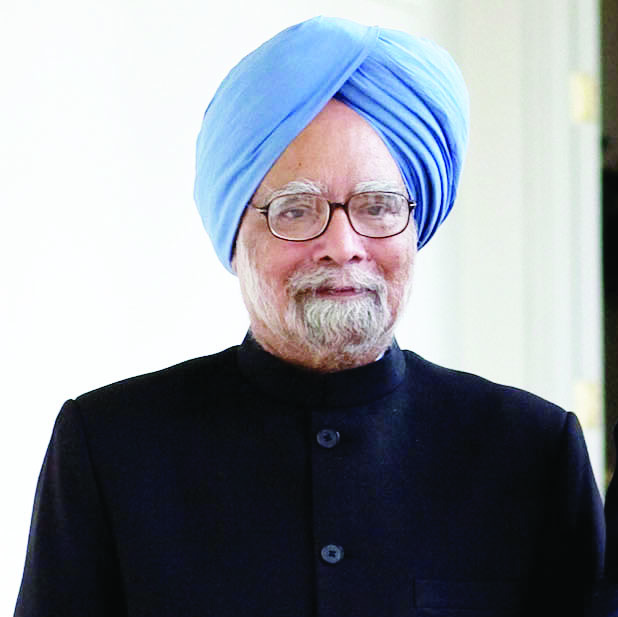
Singh breathed his last at All India Institute of Medical Sciences in New Delhi
Former Prime Minister Manmohan Singh, remembered for ushering in 1991 economic reforms that put India on the path to economic progress, is no more. He was 92.
The veteran leader was brought to the emergency department of the hospital in the evening after his health deteriorated.
“With profound grief, we inform the demise of the former Prime Minister of India, Dr Manmohan Singh, aged 92,” the hospital said in a bulletin.
“He was being treated for age-related medical conditions and had a sudden loss of consciousness at home on 26 December 2024. Resuscitative measures were started immediately at home. He was brought to the Medical Emergency at AIIMS, New Delhi at 8:06 PM. Despite all efforts, he could not be revived and was declared dead at 9:51 PM,” it said.
Singh breathed his last at the All India Institute of Medical Sciences in New Delhi, where he was admitted today in a critical condition. Doctors were unable to resuscitate him.
Paying tributes to his predecessor Manmohan Singh, Prime Minister Narendra Modi on Thursday said India mourns the loss of one of its most distinguished leaders whose wisdom and humility were always visible.
Singh, the architect of India’s economic reforms, died here on Thursday night. He was 92.
Rising from humble origins, he rose to become a respected economist, Modi said, noting that Singh served in various government positions as well, including as finance minister, leaving a strong imprint on our economic policy over the years.
In a post on X, Modi said, “His interventions in Parliament were also insightful. As our Prime Minister, he made extensive efforts to improve people’s lives.”
Born on September 26, 1932, in Gah village in the Punjab province of undivided India, Singh did his matric from Panjab University in 1948 and had an illustrious academic career before he became India’s prime minister in May of 2004.
Singh went to the University of Cambridge, UK, to secure a First Class Honours degree in Economics in 1957. He got a D.Phil in Economics from Nuffield College at Oxford University in 1962. His book “India’s Export Trends and Prospects for Self-Sustained Growth” was an early critique of India’s inward-oriented trade policy—something he would go on to challenge himself in the 1990s as the union finance minister.
The suave academic, bureaucrat, politician and prime minister, Singh had his academic credentials burnished by the years he spent on the faculty of Panjab University, Chandigarh, and Delhi School of Economics.
He had a brief stint at the UNCTAD Secretariat during these years. This presaged a subsequent appointment as Secretary-General of the South Commission in Geneva between 1987 and 1990.
It was only in 1971 that Singh joined the Government of India as Economic Adviser in the Commerce Ministry. He was hand-picked by then-PM Indira Gandhi.
He then became Chief Economic Adviser in the Ministry of Finance in 1972 and went on to handle several major governmental positions, including secretary in the Ministry of Finance; deputy chairman of the Planning Commission; governor of the Reserve Bank of India; adviser to the Prime Minister; and chairman of the University Grants Commission.
The turning point in Singh’s life came when he was chosen by then-prime minister P.V. Narasimha Rao as his finance minister.
He spent five years between 1991 and 1996 in the role and ushered a comprehensive policy of economic reforms—the most abiding legacy of his term as a politician.
In his 33-year political career, Singh had been a Member of India’s Upper House of Parliament (the Rajya Sabha) since 1991, where he was Leader of the Opposition between 1998 and 2004. He was first a member of the Rajya Sabha from Assam until 2019 and later from Rajasthan until April 2024 when he finally retired from Parliament after 33 years making way for his mentor Sonia Gandhi, who became an Upper House member.
In May 2004, Sonia chose Singh as PM of the coalition and he stayed in the position for a decade until 2014, presiding over a period of 8.5% average economic growth and a period marked by serial allegations of corruption against his government.
The anti-corruption movement led by Anna Hazare proved the nemesis of Singh’s government and is widely believed to have brought it down by converting the popular anti-graft sentiment of the time into an anti-incumbency vote against the Congress.
In the 2014 Lok Sabha polls, the Congress suffered its worst electoral defeat managing to win just 44 seats in a 543-member House, while the BJP led by Narendra Modi came to power with a thumping majority giving India its first stable single-party majority government after years.
Singh’s own term as PM was, however, marked by several highs—he won the no-confidence vote brought against the government after the Left front withdrew support over the Indo-US nuke deal; Singh announced a farm loan waiver and rolled out the landmark NREGA law to provide guaranteed incomes to poor workers; and passed the path-breaking Right to Education and Right to Information Acts.
First sworn in as Prime Minister on May 22, 2004, Singh was re-elected on May 22, 2009, until the BJP decimated the Congress in 2014 on the back of the anti-corruption movement and 2G and coal block allocation scam narratives.
Common allegation stands against him was that as finance minister mortgaged India’s Gold to IMF. Blindly accepted all their conditions for Loans allowed deluge of foreign companies in India who took away vital resources from India
As Prime Minister headed the most corrupt and communal regime post 1947. Just few days before the country went for the election, he chaired the Cabinet that gifted large swathes of Delhi to Waqf Board.
Through a career that mostly saw highs, Singh suffered a massive loss of face when he was defeated in 1998 in the Lok Sabha elections from South Delhi.
He could never become a member of the Lok Sabha.
Singh is survived by his wife Gursharan Kaur and three daughters.