
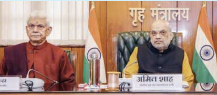
New Delhi, Feb 18: Stating that the Jammu & Kashmir police should now prioritize safeguarding citizen rights, Union Home Minister Amit Shah on Tuesday directed the Union Territory administration to ensure the full implementation of three new criminal laws by April 2025.
Shah, who chaired a high-level review meeting on the implementation of these laws in Jammu & Kashmir, noted that with the decline in terror activities and improvement in the security scenario in the region, the police should now prioritize safeguarding the rights of its citizens.
Shah, who reviewed the implementation of the laws in the presence of LG Manoj Sinha and Chief Minister Omar Abdullah, asked the UT administration to ensure the full implementation of the three new criminal laws, made under the leadership of Prime Minister by April 2025.
The three criminal laws—Bharatiya Nyaya Sanhita, the Bharatiya Nagarik Suraksha Sanhita, and the Bharatiya Sakshaya Act—came into effect on July 1, 2024. These laws replaced the Indian Penal Code, Code of Criminal Procedure, and Evidence Act.
Shah said that for the full implementation of the new laws, it is imperative to change the attitude of police personnel and the administration and create awareness about the new laws among citizens. “He said that optimum use of technology should be made to ensure speedy justice under the three new criminal laws,” reads an official handout issued by the Ministry of Home Affairs (MHA) after the meeting.
Shah added that there is an urgent need to use the provision of Trial in Absentia in the Union Territory. The Union Home Minister stressed the need to fix the responsibility of police officers to expedite the process of filing chargesheets. He said that every police station in Jammu Kashmir should maximize the use of the National Automated Fingerprint Identification System (NAFIS). He also emphasized that 100% training of investigating officers regarding the provisions of the new laws should be ensured at the earliest.
The Home Minister said that decisions on provisions related to terrorism and organized crime should be taken only after thorough scrutiny at the level of Superintendent of Police. He added that strict monitoring is required to ensure that these provisions under the new laws are not misused.
Shah commended the Jammu Kashmir administration and government for their satisfactory work towards the implementation of the new criminal laws despite difficult circumstances. He stated that the progress of implementation should be reviewed on a monthly, fortnightly, and weekly basis at the level of the Chief Minister, Chief Secretary, and Director General of Police, respectively.
The meeting was attended by the Union Home Secretary, Chief Secretary and Director General of Police of Jammu and Kashmir, the Director General of the Bureau of Police Research and Development (BPRD), the Director General of the National Crime Records Bureau (NCRB), and other senior officials from the Ministry of Home Affairs (MHA) and the UT administration.
Awareness on New Criminal Laws is imperative: CM
New Delhi, Feb 18: Chief Minister, Omar Abdullah on Tuesday said that implementing three new criminal laws is not the mandate of the elected government in Jammu Kashmir, but the dispensation led by will have to make efforts to create awareness among people about them.
Talking to reporters here after attending a meeting called by Home Minister Amit Shah to review the implementation of the new criminal laws, Omar said, “As far as the elected government is concerned, it is not our responsibility to implement these laws. Since these are new laws, people should be aware of them. For this, the elected government needs to do more,” he said.
He said they will have to make efforts to create awareness about these laws in colleges, universities or other places.
The CM added that J&K has done better in implementation but there are few weak areas which need to be fixed.
Omar said there was no discussion on J&K’s security situation during today’s meeting. “I had discussed security matters relating to J&K during my recent meeting with HM (Amit Shah) on Parliament premises,” Omar said.
Omar expresses inability to comment on his exclusion from security reviews relating to the Union Territory.
“There is a difference between this meeting and those meetings. This meeting was about new laws and their implementation. If the decision has been made to exclude representatives elected by the people from security issues, what can we do? That is ok,” he said.
On the reaction of Leader of Opposition Rahul Gandhi over the appointment of the Chief Election Commissioner, Omar said, “The LoP has the right to dissent in the selection meeting. Opposition does not need to always agree with the government. The matter (relating to the constitution of the selection committee for picking the CEC and election commissioners) is sub-judice in the Supreme Court.”

