By Ravi Rohmetra
Maharaja Gulab Singh, the founder of the princely State of Jammu and Kashmir, was a remarkable soldier, statesman and visionary. Born on October 21, 1792, into the Jamwal Rajput family of Jammu, he rose from a relatively small hill principality to establish one of the most significant princely states in the Indian subcontinent. His successful career continues to evoke admiration, and historians have often described him as the “Ulysses of the Hills” and the “Talleyrand of the East” for his diplomatic acumen and political foresight.
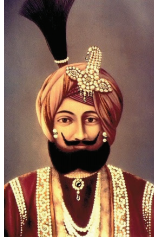
Maharaja Gulab Singh’s life has an aura of adventure and romance. At the age of sixteen, he distinguished himself during the defence of Jammu against forces sent by Maharaja Ranjit Singh. Driven by ambition and courage, he later joined the Khalsa Army and rose rapidly through its ranks, earning recognition as a capable military commander. He accompanied Maharaja Ranjit Singh in several important campaigns and played a significant role in the consolidation and expansion of the Lahore State.
His services were acknowledged in 1822 when Maharaja Ranjit Singh personally installed him as the Raja of Jammu. Thereafter, Gulab Singh restored order in his territories, subdued rebellious chiefs and, through a series of military campaigns, brought Kishtwar, Baltistan, Ladakh and Gilgit under his authority.
The establishment of the State of Jammu and Kashmir under the Treaty of Amritsar in 1846 and its subsequent emergence as one of the major princely states of India reflected Gulab Singh’s abilities as both a soldier and a statesman. He is often regarded as the only Indian ruler of his time who significantly expanded the geographical frontiers associated with India. His conquests in Ladakh and Gilgit remain notable chapters in Indian military history. Endowed with immense courage, determination and political wisdom, Maharaja Gulab Singh laid the foundation of a state whose legacy endured for over a century.
Gulab Singh (1792–1857) became the first Maharaja of the princely State of Jammu and Kashmir under British suzerainty and founded the Dogra dynasty, which ruled until the accession of the state to India in 1947.
Belonging to the Jamwal clan of Rajputs, Gulab Singh was the son of Kishore Singh, a relative of Raja Jit Singh of Jammu. In 1808, while still in his teens, he defended Jammu against an invasion by forces aligned with Maharaja Ranjit Singh. This eventually resulted in Jammu retaining a degree of internal autonomy while becoming a tributary of the Sikh Empire.
In 1812, Gulab Singh became commander of the Dogra cavalry contingent in Maharaja Ranjit Singh’s army. He participated in several military campaigns, including those at Multan in 1816 and Reasi. Following the annexation of Jammu by Ranjit Singh, Gulab Singh and his family continued to rise in prominence. In recognition of their services, the Jammu region was bestowed upon Kishore Singh in 1820.
Driven by territorial ambitions, Gulab Singh conquered Rajouri in 1821 and later annexed Kishtwar. He also suppressed local rebellions, including that led by Dido Jamwal. After the death of Kishore Singh in 1822, Gulab Singh formally assumed the title of Raja of Jammu with the approval of Maharaja Ranjit Singh.
During the following years, Gulab Singh expanded his influence further. He captured strategic forts, suppressed Afghan insurgents and was rewarded with control over valuable salt mines in northern Punjab. The political instability that followed Maharaja Ranjit Singh’s death in 1839 saw the Dogra brothers emerge as influential figures in Lahore politics, with Raja Dhian Singh serving as Prime Minister.
The period was marked by intrigue, palace rivalries and shifting alliances. Several members of the Dogra family, including Dhian Singh, Suchet Singh and Hira Singh, lost their lives in the political turmoil that engulfed the Sikh Empire. Nevertheless, Gulab Singh consolidated his position in Jammu and maintained his authority.
Under his leadership and through the military exploits of General Zorawar Singh, the Dogra kingdom expanded into the trans-Himalayan regions. Ladakh was fully integrated into the kingdom between 1834 and 1840, while Baltistan was conquered in 1840. Encouraged by these successes, Zorawar Singh launched an expedition into western Tibet in 1841. Although initial gains were made, the harsh winter conditions and logistical difficulties led to a setback, and Zorawar Singh was killed in battle in December 1841.
Subsequently, the Treaty of Chushul helped define the boundaries between Ladakh and Tibet and restored peace in the region.
The Sandhawalia Sardars, who were related to Maharaja Ranjit Singh, later allied themselves with British interests and were involved in the assassinations of Raja Dhian Singh and Maharaja Sher Singh in 1843. Political instability within the Sikh Empire continued to deepen.
In 1844, an attempt by the Lahore Darbar to extract tribute from Gulab Singh resulted in military confrontation, but the fort of Jammu remained unconquered. Eventually, negotiations led to a settlement involving an indemnity payment.
During the First Anglo-Sikh War, Gulab Singh maintained close contacts with the British. Following the Treaty of Lahore, and subsequently the Treaty of Amritsar in 1846, he was recognised by the British as Maharaja of Jammu and Kashmir in return for payment of 75 lakh rupees. The Treaty of Amritsar formally established the princely State of Jammu and Kashmir.
Although the treaties defined the eastern, southern and western frontiers of the state, its northern boundaries remained unsettled for some time. Chilas was annexed in 1850, while Gilgit witnessed periods of rebellion before eventually being re-established under Dogra control during the reign of Maharaja Ranbir Singh.
Maharaja Gulab Singh passed away on June 30, 1857, and was succeeded by his son, Maharaja Ranbir Singh. The kingdom he founded endured through successive generations of Dogra rulers until the events of 1947–48 transformed the political landscape of the region.
His achievements in extending the frontiers of the state towards Tibet and Central Asia remain a significant part of the history of Jammu and Kashmir. Many historians consider him among the few Indian rulers who substantially expanded the territorial reach of their realm during the nineteenth century.
In recognition of his contribution, the foundation stone of Shri Maharaja Gulab Singh (SMGS) Hospital, Jammu, was laid by Maharaja Hari Singh on May 6, 1940, in memory of his grandfather, Maharaja Gulab Singh.
(Ravi Rohmetra Social Worker & Freelance Writer; Mob.: 9419652999)