By Ashutosh Pandey
India’s economy has demonstrated considerable resilience in recent years. Despite global uncertainties, it has remained one of the world’s fastest-growing major economies. Increased public investment in infrastructure, the expansion of digital platforms, policy support for manufacturing, and robust domestic demand have contributed significantly to this momentum. New highways, modern rail networks, airports, digital services and production-linked incentive schemes underline the emphasis on long-term economic development.
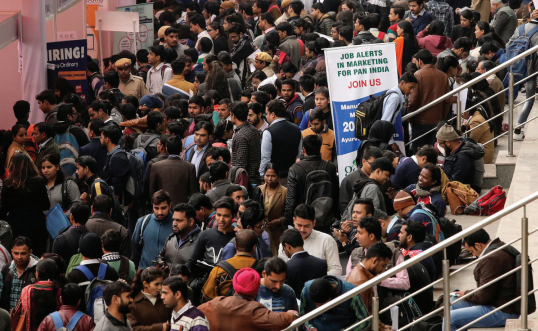
Yet a key question continues to shape public discourse: Is economic growth generating enough quality jobs?
Growth figures alone cannot provide a complete answer. Employment is more than an economic indicator; it influences household stability, social mobility and individual aspirations. For a country with one of the youngest populations in the world, the capacity to create productive and sustainable employment will determine whether India’s demographic dividend becomes a lasting advantage or a missed opportunity.
The employment debate in India is often framed in extremes. One narrative portrays the country as facing a severe jobs crisis, while another highlights improving labour market indicators to suggest that concerns are overstated. The reality lies somewhere between these competing perspectives.
According to the latest Periodic Labour Force Survey (PLFS) released by the National Statistical Office, the unemployment rate for individuals aged 15 years and above declined marginally to 3.1 per cent in 2024–25 from 3.2 per cent in the previous year. Labour Force Participation Rate and Worker Population Ratio also registered improvements, indicating that more people are entering the labour market and finding work. These developments are encouraging and deserve recognition.
However, unemployment statistics reveal only one dimension of the challenge.
The more significant issue concerns the quality of employment. A substantial section of India’s workforce remains engaged in the informal economy, where incomes are uncertain and access to social security, health insurance, pensions and legal protections is limited. Many individuals may technically be employed, yet irregular earnings and insecure working conditions continue to make them economically vulnerable.
This distinction is important. Generating employment is necessary, but creating decent and productive jobs is equally vital. As the economy expands, expectations have also evolved. Young people increasingly seek opportunities that provide fair wages, stability, career advancement and skill enhancement, rather than merely a means of subsistence.
The challenge is especially evident among educated youth. Over the past decade, higher education has expanded considerably, producing millions of graduates every year. At the same time, employers frequently point to a shortage of suitably skilled candidates. This reflects not simply a lack of jobs, but a widening gap between educational outcomes and industry requirements.
Many graduates enter the job market with academic credentials but without the practical skills demanded by technology-driven workplaces. Consequently, companies struggle to recruit job-ready talent, while many educated young people continue searching for meaningful employment. Bridging this divide requires stronger collaboration between educational institutions and industry, alongside greater emphasis on vocational education, apprenticeships and hands-on training.
Technological change is adding another layer of complexity. Artificial intelligence, automation and digital platforms are reshaping labour markets worldwide. While these developments are expected to create new opportunities, they are also reducing demand for routine and repetitive tasks. India’s youthful workforce remains a major strength, but maintaining that advantage will require sustained investment in digital literacy, reskilling and lifelong learning.
Recognising these challenges, policymakers have increasingly focused on manufacturing, infrastructure development and entrepreneurship as drivers of employment generation. Efforts to strengthen domestic production, improve logistics, encourage start-ups and simplify business regulations are aimed at creating jobs over the medium and long term. Enhanced capital expenditure on infrastructure has also supported employment in construction, transportation and allied sectors.
The true test of these initiatives, however, lies not merely in the number of jobs created, but in whether they result in large-scale, formal and better-paying employment opportunities.
Regional disparities also merit greater attention. Economic opportunities continue to be concentrated in a few metropolitan centres, prompting millions of young people to migrate in search of work. Smaller towns and rural regions often lack adequate industrial investment, quality educational institutions and skill-development infrastructure. Unless employment opportunities become more geographically dispersed, regional imbalances are likely to persist.
India’s employment debate, therefore, needs to move beyond simplistic claims of success or failure. Official data points to improvements in labour market indicators, but structural issues such as informality, low productivity, skill mismatches and limited access to quality jobs remain significant challenges. A meaningful policy discussion must acknowledge both the progress achieved and the constraints that still exist.
Sustained economic growth remains essential, but it must be complemented by labour-intensive industrialisation, improved educational outcomes, modern vocational training systems and an investment climate that encourages enterprise while protecting workers’ interests.
Economic growth creates opportunities. Employment transforms those opportunities into broad-based prosperity. In the years ahead, India’s development trajectory will be judged not only by the pace of its economic expansion, but also by its ability to provide meaningful livelihoods and brighter prospects for millions of its citizens.