Author: Colonel Dev Anand Lohamaror
Security & International Affairs Expert
The night of June 15, 2020, in the Galwan Valley of Ladakh was not merely another border skirmish. It marked a defining moment in the history of India–China relations, fundamentally altering the balance of power, military strategy, and political thinking along the Line of Actual Control (LAC). Six years later, as we reflect in 2026, it is evident that Galwan was far more than a military confrontation; it was a watershed event that compelled India to reassess its entire approach toward China, border security, and strategic preparedness.
To understand the significance of Galwan, it is important to recall the situation that existed before 2020. For decades, China had pursued a “salami-slicing” strategy, periodically advancing into areas claimed by India to create temporary facts on the ground, exert pressure, and later withdraw partially. The objective was to gradually alter the status quo without triggering a major conflict. While tensions along the border were not uncommon, both sides generally avoided large-scale military confrontations. Consequently, Beijing often operated under the assumption that limited coercive actions could yield strategic advantages without provoking a determined response.
The events of 2020 changed that equation dramatically. In Eastern Ladakh, China significantly increased troop concentrations and attempted to alter the status quo across multiple sectors, including Pangong Tso, Depsang, Gogra, Hot Springs, and Galwan. Beijing likely assumed that India would react with its historical restraint. However, the confrontation in Galwan Valley shattered that perception. Indian soldiers demonstrated extraordinary courage and resolve, sending a clear message that India would not passively accept unilateral attempts to alter the border.
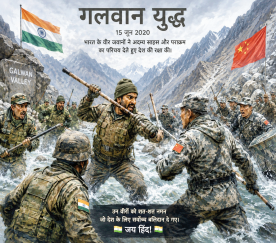
The clash of June 15, 2020, resulted in the sacrifice of twenty brave Indian soldiers. Leading them from the front was Colonel B. Santosh Babu, the Commanding Officer of 16 Bihar—a brave battalion whose fierce counter-response wrote a new chapter in Indian military folklore. Adhering to long-standing border protocols to prevent escalation, the troops engaged in savage, hand-to-hand combat using clubs, barbed wire, and physical force rather than firearms. China also suffered significant casualties, although Beijing was initially reluctant to disclose the full extent of its losses. Beyond the tragic loss of life, the outcome of Galwan was profoundly psychological and strategic, proving that coercion along the border would carry an unacceptable cost.
Galwan triggered a transformation in India’s strategic mindset. Prior to 2020, border crises were managed through diplomacy and limited localized responses. After Galwan, India adopted an assertive strategy of “mirror deployment.” If China deployed troops, armor, artillery, or air defense systems, India responded with equivalent or superior force, effectively ending the era of passive defensive positioning. What was once considered extraordinary in Eastern Ladakh became the new normal. Thousands of troops, heavy armor, long-range artillery, and advanced air defense assets became permanent features of the region, demonstrating India’s ability to operate heavy military equipment at extreme altitudes.
A masterstroke of proactive deterrence occurred in late August 2020, when Indian forces occupied key heights on the Kailash Range. This brilliant tactical move altered the dynamic and placed real pressure on Chinese positions for the first time during the crisis. It demonstrated India’s willingness and capability to undertake proactive military operations when required, strengthening New Delhi’s position during subsequent rounds of negotiations and signaling a new level of strategic confidence.
Galwan also accelerated India’s border infrastructure development at an unprecedented pace. Roads, bridges, tunnels, airstrips, and logistics networks were expanded and modernized across Ladakh. Areas that once took days to reinforce can now be accessed rapidly, serving as a long-term investment in national security and regional connectivity.
Beyond military deployments, New Delhi has fundamentally recalibrated its broader China policy. A central principle has emerged: normal bilateral relations cannot coexist with instability and tension along the border. India has consistently maintained that meaningful progress in economic, trade, and political relations requires peace and stability on the frontier. Furthermore, Galwan accelerated India’s geopolitical realignments on the global stage. It cemented New Delhi’s commitment to the Quad (India, the US, Japan, and Australia) and triggered a parallel sharpening of India’s maritime strategy in the Indian Ocean, creating a multi-theater counter-pressure against Chinese expansionism.
Today, in 2026, Eastern Ladakh stands as one of the most heavily militarized high-altitude regions in the world. Numerous rounds of negotiations have taken place, and disengagement has occurred in several friction points like Pangong Tso and Gogra-Hot Springs. Yet the broader boundary dispute remains unresolved, and both nations have adapted to a long-term military presence along the LAC as the new strategic normal.
Although China continues to possess immense resources, Galwan produced a crucial psychological shift. Beijing learned that India would no longer tolerate coercive attempts to alter the status quo. This triad of military readiness, political determination, and national resolve has significantly influenced Chinese strategic calculations. The Galwan clash has become a defining chapter in the evolution of modern Indian military doctrine, proving that while the desire for peace is essential, peace can only be preserved through strength.
Six years later, remembering Galwan is about recognizing a profound strategic transformation. The blood shed in the icy heights of Ladakh reshaped India’s approach to national security and redefined the strategic balance along one of the world’s most contested frontiers. When future historians examine the trajectory of India–China relations, June 15, 2020, will be remembered as the day when India demonstrated that the defense of sovereignty was non-negotiable—and when the strategic landscape of the Himalayas entered a new and enduring chapter.