An AI stack is the complete set of tools and systems that work together to build and run AI applications. These applications range from everyday tools such as virtual assistants like Siri and Alexa, and personalized recommendations on platforms like Netflix and Spotify, to advanced systems used in healthcare diagnostics, financial fraud detection, and transportation. The AI stack brings together hardware, software, and platforms that help collect data, train AI models, and use them in real life, ensuring AI works smoothly from start to finish.
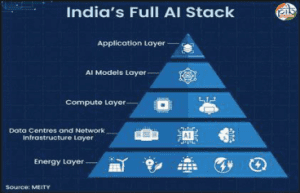
The AI stack is made up of five layers, each playing a critical role. The AI stack makes artificial intelligence work in the real world, from the apps people use every day to the data, computing power, networks, and energy that run behind the scenes. Together, these layers ensure AI solutions are scalable, reliable, and capable of delivering impact at population scale.
- Application Layer
The application layer represents the user-facing component of the AI stack. It includes AI-powered apps and services such as health diagnostic tools, farming advisory platforms, chatbots, and language translation applications. This layer turns complex AI processes into simple, user-friendly services that people can easily use.
- AI model layer
It acts as the brain of AI systems. AI models are trained on data to recognize patterns, make predictions, and take decisions. For example, they help detect diseases from X-rays, predict crop yields, translate languages, or answer questions through chatbots. These models provide intelligence to the applications, enabling them to deliver meaningful AI-powered results to users.
- Compute layer
The muscle of AI; it provides the computing power required to train and run AI models. During training, compute processes vast amounts of data so the model can learn and improve. Today, this power comes from advanced processing chips such as NVIDIA’s Blackwell Graphics Processing Unit (GPU), Google’s Tensor Processing Units (TPUs), and Neural Processing Units (NPUs), which allow AI systems to operate efficiently and at scale.
- Data Centres and Network Infrastructure Layer
This layer forms the home and highways of AI. Data centres are where AI systems are stored and operated, while networks like the internet, broadband, and 5G move data between users, computers, and AI models. Together, they ensure AI works reliably, quickly, and reaches users wherever they are. Without strong networks and data centres, AI applications would not function or scale effectively.
- Energy Layer
This layer keeps the entire AI stack running. AI data centres consume large amounts of electricity because powerful computers are needed to train and operate AI systems. Even as technology becomes more efficient, AI still requires a steady and reliable power supply. Clean and affordable energy is therefore essential to support the sustainable growth of AI infrastructure.
Conclusion
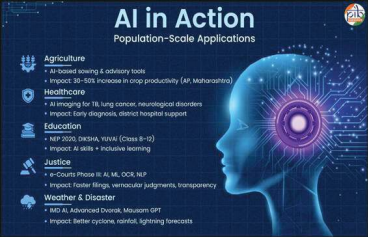
Building a robust AI stack is both a technological priority and a social commitment for India. By strengthening every layer, including applications, AI models, compute, digital infrastructure, and energy, India is enabling the democratisation of AI and ensuring that its benefits reach citizens at population scale. The focus on real-world use cases across agriculture, healthcare, education, justice, and disaster management demonstrates how AI can directly improve service delivery, productivity, and public welfare while remaining inclusive, sovereign, and aligned with national priorities.
Through affordable access to compute, indigenous model development, secure data infrastructure, and sustainable energy systems, India is creating an AI ecosystem that is scalable, resilient, and future-ready. This integrated approach ensures that AI innovation is not constrained by cost, infrastructure, or energy availability, while supporting long-term self-reliance. Anchored in the vision of AI for Humanity, India’s AI stack positions technology as a tool for inclusive growth, social equity, and well-being, advancing welfare for all and happiness for all in the digital era.