
Ramesh Sarraf, Dhamora
India is a diverse country where people of many religions and cultures live together. Numerous festivals are celebrated throughout the year that not only hold religious significance but also symbolize social unity and cultural prosperity. One of these major festivals is Dussehra, also known as Vijayadashami. This festival symbolizes the victory of good over evil and holds a special place in Indian culture. Dussehra is celebrated to commemorate Lord Rama’s victory over Ravana. It is called Vijayadashami, which means “the tenth day of victory.” According to the Ramayana, Lord Rama killed Ravana and freed his wife Sita from his prison. This festival conveys the message that no matter how powerful evil may be, truth and righteousness ultimately prevail. This festival inspires people to follow the path of moral values, truth, and duty.
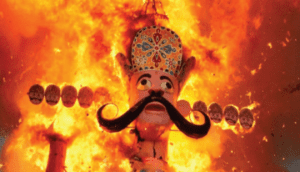
The word Dussehra is derived from the Hindi words “dus” and “hara.” Ten represents the mathematical number ten (10), and “hara” signifies defeat. Therefore, combining these two words results in Dussehra, which marks the day when Lord Rama killed the ten-headed demon Ravana. Whether celebrated as the victory of Lord Rama or as Durga Puja, Dussehra, or Vijayadashami, is a festival of Shakti worship, a day of weapon worship, a festival of joy, happiness, and victory.
Dussehra is one of India’s most important festivals. It is on this day that Lord Rama killed the ten-headed Ravana, the symbol of evil, and after a fierce ten-day battle, Goddess Durga slew Mahishasura, who had conquered heaven after defeating the gods. Therefore, it is known as Vijayadashami. It is held on the tenth day of the bright fortnight of the month of Ashwin. It is celebrated as the victory of truth over falsehood. On this day, people begin new work. Weapon worship is performed on this day. Fairs are held at various places. Ramlila concludes. A huge effigy of Ravana is made and burned.
Indian culture worships bravery and valor. Dussehra is celebrated to manifest bravery in the blood of individuals and society. India is an agricultural country. When a farmer brings home the harvest from his fields, his joy and enthusiasm are boundless. He attributes this happiness to God’s grace and worships Him to express it. This festival is celebrated in different ways in different regions of India.
In Bengal, Odisha, and Assam, this festival is celebrated as Durga Puja. It is the most important festival for Bengalis, Odias, and Assamese people. In Bengal, Dussehra is celebrated for a full five days. In Odisha and Assam, the festival lasts for four days. Here, Goddess Durga is enshrined in elaborately decorated pandals. Renowned artists from across the country are called in to create the Durga idol. On Dashami, a special puja is held and prasad is distributed. Men embrace each other, known as Kolakuli. Women apply vermilion to the goddess’s forehead and bid her a tearful farewell. They also apply vermilion to each other and play with it. Seeing the Neelkanth bird on this day is considered auspicious. Finally, the idols are taken for immersion.
In Maharashtra, the nine days of Navratri are dedicated to Goddess Durga, while the tenth day is dedicated to Saraswati, the goddess of knowledge. On this day, school-going children worship the Tantric symbols of Goddess Saraswati to seek blessings for their studies. This day is considered auspicious for starting anything, especially for beginning education. People in Maharashtra consider this day an auspicious time for marriages, housewarming ceremonies, and buying new homes. In Maharashtra, this occasion is also celebrated as a social festival called Silangaṇa.
Mysore Dussehra in Karnataka is also famous throughout India. During Dussehra in Mysore, the streets of the city are illuminated, and a grand procession is taken out through the city, with elephants decorated. The famous Mysore Palace is decorated like a bride with garlands of lamps. People in the city enjoy a torchlight procession, accompanied by dance and music. In Punjab, Dussehra is celebrated by observing a nine-day fast during Navratri.
Kullu Dussehra is very famous in Himachal Pradesh. Like other places, preparations for this festival begin ten days or a week in advance. Dressed in beautiful clothes, men and women go out with musical instruments like drums, trumpets, flutes, and other instruments. The hill people worship their village deities with a grand procession. The idols of the deities are beautifully decorated in impressive palanquins. They also worship their main deity, Raghunathji. Trained dancers perform the Nati dance in this procession. The procession then circumambulates the main parts of the city, and in Kullu, the Dussehra celebrations begin with the worship of the deity Raghunathji. This festival on Dashami is unique.
In Bastar, instead of considering Dussehra as the main event, people consider it a festival dedicated to the worship of Goddess Danteshwari. Danteshwari is the revered goddess of the Bastar region and is a form of Durga. Here, the festival lasts for 75 days. Dussehra runs from the new moon day of Shravan month to the Shukla Triyodashi of Ashwin month. In Bastar, the celebrations began around the 15th century. It concludes with the Ohadi festival on Ashwin Shukla Triyodashi.
In Gujarat, a decorated earthen pot is considered a symbol of the Goddess, and unmarried girls carry it on their heads and perform a popular dance called Garba. The Garba dance is the highlight of this festival. Men and women dance in circles, striking two small, colorful sticks against each other to the rhythm of music. In Tamil Nadu, Telangana, Andhra Pradesh, and Karnataka, Dussehra lasts for nine days, during which the worship of the three goddesses Lakshmi, Saraswati, and Durga is celebrated. The first three days are dedicated to Lakshmi, the goddess of wealth and prosperity. The next three days are dedicated to Saraswati, the goddess of arts and learning, and the final day is dedicated to the worship of Durga, the goddess of power. The place of worship is lavishly decorated with flowers and lamps. People give each other sweets and clothes.
The minority Hindu community in Kashmir celebrates Navratri with devotion. All adult family members fast for nine days. According to an ancient tradition, people visit Mata Kheer Bhawani for nine days. It is believed that the auspicious time for the rising of the star on Ashwin Shukla Dashami is Vijay. This time is considered auspicious for all endeavors. This is why it is called Vijayadashami.
(The author is a freelance journalist accredited by the Rajasthan government.)