
International Day of Yoga: June 21
Dr. Parveen Kumar*
June 21, this year marks eleventh ‘International Yoga Day’. Having its roots in the ancient traditions of India and a healthy practice handed over as a valuable gift to entire humanity by India, Yoga embodies unity of mind and body; thought and action; restraint and fulfillment. It signifies a well knit harmony between human beings and their environment, and embodies a holistic approach to health and well-being. It just is not about few exercises but aims to discover the sense of oneness with oneself; the world and the nature. Yoga’s origins can be traced to northern India over 5,000 years ago. The word yoga was first mentioned in ancient sacred texts called the Rig Veda. The Vedas are a set of four ancient sacred texts written in Sanskrit. Researchers and historians trace the development of yoga back 5,000 years. Some take yoga origins even further back to 10,000 years. India is widely considered one of the most spiritual places on Earth and it’s easy to see why. It is home to several of the most sacred sites in the world and it offers more than 1,300 yoga retreats, yoga ashrams and yoga teacher training courses.
On September 27, 2014, during his speech at the UN General Assembly, Prime Minister Narendra Modi put forth his suggestion for the occasion of a ‘Yoga Day’. The draft resolution proposed by India was then endorsed by a record 177 member states. Recognizing the universal appeal of Yoga and owing to its demonstrated benefits towards immunity building and stress relief, United Nations General Assembly proclaimed June 21 as the International Day of Yoga. Since then, this day has been observed all over the globe with growing numbers with the objective of reminding the peoples across the globe about the benefits of Yoga and to build enduring public interest in Yoga by highlighting its importance and contribution to public health. In 2015 Reserve Bank of India issued a 10 rupees commemorative coin to mark the International Day of Yoga. In April 2017, UN Postal Administration (UNPA) issued 10 stamps on Asanas on a single sheet to mark International Day of Yoga. When proposing 21 June as the date, Modi said that the date was the longest day of the year in the mass northern hemisphere (shortest in the southern hemisphere), having special significance in many parts of the world. From the perspective of yoga, the summer solstice marks the transition to Dakshinayana. The second full moon after summer solstice is known as Guru Purnima. Shiva, the first yogi (Adi Yogi), is said to have begun imparting the knowledge of yoga to the rest of mankind on this day, and became the first guru (Adi Guru). Following the adoption of the UN resolution, several leaders of the spiritual movement in India voiced their support for the initiative. The founder of Isha Foundation, Sadhguru, stated, ‘this could be a kind of a foundation stone to make scientific approach to the inner well-being of the human being, a worldwide thing… It’s a tremendous step for the world.’ The founder of Art of Living, Ravi Shankar, lauded the efforts of Modi, saying, ‘It is very difficult for any philosophy, religion or culture to survive without state patronage.
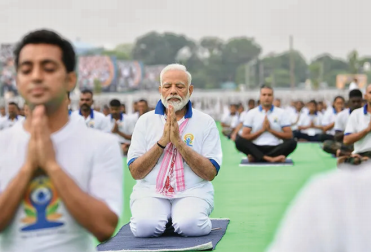
The first International Day of Yoga was observed around the world on 21 June 2015. More than thirty five thousand peoples, including PM Modi and dignitaries from 84 nations, performed 21 asanas (yoga postures) for 35 minutes at Raj path in New Delhi, becoming the largest yoga class ever held. Similar days have been held in cities in India and around the world each year since then. This year this special day is celebrated under the theme ‘Yoga for One Earth, One Health’. The theme embraces the connection between human well-being and a healthier planet. It encourages us to recognize that when our bodies and minds are well, we are better able to support the health of our communities and environment. As the world comes together to celebrate the International Day of Yoga, it gives an opportunity to all to practice and spread awareness about the benefits of this spiritual and physical practice that had first started in ancient India.
Yoga improves strength, balance and flexibility. Slow movements and deep breathing increase blood flow and warm up muscles, while holding a pose can build strength. Yoga helps with back pain relief. Yoga is as good as basic stretching for easing pain and improving mobility in people with lower back pain. The American College of Physicians recommends yoga as a first-line treatment for chronic low back pain. John Hopkins University review of 11 recent studies has shown that Yoga can ease arthritis symptoms. Gentle yoga has been shown to ease some of the discomfort of tender, swollen joints for people with arthritis. Yoga benefits heart health. Regular yoga practice may reduce levels of stress and body-wide inflammation, contributing to healthier hearts. Several of the factors contributing to heart disease, including high blood pressure and excess weight, can also be addressed through yoga. Yoga relaxes us helping us sleep better. Research shows that a consistent bedtime yoga routine can help us get in the right mindset and prepare our body to fall asleep and stay asleep. Yoga can mean more energy and brighter moods. One feels increased mental and physical energy, a boost in alertness and enthusiasm, and fewer negative feelings after getting into a routine of practicing yoga. Yoga helps us manage stress. According to the National Institutes of Health, scientific evidence shows that yoga supports stress management, mental health, mindfulness, healthy eating, weight loss and quality sleep. Yoga connects us with a supportive community. Participating in yoga classes can ease loneliness and provide an environment for group healing and support. It promotes better self-care. Numerous studies show yoga’s benefits in arthritis, osteopenia, balance issues, oncology, women’s health, chronic pain and other specialties. Yoga has existed so far almost like an orphan. Now, official recognition by the UN would further spread the benefit of yoga to the entire world. To quote Sh. Ravi Shankar of ‘The Art of Living’, Yoga has existed so far almost like an orphan. Now, official recognition by the UN would further spread the benefit of yoga to the entire world.
Yoga has been found to be useful in farming also. Yoga in Farming means applying power of thought. Power of thought is believed to be a new fertilizer that leads to food security. It is a unique form of farming that combines thought-based meditative practices with methods of organic agriculture and is bringing clear economic and social benefits to smallholder agrarian communities in India. It is based on the principle that in the same way as people can feel good or bad vibrations from one another; seeds will also react to thoughts exposed to them. When we show modesty towards your crops, they return us back with the maximum productivity.
Farmers have to give seeds the power of positive thoughts through a higher state of consciousness through meditation. This is done through practiced meditators which focus thoughts of peace, non-violence, love, strength and resilience on the seeds for up to a month before sowing. Regular meditations are conducted remotely and in the fields with specific thought practices designed to support each phase of the crop growth cycle from empowering seeds and seed germination, through sowing, irrigation and growth, to harvest and soil replenishment. Positive thoughts have an impact on nature and even livestock and peoples’ around. Nature reads our minds and power of thoughts can be effectively used in farm sector. Presently, nearly one thousand farmers throughout India are combining organic farming with meditation, which is showing remarkable results. It has also improved farmers’ emotional well-being and enhanced community resilience. The meditative practices have been designed for each phase of the agrarian cycle, from seed to harvest.
International Yoga Day is a chance to pause and reconnect, not just with your body, but also with your surroundings. Even five to ten minutes of slow, deep breathing can help calm the mind and improve focus. This can be a simple way to mark the day if you don’t feel like doing full poses. Choose what feels comfortable for you. International Yoga Day is not about how perfectly you perform a pose but about taking a small step towards better physical and mental health. Yoga doesn’t require hours of practice, just a few mindful minutes each day can make a real difference to how we feel both physically and mentally.
The author writes on agriculture and social issues; can be reached at [email protected]


