Revised IMF growth data for 2025 shows American Economy in a better light
By T N Ashok
NEW YORK: The American consumers showed cautious optimism in July, as the latest data from the Conference Board indicates a slight uptick in consumer confidence. But beneath the surface of that modest gain lies an economy still weighed down by anxiety—particularly over the Trump administration’s aggressive tariff regime, which is beginning to take a toll on both purchasing power and economic expectations.
The Conference Board’s monthly Consumer Confidence Index rose by two points in July, from 95.2 in June to 97.2—a move that aligned with economists’ forecasts and offered a tentative signal that American households are beginning to adjust to the current economic climate.
Though this marks the second consecutive month of improvement, the current index remains well below the levels seen during the pandemic recovery in 2022–2023. More notably, the Expectations Index, which reflects short-term views on income, business, and labour conditions, rose to 74.4—still well under the critical 80 mark. Readings below 80 have historically signalled a potential recession within the next 12 months.
“The rebound in confidence is encouraging but fragile,” said Dana Peterson, chief economist at the Conference Board. “Consumers are watching prices, employment, and especially tariffs with a wary eye.”
Americans’ biggest concern, according to the survey, is the impact of tariffs on their day-to-day lives. President Donald Trump’s second-term protectionist policies have led to a new wave of import taxes, hitting everything from automobiles and steel to groceries and consumer electronics.
In June alone, consumer prices rose 2.7% year-over-year, up from 2.4% in May—marking the highest inflation spike since February. This is due in part to tariffs being passed directly onto consumers. Core inflation, which strips out volatile food and energy prices, also rose, signalling deeper inflationary pressure in the system.
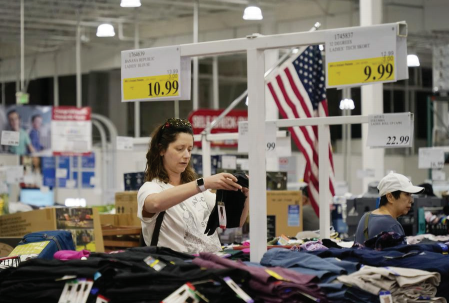
Furniture, home appliances, and clothing—all heavily reliant on imports—saw the largest increases. These were not gradual climbs either; in many cities, shoppers saw prices jump by double digits overnight as retailers adjusted to higher wholesale costs.
“There’s a direct connection between tariffs and what we pay at the checkout counter,” said Sarah McNeil, a retail analyst with New York-based Brookline Advisory. “It’s not a delayed effect anymore—it’s immediate, and consumers feel it.”
The U.S. labour market remains relatively healthy—at least on the surface. In June, employers added a surprisingly strong 147,000 jobs, and unemployment fell slightly to 4.1%. However, labour market data beneath the headline paints a more complex picture.
The number of job openings in June fell to 7.4 million, down from 7.7 million in May, according to the Department of Labour. Additionally, the number of people quitting jobs—a traditional sign of labour market confidence—dropped, suggesting that workers are becoming more risk-averse.
The Conference Board’s survey also noted this sentiment. Consumers’ assessment of current conditions, including job availability, dipped 1.5 points to 131.5, indicating reduced optimism about finding new or better employment.
That trend is especially stark in sectors directly affected by Trump’s tariffs. Manufacturing companies, for example, have already announced layoffs due to rising costs of imported components. Several multinational firms have delayed U.S. hiring decisions until trade policies become clearer.
In a rare note of optimism, the International Monetary Fund (IMF) released a revised outlook Tuesday showing global GDP growth expected at 3% for 2025, up from a previous 2.8% forecast. However, that’s still down from 3.3% growth in 2024.
Interestingly, the IMF also acknowledged that Trump’s tariffs, while controversial, have done less global damage than anticipated so far. Nevertheless, the Fund warned that the cumulative impact of prolonged trade tensions could undermine global supply chains and consumer sentiment in the long term.
“The U.S. economy appears resilient for now,” said IMF spokesperson Monica Salazar, “but it is walking a tightrope. Protectionist policies create instability in price systems, and that can have ripple effects both domestically and abroad.”
According to the Conference Board’s findings, fears of a pending recession have decreased slightly in July. However, these fears remain elevated compared to last year, especially among households making under $75,000 annually. This demographic is most sensitive to inflation, and they’re feeling the sting of higher prices at gas stations, grocery stores, and retail outlets.
For low- and middle-income families, the double threat of rising prices and a softening job market continues to weigh heavily. Some families have dipped into savings or increased credit card debt to meet basic living expenses, a pattern that economists warn is unsustainable over the long term.
“Confidence is a delicate thing,” said Daniel Truong, a behavioural economist at the University of Michigan. “Even a modestly improving job report can’t undo the psychological impact of seeing your grocery bill jump 15% in a year.”
Consumer fears are not occurring in a political vacuum. The Trump administration remains firm on its trade policies, despite opposition from business groups, international partners, and even moderate Republicans.
Tariffs have become a flashpoint in the 2025 political landscape. Trump’s MAGA base largely supports the measures, viewing them as a defense against outsourcing and foreign competition. But Democratic leaders and moderate economists argue that tariffs act like a tax on American consumers and hurt domestic manufacturers who rely on foreign inputs.
Senator Elizabeth Warren (D-MA), speaking Tuesday at a labor forum in Ohio, denounced Trump’s latest tariff expansions. “You can’t build American industry by blowing up supply chains and driving up prices for working families,” she said.
Meanwhile, Trump’s economic advisors maintain that the tariffs are a necessary tool to force fairer trade deals, especially with China, India, and the European Union. “Short-term pain for long-term gain,” tweeted U.S. Trade Representative Robert Lighthizer.
Retailers are adapting. Some are stockpiling goods before new tariffs take effect. Others are shifting suppliers from tariff-affected countries to more favourable markets. But those adjustments take time—and consumers are bearing the brunt in the meantime.
Online platforms like Amazon and Walmart have adjusted pricing algorithms to pass higher costs along to shoppers. Independent retailers and small businesses, however, lack such flexibility and are often forced to eat the costs—or close shop entirely.
For the average American consumer, the long-term impact of tariffs remains murky. Some express resignation, others defiance. “Look, I get that Trump wants to protect American jobs,” said Tina Maldonado, a nurse in Albuquerque. “But when I see eggs, sneakers, and even medicine go up in price—how is that helping me?”
For now, the consumer outlook remains cautiously positive. The modest rise in the confidence index shows that Americans haven’t entirely lost faith in the economy. But tariffs, inflation, and an unpredictable job market continue to erode stability.
Key questions remain: Will Trump expand tariffs further, and if so, on what sectors? Can inflation be brought under control without triggering a recession? Will the Federal Reserve act if consumer confidence sours again?
In this climate, the American consumer—a cornerstone of the national economy—finds themselves trapped between an optimistic present and an uncertain future. And as long as tariffs continue to squeeze both wallets and confidence, the recovery will remain fragile at best. (IPA Service)