By Omkar Dattatray
One is at a loss to understand the issue surrounding the restoration of statehood to Jammu and Kashmir. Is the dissolution of the legislative assembly a corollary to the restoration of statehood? Does restoring statehood necessarily imply dissolving the existing assembly? Or is the dissolution of the legislative assembly a precondition for granting statehood to J&K?
Feelers about the possible dissolution of the assembly seem to have been dropped by New Delhi. It appears an impression has been created among the political leadership, parties, and the people of Jammu and Kashmir that dissolution is necessary for the restoration of statehood.
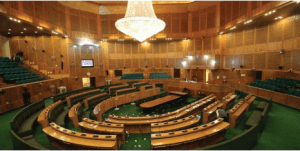
National Conference (NC) leader and Vice President Omar Abdullah has stated unequivocally that they are not afraid of such a move. He said that the day statehood is restored, his government will recommend the dissolution of the legislative assembly and that he, as Chief Minister, will approach the Lieutenant Governor (LG) accordingly.
The pertinent question remains: does the restoration of statehood necessitate dissolving the assembly? Omar Abdullah, who was sworn in as Chief Minister of the Union Territory in October last year, asserted that statehood is the right of the people of J&K. He expressed no objection to holding fresh elections post-statehood.
Abdullah said, “I have read in newspapers that statehood will be restored but Assembly elections would have to be held afresh. Let them do it—who has stopped them? I know where the story has come from. I know who planted it in the newspaper—it was planted only to scare the MLAs. This statehood is not for any MLA or government. It is for the people of Jammu and Kashmir, and we MLAs will not be an obstacle.”
“If the MLAs are being threatened with dissolution of the Assembly for the restoration of statehood, then do it. The day the state is restored, we will go to the governor and recommend dissolution. Don’t try to scare us—statehood is our right. Give it back to us. Stop planting stories in newspapers; it won’t work.”
Legal experts also opine that restoration of statehood from UT status does not mandate the dissolution of the current legislative assembly. Responding to a query, senior constitutional expert Rakesh Dwivedi said it would not be necessary to dissolve the assembly. Senior advocate Gopal Sankaranarayanan echoed this, stating that restoration of statehood would not affect the Assembly’s validity since it is already constituted.
Their statements come amid rising demands for the restoration of statehood—a major electoral promise of the National Conference, which secured a majority in the 90-member Assembly on October 9 last year. The NC-Congress alliance had won a comprehensive victory in the first election held after the abrogation of Article 370 in 2019.
Dwivedi noted, “It will not be necessary to dissolve the Legislative Assembly. It will continue to function as a State Assembly. A parliamentary amendment to the law made post-370 abrogation would suffice. Even if two states—Jammu and Kashmir—are created, it would be done through a State Reorganization Act under Articles 3 and 4 of the Constitution.”
On December 11, 2023, the Supreme Court unanimously upheld the 2019 revocation of Article 370 but also directed that assembly elections must be held by September 2024 and statehood restored “at the earliest.”
Speaking at a function in Gulmarg, Omar reiterated that statehood was a right of the people, not a favour from the Centre. “If the restoration of statehood requires fresh elections, let them do it. The day it is restored, I’ll write to the LG recommending dissolution,” he said. “Don’t try to scare us with such reports. We are not in this for the chair. This Assembly is not above the will of the people.”
His remarks came after media reports suggested that the Government of India may consider restoring statehood only if fresh elections are held. Omar dismissed such narratives as efforts to intimidate legislators. “I know who is planting these stories to create fear that if MLAs press for statehood, the Assembly will be dissolved. That won’t work. No legislator here is afraid.”
He emphasized that the demand for statehood was not for politicians, but for the people. “This is not for Farooq Sahib or me. This is about the rights, dignity, and identity of the people of Jammu and Kashmir,” he said.
NC President Farooq Abdullah also weighed in, alleging that the Centre’s decision in August 2019 had communal overtones. “Was it because we were a Muslim-majority state?” he asked while speaking in South Kashmir. He further warned that if there is a prolonged delay in restoring statehood, his party will move the Supreme Court.
It has been recently reported that the Centre is not opposed to restoring statehood but may insist on fresh elections under a new framework. This could either mean waiting for the current Assembly’s term to end or dissolving it for fresh polls. Legal opinion is reportedly being sought on the matter. Meanwhile, the UT administration has said that it has not received any official communication regarding this.
To sum up, it appears that the Government of India is laying down the dissolution of the Assembly as a precondition for restoring statehood.
(The author is a columnist, KP activist and freelance writer).