Jammu Tawi, Nov 4: Jammu and Kashmir Lieutenant Governor Manoj Sinha on Tuesday inaugurated the 10-day annual Jhiri Mela at Marh on the outskirts of Jammu city, urging people to follow the path of selfless service and equality as envisioned by the 16th-century farmer-saint Baba Jitto.
Every year, the Jhiri Mela draws around 10–12 lakh devotees from Jammu region, Punjab, Himachal Pradesh, and Haryana, who gather to commemorate Baba Jitto’s ultimate sacrifice against oppression nearly five centuries ago. According to legend, Baba Jitto, a humble farmer, ended his life in protest against the unjust demands of a landlord, while his daughter Bua Kouri immolated herself on his funeral pyre in an act of devotion.
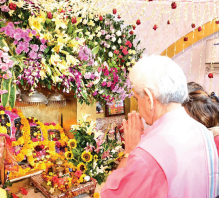
After paying obeisance at the shrine of Baba Jitto and Bua Kouri, LG Sinha inaugurated several development projects, including a pilgrim community hall, four modular bus stops, and laid the foundation stone for the first Indoor Sports Complex at Marh under the Corporate Social Responsibility (CSR) initiative.
Speaking on the occasion, the Lieutenant Governor said Baba Jitto’s life and message remain a universal symbol of public welfare, equality, and social justice. “His values of truth, non-violence, and brotherhood strengthen society and make the Jhiri Mela a celebration of multiculturalism and social harmony. The real tribute to Baba Jitto is to ensure that the benefits of government schemes reach every farmer,” he said.
Sinha called upon the people to take a pledge to embrace the spirit of selfless service and collective responsibility. “Together, we can build a strong, secure, prosperous, and self-reliant Jammu and Kashmir,” he added.
The Lieutenant Governor also reflected on the recent natural calamity that struck Jammu and Kashmir in August, which caused extensive damage due to cloudbursts and flash floods, particularly in parts of the Jammu region. He said the disaster tested the resilience of J&K’s farmers, who suffered heavy losses to crops, livestock, and property.
“Despite adversity, the farmers of Jammu and Kashmir displayed remarkable courage and perseverance. Their spirit is a lesson for all of us. The administration is committed to safeguarding their interests and promoting sustainable agricultural growth,” Sinha said. He expressed gratitude to Prime Minister Narendra Modi for ensuring timely financial relief to the affected families in October, well before Diwali, and reiterated that the welfare of the farming community remains a top priority of the government.
He emphasized that agriculture remains the backbone of the Union Territory’s economy, and the government is working on multiple fronts—technological innovation, infrastructure, and market access—to support the sector. “We must continue to draw inspiration from Baba Jitto’s legacy to empower our farmers, promote equality, and strengthen rural livelihoods,” the LG noted.
Highlighting the cultural and spiritual importance of the Jhiri Mela, Sinha said the festival embodies the values of unity and shared heritage that transcend social and regional boundaries. He urged the youth to preserve the region’s cultural traditions, arts, crafts, and customs, stressing that cultural participation can contribute to rapid economic growth. “Cultural-spiritual events like Jhiri Mela should inspire young people to learn traditional skills and explore livelihood opportunities in crafts and tourism,” he added.
The LG also underscored the need for community participation in governance, saying it fosters accountability and ensures that policies reflect the aspirations of citizens. “An inclusive, transparent, and participatory approach to governance is key to improving service delivery and achieving long-term development goals,” he remarked.
The fair, jointly organised by the Directorate of Tourism in collaboration with the district administration, will continue till November 13. The Departments of Agriculture, Horticulture, and Jammu Municipal Corporation (JMC) have been actively involved in providing essential services, including sanitation, water supply, parking, health facilities, and power arrangements.
Officials said that the participation of the agriculture department at the mela also serves as an educational platform to enhance farmers’ knowledge, exposure, and engagement with modern technologies and government schemes—while paying tribute to Baba Jitto’s enduring commitment to the dignity of farmers.
Security has been strengthened across the area with the deployment of police and paramilitary forces to ensure peaceful conduct of the fair. Hundreds of pilgrims and farmers from the neighbouring states have already arrived, filling the mela grounds with vibrant colours, devotional songs, and local handicraft displays.
A special attraction of the fair is the customary dip in Baba-da-Talab, a natural pond located about four kilometres from the temple, believed to have curative powers. Devotees take the holy dip before offering prayers at the shrine.
During his visit, LG Sinha inspected stalls set up by various government departments, self-help groups, agri-entrepreneurs, and progressive farmers. He also felicitated several farmers for their outstanding achievements in agricultural innovation and productivity.
The newly inaugurated Pilgrim Community Hall at Jhiri will function throughout the year as a rest facility for devotees and as a venue for religious, cultural, and community awareness programmes. The four modular bus stops constructed at Jhiri Chowk, Rajpura Chowk, Bawa Talab Chowk, and Kanachak Chowk will ease transportation for pilgrims and strengthen connectivity to nearby rural areas.
The upcoming Indoor Sports Complex, expected to be completed within four months, will include badminton courts, judo and taekwondo rings, shooting ranges, table tennis tables, chess and carrom facilities, along with a reading and recreation zone—marking a new era for youth and sports development in the region.
As the Jhiri Mela unfolds, it stands not just as a tribute to Baba Jitto’s timeless ideals of justice and equality but also as a celebration of resilience—of farmers, culture, and community spirit that define Jammu and Kashmir’s living heritage.