Rising environmental danger threatens to poison our future
By Raju Kumar
BHOPAL: E-waste — or electronic waste — has emerged as one of the fastest-growing environmental threats of our time. The increasing number of electronic devices in modern life has undoubtedly made daily living more convenient, but once these gadgets become obsolete or fall out of use, the waste they generate poses a serious danger to both the environment and human health. According to the Global E-waste Monitor 2024, about 62 million tonnes of e-waste were generated worldwide in 2022, and the figure is projected to rise to around 82 million tonnes by 2030. Only 22.3 percent of this waste is formally and scientifically recycled; the rest is either dumped in open landfills or buried underground, releasing toxic substances into soil and groundwater.
India is now the third-largest producer of e-waste in the world. During the COVID-19 pandemic, dependence on digital infrastructure — for online work, e-learning, e-commerce, and remote communication — rose sharply. This surge in the consumption of laptops, mobile phones, tablets, cameras, and networking equipment led to a parallel rise in e-waste generation. As per data presented in the Rajya Sabha on December 16, 2024, by the Union Ministry of Housing and Urban Affairs, India witnessed a sharp 72.5 percent increase in e-waste generation over five years — from 1.01 million metric tonnes in 2019-20 to 1.751 million metric tonnes in 2023-24. This escalation clearly reflects how growing digital dependence has intensified environmental challenges.
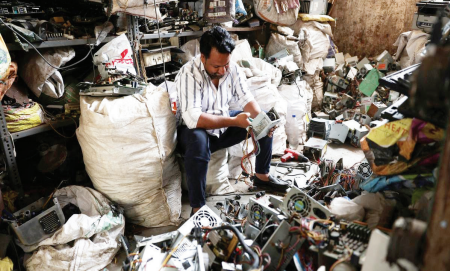
In developing countries like India, where awareness about waste segregation and safe disposal remains limited, e-waste has become a critical hazard. Devices such as old computers, mobile phones, televisions, refrigerators, and printers contain toxic elements like lead, mercury, and cadmium. When these seep into soil and water, they cause irreversible contamination, affecting ecosystems and human health. In many informal recycling hubs and urban slums, workers extract precious metals by burning components — a process that releases poisonous fumes, elevates air-pollution levels, and exposes people to respiratory and skin diseases.
Nearly 95 percent of India’s e-waste is still handled by the informal sector, often without adherence to environmental safety standards. The government introduced the E-waste (Management) Rules 2022, assigning “Extended Producer Responsibility” (EPR) to manufacturers and importers for end-of-life product disposal. However, the impact of this policy will be visible only when enforcement is rigorous and public awareness grows at the same pace.
Recognising the urgency of the issue, the Government of India adopted the theme “E-waste disposal” for this year’s Swachhta Month 2025. Several public and industrial institutions across the country have launched initiatives to promote responsible waste management. One exemplary case is the Bharat Heavy Electricals Limited (BHEL) Bhopal Unit, which has shown that cleanliness is not limited to sweeping and sanitation but also extends to resource efficiency and technological innovation. BHEL Bhopal digitised and systematically disposed of old office files to reduce paper use, encouraged employees to reuse computers and printers, and introduced the use of magnetic sweepers to collect scattered metal chips across factory floors. This not only improved workplace cleanliness but also enabled metal recycling — a creative example of industrial innovation that can inspire other organisations to act responsibly toward waste reduction.
Across India, similar initiatives are taking shape. The Indian Oil Corporation launched an e-waste collection drive in its refineries for the safe recycling of outdated IT equipment. Infosys Bengaluru Campus donates refurbished computers to educational institutions, simultaneously promoting digital inclusion and waste reduction. Cities like Delhi, Pune, and Hyderabad have established E-waste Banks, where citizens can deposit their old electronic items for scientific recycling. Moreover, the growing number of resale markets and online platforms dealing in used laptops, mobiles, and other gadgets is a positive sign — encouraging reuse and extending the life cycle of devices that would otherwise end up as waste.
E-waste management is thus a multi-dimensional challenge that demands a synergy of policy enforcement, technological innovation, and community participation. Producers must uphold their EPR obligations; local bodies need to strengthen collection systems; and citizens must recognise that every device they use carries a responsibility even after its utility ends. E-waste is no longer merely an industrial or technological problem — it is a question of lifestyle and collective responsibility. We must acknowledge that e-waste is not useless junk but a reusable resource, and managing it wisely is the key to a clean and sustainable future. (IPA Service)