U.S. dilution of India’s role in Indo-Pacific is a wake-up call for New Delhi
By Nitya Chakraborty
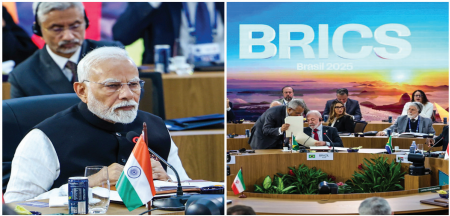
India is hosting the 18th BRICS Summit in New Delhi on September 12 and 13 this year which carries unusual significance in the present changing landscape of the geopolitics in the Indo-Pacific as also in other parts of the world. Most importantly, Chinese President Xi Jinping and the Russian President Vladimir Putin are expected to atte3nd apart from the heads of the other member nations.
BRICS originally started with Brazil, Russia, India and China, then South Africa joined. Now BRICS have eleven members. Apart from the big five, other countries include Indonesia, Egypt, Iran, Saudi Arabia, Ethiopia and UAE. Among the members right now, Iran is involved in a war with the USA and Israel while Russia has been in war with Ukraine for more than five years.
Though India has put the official theme as Building for Resilience, Innovation, Cooperation and Sustainability, the global affairs including the war in West Asia is certainly going to dominate. On this Gulf war issue, the victim Iran has differences with UAE and Saudi Arabia. India’s efforts will be contain the outburst of the differences on West Asian war and focus more on the developmental issues including strengthening of local currency trade, AI governance and possibilities of furthering economic collaboration between the member nations.
India as a leading economically strong developing nation is playing a major role in reorienting the nature of financial and technical collaboration between the BRICS members. The Reserve Bank of India (RBI) is leading technical coordination for the implementation of BRICS Pay and the interoperability of central bank digital currencies like the e-rupee and digital yuan.. Further, India is championing the cause of digital infrastructure by using platforms like UPI as a model. Indian officials are expected to take important part in discussions on ethical AI governance and knowledge sharing.
India are championing Digital Public Infrastructure (DPI) by using platforms like India’s Unified Payments Interface (UPI) as a model. The bloc is also prioritizing the development of ethical AI governance and knowledge sharing..Energy transition is one key area which India will focus. Many members of BRICS are big oil producers. So the discussions will have relevance in the context of the current problems being faced by the oil importing nations including India.
While, the economic and energy issues will form the part of the developmental agenda at the BRICS Summit, the members will closely follow the political message which the BRICS Summit hosted by India gives to the other members. Most of the members have misgivings about pro-US tilt of the Indian Prime Minister after coming to power in 2014. But this was more evident in Trump years, especially after he took over power for the second time on January 20, 2025.
For the first six months, of 2025, PM was under the spell of Trump. After the tariff war and Trump’s continuous threat to India on oil purchases from Russia, Narendra Modi got some mojo and joined the Brazil summit of BRICS in July 2025 where he took a strong position on the issues of global South. But basically, India’s foreign policy was still stuck with the US strategy without any strategic autonomy for India. India tried to woo Trump in many ways but the Trump administration has been continuing with new tariffs including the latest 200 per cent on generics affecting India.
But a new development concerning the US strategy on Indo-Pacific in the wake of Trump-Xi Jinping summit in May this year has given a wake up call to Indian foreign policy officials. The US has devalued India’s role in Indo-Pacific and in US strategy, India has lost its earlier relevance as an important ally in its containment policy against China. This may be a temporary phase as it depends on the nature of US-China relations. But the Indian foreign ministry has been compelled to give a look at the possibility of reshaping its maritime security policy also. Indian PM’s recent visit to Indonesia, Australia and New Zealand is a positive development from this aspect.
PM Narendra Modi earlier gave more emphasis on US sponsored QUAD as against BRICS. But since Trump himself is not interested in holding the QUAD summit which was scheduled to be held in India in 2026, Indian foreign office has to focus more on BRICS, though the option of QUAD still remains but in a weaker form. Foreign Minister Dr. S. Jaishankar has recently attended the QUAD foreign ministers meeting and discussed issues with the U.S. secretary of state Marco Rubio as usual, but the earlier warmth was missing. The U.S. seeks to make use of India only when it suits the Trump administration.
Experts in Washington have noted that Trump administration is more interested in cultivating Pakistan these days even at the cost of friendship with India. Pakistan has been gaining more diplomatic ground with both USA and China and that is strengthening Pakistan economically and politically. All these have been taking place in a geopolitical environment where India have been left with very few real friends.
At the BRICS meet, Prime Minister Narendra Modi has to take a firm stand in favour of the issues that help Global South. India, presently the World’s largest populated country with the possibility of emerging as the third largest economy by the end of the decade, should stick to a firm independent foreign policy. PM Modi’s tilt towards Trump at the cost of Global South has been annoying most of the BRICS members. Now, in the new situation, India can reshape its policy on the basis of strategic autonomy in its relations with all three countries, USA, China and Russia. Narendra Modi has a golden opportunity in September to emerge as a real leader of Global South. Will he do it, that is the big question. (IPA Service)