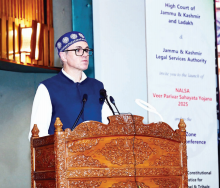
Srinagar, July 27: In a notable first, Jammu and Kashmir Chief Minister Omar Abdullah paid public tributes to the fallen soldiers of the 1999 Kargil War, acknowledging their service and sacrifice on the occasion of Kargil Vijay Diwas. Addressing the North Zone Regional Conference on “Reaffirming the Constitutional Vision of Justice for Defence Personnel and Tribals” at SKICC Srinagar, the CM emphasized the moral obligation of the legal system toward the most marginalized—including defence personnel and tribal communities.
“Today, on the solemn occasion of Vijay Diwas, let me begin by acknowledging the service and sacrifices of our defence personnel, both past and present,” Omar said, noting that many of the soldiers hailed from Jammu & Kashmir and served in “remote, inhospitable terrain with quiet dignity and enduring duty.”
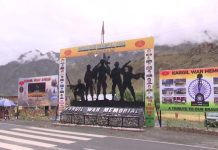
This is the first time that Omar Abdullah, or any of his predecessors, has publicly acknowledged the Kargil martyrs during Vijay Diwas, even though none have ever visited Drass or paid homage at any war memorial in person.
In his speech at the conference—jointly organised by NALSA, the High Court of J&K and Ladakh, and the J&K Legal Services Authority—Abdullah reiterated his government’s support to strengthen the delivery of justice to defence personnel and tribal populations.
“The true test of our legal system lies in its treatment of the weaker sections of society—those who defend the Constitution without question, and those whose rights have too often gone unrecognised,” he said. “This test must be met with humility, guarantee, and resolve.”
He stressed that service-related legal challenges, such as pension disputes or civil grievances faced by soldiers, are compounded by geographic remoteness, the rigidity of postings, and the distinct constraints of military life. “These challenges constitute legal disabilities under Article 39A and must be urgently addressed,” the CM asserted.
Abdullah called for robust coordination between legal services authorities, military legal cells, Zila Sainik Boards, and regimental welfare offices. He advocated for setting up legal aid clinics in cantonments and districts with significant veteran populations, and emphasized empathetic legal support for widows, elderly parents, and children of soldiers.
“Awareness must accompany access. No soldier, or the family of a soldier, should be left adrift—unsure of what procedural remedies are available to them,” he said. He proposed training paralegal volunteers in military legal issues, and leveraging technology—such as mobile apps and virtual legal platforms—to bridge information gaps.
On the issue of tribal justice, Abdullah said tribals in J&K are the custodians of an ancient cultural and ecological heritage and deserve more than just development schemes. “Development alone cannot substitute justice,” he stated, advocating legal aid delivered in native dialects and through culturally familiar frameworks.
He suggested that paralegal volunteers be drawn from tribal communities themselves, to ensure legal help is rendered in a relatable and effective manner. “Justice must reach every hamlet—from Poonch to Kishtwar, from Rajouri to Karnah.”
The CM also cautioned that national security considerations in border tribal areas must not override citizens’ fundamental rights. “Law enforcement must not translate into legal disenfranchisement,” he warned.
In a significant policy move, Abdullah announced the upcoming establishment of a dedicated law university in J&K, with an initial allocation of ₹50 crore. Preparatory work, he said, is already underway.
“This law university will be a centre of excellence in legal instruction, research, and policy innovation—particularly in tribal rights, constitutional law, military justice, and environmental governance,” he said. “It is an investment in an inclusive and capable legal ecosystem for future generations.”
The conference, attended by Justices of the Supreme Court and High Courts, senior military officials, and members of the legal fraternity, focused on strengthening access to justice for those often left on the margins. Abdullah concluded by reaffirming his government’s commitment to transforming constitutional promises into everyday realities.