
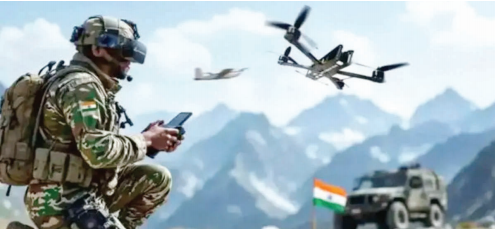
In a significant step towards enhancing national security and operational preparedness against evolving aerial threats, the Indian Army has initiated the procurement of an indigenously developed ‘SAKSHAM’ Counter Unmanned Aerial System (UAS) Grid System.
The system is designed to detect, track, identify, and neutralise hostile drones and unmanned aerial systems in real time, ensuring complete airspace security across what is now defined as the Tactical Battlefield Space (TBS), an expanded domain that includes the Air Littoral, the airspace up to 3,000 metres (10,000 feet) above the ground.
Genesis and Need
The necessity for a comprehensive Counter-UAS framework emerged prominently during Operation Sindoor, where hostile UAS activity highlighted the need for swift detection, coordinated response, and airspace control beyond traditional ground limits.
The Indian Army has since evolved its operational concept from the earlier Tactical Battle Area (TBA) to the more inclusive Tactical Battlefield Space (TBS), recognising that future wars will be fought not just on land but also in the air littoral directly above it.
This new approach ensures that the airspace up to 3,000 metres above the ground the Air Littoral remains under control of ground forces, allowing unrestricted movement for friendly aerial assets while detecting, tracking, and neutralising hostile drones or aircraft. Modern conflicts increasingly involve drones for surveillance and attacks, making situational awareness and real-time decision support essential for mission success.
The ‘SAKSHAM’ System
Conceived as a high-end, modular Command and Control System, SAKSHAM, short for Situational Awareness for Kinetic Soft and Hard Kill Assets Management, has been developed in collaboration with Bharat Electronics Limited (BEL), Ghaziabad.
The system operates over the secure Army Data Network (ADN) to provide an integrated, recognised UAS picture to all formations and arms in real time, covering both the surface and the Air Littoral layer of the Tactical Battlefield Space.
SAKSHAM aims to:
- Provide integrated situational awareness for Counter-UAS management through an effective CUAS network grid across the Tactical Battlefield Space.
- Integrateown and enemy UAS data, CUAS sensors, and soft/hard- kill systems on a common GIS-based platform.
- Enable automated decision support and real-time visualisation for field commanders.
- Offer modular, scalable, and flexible architecture adaptable to evolving UAS threats.
The system will also receive inputs from the Akasheer System, further enhancing situational awareness by mapping all airspace users; friendly, neutral, or hostile; within the combat zone.
Key Capabilities
- Real-timegeneration of a Recognised UAS Picture (RUASP)
across the entire Tactical Battlefield Space.
- Integration of CUAS weapons and sensors for synchronised response.
- AI-enabled threat analysis for predictive identification and faster decision-making.
- Battlefieldvisualisation and engagement tools for greater
- Seamless interoperability withother operational and airspace management systems of the Indian Army.
Indigenous Development under ‘Atmanirbhar Bharat’
The SAKSHAM Counter-UAS System is fully indigenous, embodying the Government’s vision of ‘Atmanirbhar Bharat’ in defence technology. Designed and developed by BEL, the system incorporates AI-driven fusion technologies for future combat systems, enabling scalability and upgradation as threat environments evolve.
To ensure speedy induction, the project has been approved under the Fast Track Procurement (FTP) route, with rollout to all field formations targeted within the next one year.
Strategic Impact
Once operational, SAKSHAM will serve as the backbone of the Indian Army’s Counter-UAS grid, giving commanders a unified picture of both ground and aerial threats in the Tactical Battlefield Space. It will enhance decision-making speed, ensure rapid engagement, and secure control over the Air Littoral, thereby protecting troops and infrastructure from aerial incursions.
This initiative represents a decisive stride towards creating a digitally enabled, technology-driven battlefield, aligned with the Indian Army’s Decade of Transformation (2023–2032).
- PIB- Defence



