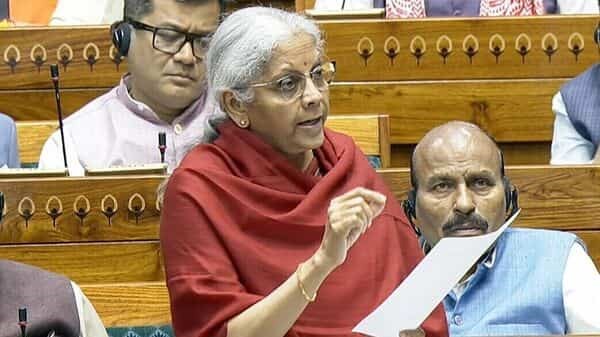
New Delhi: The new Income-Tax (I-T) Bill, announced by Finance Minister Nirmala Sitharaman during her Budget speech on February 1, is likely to be tabled in the Lok Sabha on Thursday, as per reports.
The New Income Tax Bill will span over 622 pages and aims to replace the 60-year-old Income Tax Act of 1961. Once passed, the proposed legislation will be called the Income Tax Act, 2025, and is expected to take effect in April 2026.
Approved by the Union Cabinet on February 7, and after it is passed by the Lok Sabha, the bill will be sent to the Parliament’s Standing Committee on Finance for further discussions.
Speaking to the media on February 8, Sitharaman said: “…the New Income Tax proposal, I hope to have it introduced in the Lok Sabha in the coming week. Post that it will go to a committee. The bill will again go to the Cabinet after the parliamentary committee gives its recommendations on it. After Cabinet approval, it will again be introduced in Parliament. I still have three critical stages to pass through.”
The new I-T Bill 2025 or new direct tax code is part of a larger effort to reform the India’s tax system. It aims to overhaul the existing tax structure to make it more streamlined and transparent.
FM Sitharaman first announced a comprehensive review of the Income-Tax Act, 1961 in the July 2024 Budget.
The CBDT had set up an internal committee to oversee the review and make the Act concise, clear, and easy to understand.
The aim was also to reduce disputes, litigations, and provide greater tax certainty to taxpayers.
To this end, 22 specialised sub-committees have been established to review the various aspects of the I-T Act.
The new income tax bill has been introduced to replace nearly 60-year-old Income Tax Act, 1961. The proposed bill will include simplified language to benefit taxpayers and may reduce the number of sections by 25-30 per cent in an effort to simplify tax rules and its clauses.
Long term capital gain (LTCG) and short term capital gains (STCG) remain the same as they were introduced the last year.
There were earlier speculations that the scope of tax audit would be extended to include CS and CMA as well. But the section Sec 515 (3)(b) mentions that the accountant means chartered accountant. This has apparently given a sigh of relief to the CA community.
Public inputs and suggestions were invited in four categories: simplification of language, litigation reduction, compliance reduction, and redundant/obsolete provisions.
The income tax department has received 6,500 suggestions from stakeholders on review of the Income Tax Act.
As per new law, the CBDT can now frame tax administration rules, introduce compliance measures, and enforce digital tax monitoring systems without requiring frequent legislative amendments as per the Clause 533.
“This increase in sections reflects a more structured approach to tax administration, incorporating modern compliance mechanisms, digital governance, and streamlined provisions for businesses and individuals. The new law introduces 16 schedules and 23 chapters,” AMRG & Associates Senior Partner Rajat Mohan told news agency.
“A key departure from the Income-Tax Act, 1961, is that previously, the Income Tax Department had to approach Parliament for various procedural matters, tax schemes, and compliance frameworks. Now, CBDT has been empowered to introduce such schemes independently, significantly reducing bureaucratic delays and making tax governance more dynamic,” he added.