
PM Narendra Modi’s firm resolve to counter terrorism is being reciprocated
By T N Ashok
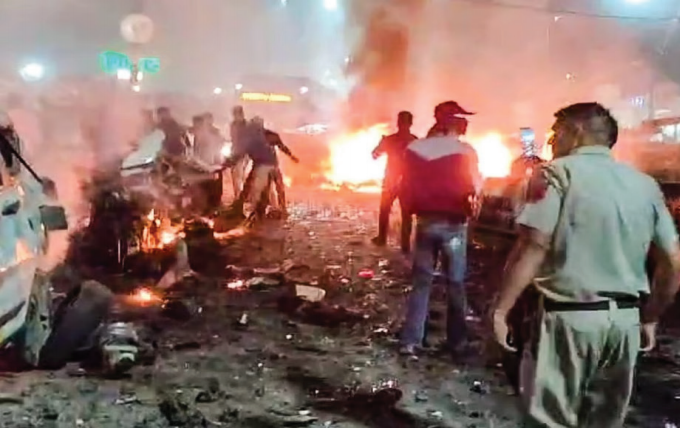
The air around Delhi’s Red Fort was thick with smoke and confusion on the evening of November 10, 2025. Sirens wailed as ambulances pushed through the crowded lanes of Old Delhi, their flashing lights reflecting off the centuries-old sandstone walls. Vendors abandoned their stalls, tourists scattered in panic, and locals stood frozen, staring at the charred remains of a car that had exploded near the Metro station. Within minutes, the city’s heartbeat shifted from routine bustle to stunned silence.
Eyewitnesses described a deafening boom that shattered the calm of the evening. “It felt like the ground shook,” said Ramesh Kumar, a shopkeeper near Chandni Chowk. “People screamed, some fell, and there was fire everywhere.”
Twelve lives were lost, more than twenty injured, and countless shaken. For Delhi, the blast was not just another tragedy—it was a strike at the symbolic heart of India’s history, a site where independence was first proclaimed and where millions gather each year to hear the Prime Minister’s address.
Within hours, Prime Minister Narendra Modi convened the Cabinet Committee on Security. The National Investigation Agency (NIA) took charge, registering cases under the Unlawful Activities (Prevention) Act. Forensic teams combed through debris, searching for traces of the explosive compound.
Police raided Al Falah University in Faridabad, reportedly linked to individuals under suspicion. Intelligence officials debated whether the blast was an accidental detonation or a deliberate act of terror. The car’s placement—parked deliberately near a crowded metro hub—suggested intent. For three hours the stationary car went unnoticed by the local police.
Families of the deceased were promised ₹10 lakh in compensation, but grief outweighed financial relief. “No amount can bring back my son,” said one father outside a government run LokNayak Hospital, clutching a blood-stained shirt.
The blast reverberated far beyond Delhi’s walls. Condolences poured in from capitals across the world, each shaped by its own history with terror and its diplomatic ties to India.
United States: Washington condemned the attack, urging vigilance and offering intelligence cooperation. The U.S. Embassy in Delhi advised citizens to avoid the Red Fort area.
United Kingdom: London’s statement carried echoes of its own experiences with urban terror, stressing solidarity and shared vulnerability.
France: Paris framed the blast as an attack on cultural heritage, aligning with India’s call to protect historic sites.
Russia: Moscow emphasized global unity against terrorism, weaving the incident into its broader narrative of multilateral security.
Iran: Tehran’s response was measured, focusing on humanitarian sympathy rather than political undertones.
European Union: Brussels highlighted the symbolic nature of the Red Fort, calling the blast “an assault on humanity’s shared heritage.”
Asia-Pacific: Japan expressed condolences and stressed international collaboration. Australia issued travel advisories, underscoring safety concerns. China offered sympathy but avoided strong language, reflecting strained ties with India.
Southeast Asia: Singapore condemned the attack, linking it to broader urban terror risks. Indonesia and Malaysia expressed solidarity, mindful of extremist networks in their own region.
The responses revealed subtle geopolitical patterns: Western nations emphasized counterterrorism cooperation. Russia and Iran framed their condolences within calls for global unity. APEC countries balanced sympathy with practical advisories. Southeast Asia focused on shared regional vulnerabilities. The blast became more than a local tragedy—it was a reminder of terrorism’s global resonance.
India’s intelligence agencies are piecing together fragments of evidence. Early reports suggest the car was parked hours before the blast, raising suspicions of a sleeper cell. Investigators are probing whether the suspects had links to organized networks or acted independently. Forensic labs are analyzing chemical residues to identify the explosive compound. “We are narrowing down possibilities,” said an NIA official, hinting at progress but withholding details.
Beyond geopolitics and intelligence reports, the blast left scars on ordinary lives. A young tourist from Kerala, injured in the explosion, recalled the moment: “I saw fire, people running, and I thought I would die.” For Delhiites, the Red Fort is not just a monument—it is memory, pride, and identity. To see it shrouded in smoke was to feel history itself under attack.
The government faces a dual challenge: Immediate security: Preventing further attacks, reassuring citizens, and tightening surveillance. Long-term reforms: Strengthening intelligence coordination, addressing vulnerabilities in crowded urban hubs, and ensuring heritage sites are protected. The Red Fort blast is a test of resilience—for India and for the world. It reminds us that terrorism is not confined by borders, and that solidarity must be more than words.
As the smoke cleared from Delhi’s skies, the world’s messages of grief and solidarity echoed across continents. Yet for those who lost loved ones, the silence that followed was heavier than any statement. The Red Fort stands still, scarred but unbroken—a symbol of India’s endurance in the face of violence. (IPA Service)


