Ashu Kumar
Jammu Tawi, Jan 24
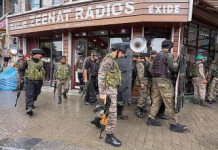
The Jammu Municipal Corporation’s ongoing anti-encroachment drive, launched in the run-up to Republic Day, has brought temporary relief to the city’s traffic-weary residents. Illegal roadside rehris, kiosks, and shops erected on public land are being removed in several areas, easing congestion and restoring road space that had long been choked by unauthorised structures.
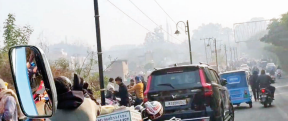
For years, unchecked encroachments on roads and footpaths have been a major contributor to Jammu’s worsening traffic situation. Narrowed carriageways, blocked pedestrian paths, and haphazard roadside markets have turned routine travel into a daily struggle for commuters. In this context, the present drive has been welcomed as a much-needed corrective step.
However, even as the operation continues, it has triggered a broader debate over selective enforcement and the absence of a uniform policy across the city.
Relief in Some Areas, Silence in Others
While JMC teams have acted swiftly in several localities, residents allege that major encroachment-prone zones remain untouched. Particular concern has been raised about Bahu Fort Bridge and Gujjar Nagar Bridge, where footpaths have reportedly been occupied for months by roadside vendors, forcing pedestrians onto busy roads and creating daily traffic bottlenecks.
Locals say that despite repeated complaints, enforcement has either been minimal or absent in these areas. “If footpaths are blocked, accidents become inevitable,” said a resident of the area. “Removing encroachments from one part of the city while ignoring others defeats the purpose”
Burma Colony and the Issue of Long-Standing Encroachments
The debate has also drawn attention to Burma Colony and adjoining settlements, often cited by residents as examples of long-standing illegal constructions that were allowed to grow unchecked over the years. Critics argue that early administrative inaction enabled unauthorised colonies and markets to expand, making corrective action more complex today.
Urban planners point out that encroachments become politically and socially sensitive when they are allowed to persist for long periods. “What begins as a temporary arrangement slowly turns permanent due to official neglect,” said a former civic official. “Timely enforcement could have prevented the present situation.”
‘Kashmiri Market’ Controversy Adds to Tensions
Another sensitive issue is the emergence of what locals refer to as ‘Kashmiri Market’ clusters, particularly near Gujjar Nagar Bridge. Vendors operating in these zones are accused of occupying public land and footpaths, further worsening traffic congestion.
While authorities have not officially categorised these markets, residents insist that the law must be applied uniformly, without regard to identity or origin. “Encroachment is a civic issue, not a regional one,” said a local trader. “The same rules should apply to everyone.”
JMC’s Position
Officials of the Jammu Municipal Corporation maintain that the drive is being carried out strictly in accordance with municipal laws and will continue in phases. They argue that large-scale settlements require coordination with multiple departments, which can delay action.
However, critics counter that delays erode public trust and strengthen the perception of selective governance.
Demand for a Permanent, City-Wide Policy
Citizens and civic groups are now calling for a consistent, long-term anti-encroachment policy rather than sporadic drives linked to national events. They stress that public roads and footpaths belong to citizens and must remain accessible at all times.
Many have also suggested that enforcement should be accompanied by rehabilitation measures for genuine vendors, ensuring that livelihood concerns are addressed without compromising civic order.
Beyond Republic Day
As Republic Day approaches, the anti-encroachment drive has become more than a cleanliness initiative—it has emerged as a test of administrative fairness. Residents say that only sustained, impartial enforcement across all areas will restore confidence in civic governance.
For Jammu, the message is clear: traffic relief and urban order cannot be selective; they must be universal.