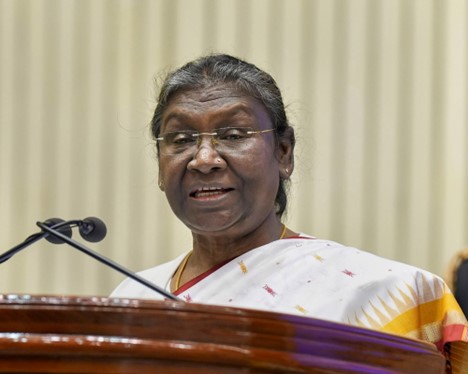
New Delhi, Dec 10: President Droupadi Murmu emphasized on Tuesday that the increasing role of Artificial Intelligence (AI) in daily life raises new challenges for human rights, as the “culprit” of rights violations could be a non-human, intelligent agent. Addressing an event hosted by the National Human Rights Commission (NHRC) to mark Human Rights Day, the President highlighted AI, cyber-crimes, and climate change as emerging threats to human rights.
In her speech, President Murmu noted that the traditional human rights discourse has always centered on “human agency,” where the violator is assumed to be a human being with emotions such as compassion and guilt. However, with the rise of AI, the perpetrator could now be an intelligent non-human entity. She invited the audience to ponder this evolving issue.
Human Rights Day, observed annually on December 10, commemorates the Universal Declaration of Human Rights (UDHR) adopted by the United Nations General Assembly in 1948, which serves as a global benchmark for human rights protection.
“As we progress into the future, we are confronted with emerging challenges,” Murmu said, referring to cyber crimes and climate change as new and growing threats to human rights. The President specifically pointed out the complex issues arising from the digital era, such as cyberbullying, deep fakes, privacy violations, and the spread of misinformation. She stressed the importance of creating a safe, secure, and equitable digital environment to protect individual rights and dignity.
President Murmu also discussed the broader implications of climate change on global human rights, urging a review of human rights frameworks in light of environmental challenges.
“The digital era, while transformative, has brought with it new and complex issues,” the President said, underscoring the need for responses that address both the technological advancements and the environmental crises affecting human rights worldwide.