Just over 2026 Festival vindicated the expertise of National Capital
By T N Ashok
After two decades of cultural exile, India’s capital has wrestled its international film festival back from Goa — and in doing so, made an argument about what serious cinema requires of a city.
For seventy years, the story of India’s great international film festival has been, at its core, a story about political will. When Jawaharlal Nehru inaugurated the first International Film Festival of India in New Delhi on February 21, 1952 — welcoming 23 countries, 40 feature films, and a deeply suspicious Frank Capra, convinced the whole affair was a communist conspiracy — he was making a declaration of civilisational ambition.
A country barely five years independent was opening its windows, in Nehru’s own words, to the best the world had to offer.
For half a century, Delhi was the undisputed centre of that ambition. It was in the capital that Satyajit Ray chaired the 1965 edition that earned the festival its FIAPF ‘A’ category accreditation, placing India’s film festival alongside Cannes, Berlin, and Venice. It was in Delhi that the Silver Peacock awards — for best actor, actress, and director — were first presented in 1977. Through coalition governments, economic crises, and thirteen Prime Ministers, Delhi held the festival with varying degrees of enthusiasm but consistent institutional seriousness.
Then, in 2004, it ended. The Manmohan Singh government shifted the International Film Festival of India permanently to Goa, citing administrative convenience and tourism potential. What nobody said openly, though everyone in Delhi’s cultural community understood, was the simpler calculation: Goa’s beach scenery, Portuguese-heritage architecture, and congenial winter climate made for better international optics than cold, bureaucratically austere November Delhi.
It was, by any measure, a Faustian bargain. IFFI gained permanence and a scenic backdrop. It lost its political seriousness — and Delhi lost something harder to quantify: its identity as a city that took the cinema of the world seriously.
For twenty years, the capital lived with the consequences. Unlike Mumbai, where the parallel cinema tradition runs from Shyam Benegal through the indie boom of the 2010s; unlike Chennai, with its deep film club culture; unlike Bengaluru, which has nurtured Kannada auteur cinema into economic viability — Delhi built no equivalent ecosystem.
A city of twenty million people, seat of national government, home to India’s most internationally exposed professional class, and it had no film societies of consequence, no infrastructure for sustained cinematic education, no institutional memory of what it means to watch and argue about serious cinema year after year.
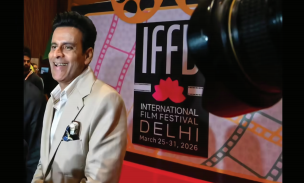
The 26th edition of the International Film Festival of Delhi — IFFD 26, staged in early 2026 under the Delhi BJP government of Chief Minister Rekha Gupta, with Tourism Minister Kapil Mishra as its political champion — represents an attempt to fill that structural absence. Whatever the political motivations, and Indian festival politics are rarely free of them, the initiative constitutes something more consequential than a cultural event: an act of civic repair.
The curatorial ambition was immediately apparent in the selection. Where Goa’s programming has long been padded by holidaymakers and under-attended retrospectives, IFFD 26 placed regional Indian new wave cinema at its moral centre.
The festival’s defining selection was Hemanth M. Rao’s Kannada two-part epic Sapta Sagaradaache Ello — Somewhere Beyond the Seven Seas — a four-hour study in the grinding arithmetic of circumstance, in which a man’s decade in prison for a crime committed by his wealthy employer returns him to a city where the woman he loved has built another life. Produced by Rakshit Shetty, who along with director Rishab Shetty has built around coastal Karnataka’s cultural specificity something more durable than a franchise — a movement — the film received the kind of platform in Delhi that Goa’s tourism-inflected programming rarely affords serious auteur work.
Alongside it, Maa, a Punjabi film anchored by Divya Dutta’s quietly devastating performance, presented a matriarch holding a fractured household together against economic despair with an unflinching attention that mainstream cinema cannot afford because it would make its audience too uncomfortable.
Dutta herself has compared the film to a modern retelling of the immortal Mother India. And Anthony Chen’s Ilo Ilo — Singapore’s first Palme d’Or nomination, set during the 1997 Asian financial crisis, tracking the complicated love that forms across class boundaries between a Filipino domestic worker and the troubled young son of her Singaporean employers — arrived as the festival’s most formally accomplished selection, demonstrating that world-class cinema requires not scale but rigour, honesty, and patience.
These are not art-house films in the pejorative sense. They are power cinema — made with discipline, rooted in social reality, received by their home audiences with the enthusiasm commercial blockbusters consider their birthright. That Delhi audiences saw them in a government-backed festival setting, rather than on streaming platforms or not at all, is itself a small act of cultural restitution.
The closing ceremony on March 31, 2026 — graced by Lieutenant Governor Taranjit Sandhu and Chief Minister Gupta — marked the formal conclusion of what was, by honest assessment, a festival of genuine promise imperfectly executed. Screenings were unevenly attended. The educated, internationally exposed Delhi audience proved less prepared for sustained engagement with subtitled regional cinema than the programming assumed.
The absence of a film club culture — the slow, cumulative cinematic education that Bengaluru or Thiruvananthapuram audiences have received over generations — was impossible to ignore.
There is an argument, not entirely cynical, that these shortcomings reflect failures not of intent but of ecosystem. A city government cannot manufacture in one edition what Berlin’s Berlinale or Cannes built across seven decades. The global festival circuit is a slow accumulation of curatorial trust, filmmaker relationships, and audience habit.
What Delhi possesses that Goa never will is political seriousness — and in 2026, that political seriousness extends further than the state government. Prime Minister Narendra Modi’s cultural diplomacy has made Indian soft power a genuine instrument of foreign policy. External Affairs Minister S. Jaishankar has made India’s global conversations sharper and more confident than they have been in a generation.
An internationally ambitious film festival in the national capital, connecting regional Indian new wave cinema to the global circuit, is not merely a cultural aspiration. It is a foreign policy instrument hiding in plain sight.
The prescription for IFFD 27 is clear: fewer films, better-prepared audiences, retrospectives that contextualise rather than showcase, and a dedicated section for new wave regional Indian cinema — Kannada, Malayalam, Marathi, Punjabi, Tamil, Assamese — programmed with the seriousness that Hemanth M. Rao’s work deserves.
Above all, the festival must invest, as seriously as it invests in film programming, in the infrastructure of cinematic education: film society workshops, school and college screening programmes, the slow cultivation of an audience that returns year after year until cinema becomes a habit and not an occasion.
The Jaipur Literature Festival demonstrated that Indian cities can build serious cultural audiences when the programming is sustained, the curatorial voice consistent, and the institutional commitment runs across years rather than editions. MAMI in Mumbai, the Chennai International Film Festival, and the Bengaluru film ecosystem have each made the same argument, in their own idioms.
Delhi has the political will. It has the physical infrastructure. What it built at IFFD 26 was a beginning — provisional, imperfect, and twenty years overdue.
The films shown made the case clearly enough. The Kannada heartbreak of Sapta Sagaradaache Ello, the Punjabi domestic intensity of Maa, the Singaporean moral precision of Ilo Ilo — together they argued, beautifully and without sentimentality, for why the wait was too long. IFFD 27 must now make the case that it will not happen again. (IPA Service)