
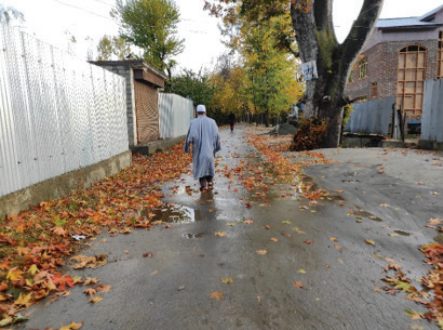
By Kamran Hamid Bhat
I stood long before the mirror, watching the uneven flush on my face under the autumn sun. My mother, tired of my silent staring, finally asked, almost in a cry, “What has happened to you? Ever since you returned from Bangalore, you have been spying on your own image like thieves. What troubles you so much?”
“Mother,” I answered meekly, “half my face seems burnt under the eyes of this November sun.”
She replied without surprise, as one who had long known the world’s ways. “Such a November sun,” she said, “racks the velvet leaves from their trees, leaves them half-burned, scattered like ashes upon the same ground that will one day bury them. If the sun does this to leaves, what value does a face of clay hold before it?”
Her words spread through the room like cold mist. Outside, the season seemed to echo her truth. A sharp draft cut through the window and sliced my body in fragments. “Mother,” I asked, “is not autumn the poets’ favourite season?”
“Yes, Ruh,” she said gently. “For only poets can be seduced by the agony of parting. Without distance, pain, longing, and the wounds that turn our hearts into a sieve, nothing flows onto pages. This loneliness is fatal — but fertile, too.”
“And this sun,” I asked, “the sun that burns everything… does it also tell stories? It feels like a fairy tale written on desperate occasions.”
She looked out the window. “We cannot escape this world — not from our enemies, nor from those who pretend to love us but poison us more than hatred can. People have grown greedy and passionless. No season can hide that.”
Her words lingered like fog on the Chinar trees. The November sun lay low, its long shadows sweeping the wooden floor like tired fingers trying to grasp something they never could. My hand rested on the cold glass, though the sun’s warmth still clung to my cheek.
“So tell me about Bangalore,” she said, her voice quiet, as though fire should be whispered about.
My eyes shut on their own, and the memories poured like rain through a broken roof. Bright lamps turning my skin ghost-white. The acid attack — meant for someone else, yet touching me. The splash on my left cheek as I tried to shield a stranger from her enemy’s rage. Doctors called it partial-thickness damage. My mother called it the signature of the November sun.
“It wasn’t the sun,” I whispered. “It was a misunderstanding. But when the acid struck, I felt as though the sun itself reached down and wrote on my face.”
My mother came closer, her hands rough from kneading dough, tending roses, surviving life. “Child,” she said, “the November sun does not discriminate. It burns guilty and innocent. It turns grapes to wine and leaves to gold. It is the great equalizer.”
“But why?” I burst out, like a trapped bird breaking from its cage. “Why must beauty be destroyed?”
She stayed silent for a long time. Outside, a Chinar leaf floated down slowly, landing on frost-bitten grass with a surrender that felt ancient. At last she spoke:
“Remember the silkworms? How they wrapped themselves in their own threads until they disappeared? Then came the waiting. The dark waiting.”
I nodded, remembering my childhood wonder — running my tiny fingers over the golden cocoons.
“The metamorphosis demands dissolution,” she continued. “The caterpillar cannot remain itself and become a butterfly. It must die first. Become liquid potential. Only then can something new be born.”
“But I did not choose this,” I whispered, tracing the pale patch on my cheek. “I didn’t choose to be burned.”
“Nor does the leaf choose to fall,” she said softly. “Nor the silkworm to be boiled for its thread. The November sun asks no permission. It simply is.”
I turned to her, and noticed the ancient rivers of fine lines across her face. “Ammi,” I asked, “did you ever feel beautiful? Before the world told you otherwise?”
She laughed, like wind chimes stirred by a soft breeze. “Beauty is not owned,” she said. “It is witnessed. I saw it in the way your father looked at me from across a crowded room, in the way you danced in the rain without shame, in the way this sun transforms what it touches.”
“Even scars?” I asked.
“In particular, scars,” she replied. “A scar is a story that refuses to be forgotten. The November sun writes such stories on leaves, on skin, on hearts. The question is not whether we are marked, but what story we choose to tell with our markings.”
I returned to the mirror. Now I saw not just the white patch, but the whole of me — the dark eyes, the cheekbones like mountain ridges at sunset, lips carved by words such as survive and transform. Under the harsh light, I finally saw what I had not seen in weeks: the scar was not stealing beauty; it was deepening it.
The sun began to set, burning the sky in shades of copper and bronze. I spoke quietly, “We formed an organization. Not for victims, but for survivors. We learn skills, provide legal help, but most of all, we are teaching that beauty is not the absence of hurt. Beauty is what we make from our hurt.”
My mother nodded. “Then you must go,” she said. “Teach others what the November sun has taught you. Show them that a half-scalded face can still love, laugh, and lead. Scars are not curses; they are proof that the sun touched us — and we lived.”
As the sun vanished behind the mountains, I finally understood what she had always known: the same sun that destroys also gives life. The same November that strips trees bare prepares them for spring. And this scar — my scar — does not hide me. It reveals me.
“Ammi,” I said softly, “I am done with the mirror.”
She smiled the smile of every mother who has seen her child through the un-survivable. “Good,” she said. “The world needs more people who can see beauty in what the November sun has kissed. To be burned is not to be broken — but to be changed.”
Outside, the sun had set, yet its tale lingered in the frost on the windows, the bare branches drawing calligraphy against the sky, and in the mark on my cheek like a signature at the bottom of a masterpiece. Tomorrow, the sun would rise again — harsh and necessary — writing new stories on every surface it touched.
And I would read them. I would teach others to read them. I would show them that to be branded by the November sun is not to be cursed but to be chosen: chosen to turn damage into beauty, ash into art, and what was broken into something fiercely whole.
I touched my scar once more, not with shame, but with reverence. The story was only beginning. And I, along with all who had been burned and transformed, would learn to read the handwriting of the sun — and in its fierce lessons, discover the promise of spring.


