Most diverse toolkit for financing insurgency and terror in South Asia
By Salah Uddin Shoaib Choudhury
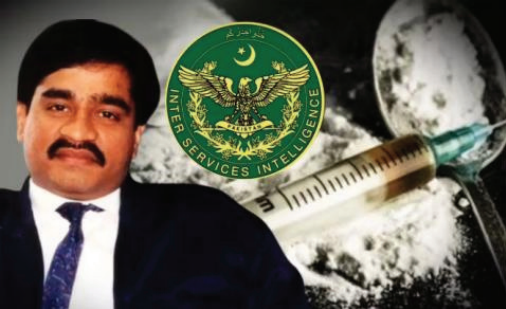
For decades a shadow economy of drugs, counterfeit currency and illicit cash flows has threaded its way across South Asia, North Africa and beyond. What makes this underground economy especially dangerous is not only its scale but the way statecraft, organized crime and violent Islamist militancy appear to intersect – creating a self-reinforcing funding loop for groups that seek to destabilize societies and export terror. At the centre of recent concerns are two names often linked – Pakistan’s Inter-Services Intelligence (ISI) and India’s most notorious fugitive, Dawood Ibrahim. Together, analysts and media reports say, they help sustain a transnational “narco-jihad” aimed as much at financing jihadi networks as at undermining rival states.
The modern toolkit for financing insurgency and terror is diverse: heroin and cocaine profits, protection rackets and extortion, hawala transfers, counterfeit notes and smuggling corridors. Where these revenue sources meet disciplined criminal networks and permissive or complicit institutions, the result is an extremely resilient terror economy. Observers say narcotics trafficking -sometimes routed through criminal outfits with political protection – has long been a major revenue stream used to arm, train and sustain militants across multiple theatres.
The pattern is simple and frighteningly effective. Farmers or traffickers produce or source drugs; organized groups refine, move and launder the proceeds; militant cells take a cut for protection and logistics; corrupt officials, brokers and false-front businesses recycle the money back into operations. When one finds links running between a state’s security apparatus, an organized crime syndicate and jihadi organizations, the possibilities for both funding and strategic deniability multiply.
Dawood Ibrahim – long linked in open-source reporting to organized crime, extortion rackets and alleged support for violent extremist activity – heads a network (frequently referred to as “D-Company”) that has been tied to smuggling and trafficking routes spanning South Asia, the Middle East and parts of Africa. Investigations and long-running coverage by security analysts indicate D-Company’s role in narcotics and other illicit trades has helped it build logistical reach that can be exploited by militant elements.
There are also reported intersections between D-Company’s global crime contacts and Islamist militants in Africa and West Asia. Indian media coverage from 2014, for example, cited concerns in security circles about emerging links between Nigerian militant networks and elements of Dawood’s organization for smuggling and distribution routes into India. These connections, if true, demonstrate how criminal and extremist groups can mirror each other’s networks to mutual advantage.
Indian and international intelligence agencies have repeatedly linked D-Company’s drug profits to terrorist financing, including Lashkar-e-Taiba and Jaish-e-Mohammed. Dawood’s younger brother, Anees Ibrahim, reportedly established contacts with extremist commanders in Africa and West Asia, enabling D-Company to utilize Boko Haram and Al Qaeda networks to move cocaine and heroin. Nigerian couriers were initially used to smuggle narcotics into India before local collaborators took over distribution.
Several extremist organizations have long used criminal revenue streams to fund operations: from conventional smuggling to drug production, and from hawala networks to extortion. In parts of Africa, jihadi groups and criminal syndicates have reportedly moved cocaine and other drugs along routes that ultimately reach Asian and European markets, often with local and regional facilitation. Similarly, the “southern route” for Afghan heroin – which flows through Pakistan and Iran toward Gulf and European markets – remains a key artery in the narcotics economy despite periodic interdictions and policy shifts.
UN agencies report that, while global opium production has seen major swings since the Taliban’s 2022 ban, cultivation in some years has rebounded in new forms and localities, keeping pressure on transit states and widening the reach for smugglers.
Meanwhile, porous borders in South and Southeast Asia – and criminal links into Myanmar and the Golden Triangle – have made India’s northeastern states and coastal hubs attractive for traffickers seeking alternative transit corridors. Analysts warn that as enforcement tightens in older routes, criminal networks adapt, shifting trade to weaker-policed borderlands and urban distribution nodes.
Perhaps the most troubling allegation is not that criminals and militants trade with one another – that has long been documented worldwide – but that elements within Pakistan’s state security apparatus may either tolerate or actively facilitate parts of the system for strategic objectives. Historical reporting and some insider claims have suggested that, at various times, Pakistan’s establishment viewed narcotics profits as a possible source to underwrite covert operations. Whether this is formal policy or the work of “rogue” networks embedded within the institutions, the operational effect is similar: an expanded, semi-protected hinterland for illicit finance.
These allegations are highly sensitive and politically charged. International bodies and watchdogs have repeatedly emphasized the need for robust, transparent financial controls precisely because permissive environments allow malign actors to exploit grey areas. Pakistan’s removal from the Financial Action Task Force (FATF) grey list in October 2022 did not, experts warned, mean the underlying vulnerabilities vanished – rather, it made continued vigilance even more important.
Beyond drugs, counterfeit currency and forgery can be used as tools of economic sabotage. Incidents of near-perfect Fake Indian Currency Notes (FICN) seizures in the region over recent years have raised alarms about networks that manufacture and move counterfeit notes to destabilize neighbouring economies or to fund black-market operations. When such operations are tied into smuggling chains that also carry narcotics and contraband, the criminal economy becomes a multi-headed threat that is hard to starve without coordinated regional action. (IPA Service)
Courtesy: Arabian Post