
New Delhi has to take note of emerging Nuclear scenario in Asian continent
By Girish Linganna
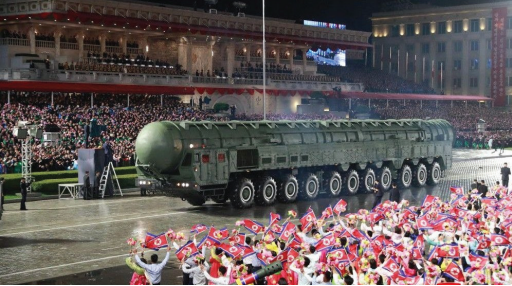
In the heart of Pyongyang, under the bright lights of Kim Il Sung Square, North Korea unveiled what it calls “the world’s most powerful nuclear weapon” — the Hwasong-20 intercontinental ballistic missile. The timing was no accident. As U.S. warplanes and aircraft carriers patrolled nearby waters, Kim Jong Un stood beside his daughter and top military officials, sending a message that echoed far beyond the Korean Peninsula: North Korea is no longer just a regional threat. It is now a global nuclear power.
The Hwasong-20 represents a quantum leap in North Korea’s missile technology. At first glance, it may look similar to its predecessor, the Hwasong-17, but inside it has been completely redesigned. With a range of approximately 15,000 kilometres, it can reach any major American city — from New York to Los Angeles — matching the reach of China’s formidable DF-41, one of the world’s most powerful intercontinental ballistic missiles. This means Pyongyang now has the ability to strike deep inside the United States, fundamentally changing the balance of power in Asia and beyond.
The technical specifications are staggering. The Hwasong-20’s solid-fuel engine produces about 200 tons of thrust, which is roughly 40 percent stronger than the Hwasong-18 tested in 2023. This massive power boost translates into better mobility, faster launch times, and higher survival rates in combat situations. The missile can carry a payload of 80 to 100 tons, meaning it can hold multiple nuclear warheads or one extremely powerful bomb. Intelligence suggests it is MIRV-capable, able to deploy three to five warheads that can hit different targets simultaneously. This makes it nearly impossible for even the most advanced missile defense systems — including America’s THAAD, Aegis, and GMD — to intercept all incoming warheads at once.
To understand the Hwasong-20’s significance, we must compare it with the world’s elite nuclear missiles. America’s Minuteman III, operational since 1970, has a range of about 13,000 kilometres and carries up to three warheads, but it is launched from fixed underground silos, making it vulnerable to preemptive strikes. Russia’s RS-24 Yars, in service since 2010, has a 12,000-kilometer range and carries up to four warheads, with the flexibility of mobile or silo-based launches. China’s DF-41, operational since 2019, matches the Hwasong-20’s 15,000-kilometer range but can carry up to ten warheads, representing the peak of Chinese missile technology.
What makes the Hwasong-20 particularly dangerous is its deployment system. It uses massive road-mobile Transporter Erector Launcher vehicles — possibly with 11 axles — allowing it to be hidden in tunnels, moved through mountains, and launched from unpredictable locations. Unlike older liquid-fuel missiles that take hours to prepare and are easy to detect, solid-fuel missiles can be launched within minutes. This mobility makes them almost impossible to track or destroy before they are fired, giving North Korea a significant tactical advantage that rivals even American and Russian capabilities. Satellite images from Maxar and Planet Labs confirm that North Korea has expanded its defense factories in Pyongyang and Chagang Province since 2023, investing heavily in solid-fuel production and testing heat shields that protect warheads during atmospheric reentry — critical technologies that only a handful of nations have mastered.
But the Hwasong-20 is more than just a technical achievement. It is a political statement. Kim Jong Un is telling the world that despite decades of sanctions, international isolation, and economic hardship, North Korea has not only survived but thrived militarily. The presence of Chinese Premier Li Qiang, Russian Deputy Prime Minister Dmitry Medvedev, and Vietnamese President To Lam at the military parade was no coincidence. It showed that North Korea is no longer alone. It has powerful friends who are willing to shield it from Western pressure and possibly even help it develop more advanced weapons.
Russia’s growing cooperation with North Korea is especially troubling. Reports suggest Moscow may be sharing critical technology in solid-fuel engines and miniaturized nuclear warheads in exchange for North Korean ammunition and troops for the war in Ukraine. If true, this would be one of the most serious violations of UN sanctions in recent history and a clear sign that the old rules of nuclear non-proliferation are breaking down.
The Asian nuclear landscape is rapidly changing. What experts now call the “Asian Nuclear Triangle” — made up of China, India, and North Korea — is pushing the region into a dangerous arms race. Japan and South Korea, once content to rely on American protection, are now rethinking their defense strategies. South Korea is openly discussing nuclear sharing arrangements, while Japan is debating whether to develop its own long-range strike capabilities. The era of U.S. nuclear dominance in Asia is ending, and what comes next is uncertain and deeply unstable.
North Korea’s nuclear policy has also become more aggressive. It has shifted from a defensive posture to what experts call “preemptive deterrence” — meaning it reserves the right to strike first if it feels threatened. This makes the situation far more dangerous because it lowers the threshold for nuclear use. Even a small misunderstanding or miscalculation during a crisis could spiral into a nuclear conflict.
Yet, despite all this military progress, North Korea’s people continue to suffer. The regime is pouring billions into missile programs while its citizens face food shortages and power cuts. This military-first policy, known as Songun, has been North Korea’s guiding principle for decades. It funds its weapons through illegal trade, cryptocurrency theft, and secret deals with sympathetic nations. The Hwasong-20 is not just a missile — it is proof that North Korea can sustain its nuclear ambitions even under the tightest international economic pressure.
The global response has been predictably divided. The United States and its allies condemned the missile display and called for tougher sanctions. South Korea and Japan are strengthening their defenses and deepening military cooperation. But China and Russia defended North Korea’s right to self-defense, framing the missile launch as a legitimate response to American aggression. This divide reflects a larger shift in global politics — a world splitting into competing blocs, with Western powers on one side and a rising Eurasian axis on the other.
The collapse of major arms control agreements has only made things worse. The INF Treaty, which once banned certain types of missiles, is gone. The future of the New START treaty between the U.S. and Russia is uncertain. As old nuclear rules fade away, countries like North Korea and Iran are exploiting the vacuum, rewriting the meaning of nuclear stability in the 21st century.
For India, this should be a wake-up call. The rise of North Korea’s nuclear capabilities affects the entire Asian security architecture. If North Korea can challenge U.S. dominance in Northeast Asia, it emboldens other nations to pursue similar paths. The normalization of nuclear weapons as tools of statecraft is a dangerous trend that threatens not just regional peace but global stability.
The world now faces a choice. Either engage North Korea through difficult but necessary diplomacy, or prepare for an era of heightened military tensions and nuclear brinkmanship. The Hwasong-20 is not just a symbol of North Korea’s defiance. It is a warning that America’s era of uncontested global power is ending, giving way to a multipolar nuclear world filled with danger, competition, and uncertainty. How the world responds to this challenge will define the security landscape for decades to come.


