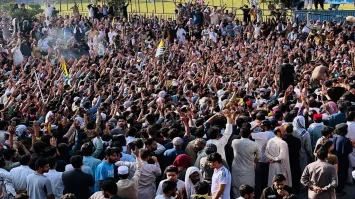
Islamabad, Oct 4: The Pakistan government and protesters in Pakistan-occupied Jammu and Kashmir (PoJK) reached a breakthrough late Friday night, signing a 25-point agreement that brought an end to nearly a week of violent demonstrations which left at least 10 people dead, including three policemen, and hundreds injured.
Agreement Ends Week of Unrest
The deal was announced by Federal Minister for Parliamentary Affairs **Tariq Fazal Chaudhry**, who posted on social media that “the negotiating delegation has signed the final agreement with the Action Committee… the protesters are returning to their homes. All roads have been reopened. This is a victory for peace.”
The settlement came after Prime Minister **Shehbaz Sharif** dispatched a high-powered delegation, led by former premier **Raja Pervaiz Ashraf**, to Muzaffarabad for two days of marathon talks with leaders of the **Jammu Kashmir Joint Awami Action Committee (JKJAAC)** – the main group steering the protests.
Background of the Violence
The unrest began on **September 29**, after negotiations between officials and the JKJAAC collapsed over a 38-point charter of demands. Protesters threatened mass mobilisation if demands were ignored, eventually taking to the streets in large numbers. Violent clashes with security forces soon erupted, with police vans torched, government offices attacked, and heavy baton charges reported.
By October 3, at least 10 people – including three police personnel – had lost their lives, while both civilians and hundreds of policemen were injured. A strict shutdown gripped PoJK for five consecutive days, with public transport paralysed and communication networks restricted, further fueling resentment among residents.
Key Provisions of the 25-Point Agreement
According to the agreement, the government and JKJAAC settled on several immediate and long-term measures:
* **Compensation**: Families of those killed will be compensated; cases of terrorism will be registered for violence resulting in deaths of civilians and police personnel.
* **Healthcare**: Implementation of health cards within 15 days for free treatment; MRI and CT scan machines to be provided phase-wise in every PoJK district.
* **Education**: Establishment of two new intermediate and secondary educational boards for Muzaffarabad and Poonch divisions.
* **Infrastructure**: PKR 10 billion allocated to improve PoJK’s fragile electricity system; feasibility studies for two tunnels on the Neelum Valley road at Kahori/Kamser (3.7 km) and Chaplani (0.6 km).
* **Governance Reforms**: Size of PoJK cabinet capped at 20 ministers/advisors; no more than 20 administrative secretaries; departmental mergers to cut costs.
* **Future Projects**: Federal government to take steps toward construction of an **international airport in Mirpur**.
* **Tax Reforms**: Property transfer taxes in PoJK to be aligned with Punjab and Khyber Pakhtunkhwa within three months.
* **Oversight**: A high-powered committee of legal and constitutional experts to deliberate on PoJK Assembly members’ issues; a monitoring and implementation body to track progress of the deal
Political and Social Reactions
While the government termed the deal a success, critics say the agreement reflects the depth of anger in PoJK, where residents have long accused Islamabad of neglect, inequitable taxation, crumbling infrastructure, and lack of political autonomy.
The JKJAAC hailed the agreement as “a step forward” but vowed to remain vigilant in holding authorities accountable for timely implementation.
For now, traffic and daily life in Muzaffarabad, Mirpur, and other districts are slowly resuming, but tensions remain high. Analysts warn that if promises are not implemented, unrest could resurface. The deal provides temporary relief, but whether it leads to long-term stability in Pakistan-occupied Jammu and Kashmir will depend on the government’s sincerity in delivering reforms and rebuilding trust with a disenchanted population. (Agencies)