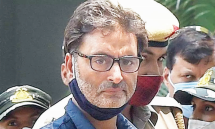
New Delhi, Sep 19: Kashmiri separatist leader Yasin Malik has claimed that he spent nearly three decades as part of a state-backed “backchannel” for peace in Jammu and Kashmir, engaging with successive prime ministers, intelligence chiefs, and business leaders.
In an 85-page affidavit before the Delhi High Court, Malik, chief of the banned Jammu and Kashmir Liberation Front (JKLF), detailed his journey from school days to his role in Kashmir’s political landscape. The affidavit comes after the National Investigation Agency (NIA) sought enhancement of his life sentence to the death penalty in a terror funding case.
Malik, lodged in Tihar Jail since 2019, alleged that the state is now attempting to “erase” this history of engagement. He said he had become a “sacrificial goat” despite decades of work to keep peace efforts alive.
According to him, after his release in 1994, he announced a unilateral ceasefire on assurances that pending cases against him would not be pursued. He claimed that successive prime ministers, including Narasimha Rao, Atal Bihari Vajpayee, I K Gujral, Manmohan Singh, and even Narendra Modi during his first term, honoured this understanding.
Malik recounted his involvement in Vajpayee’s 2000 Ramzan ceasefire initiative, saying he met Congress leaders, including Manmohan Singh, to secure opposition support for the move. He also claimed meetings with V P Singh, Gujral, and Left leaders to build consensus.
He said it was under a BJP government that he received his first passport, enabling visits to the US and UK. Malik recalled Manmohan Singh’s efforts to strengthen Vajpayee’s peace process, which drew BJP criticism, prompting him to write to Vajpayee crediting him for the initiative.
Malik alleged that his meeting with Lashkar-e-Taiba founder Hafiz Saeed happened at the instance of the Central government, which wanted him to reach out to militant leaders. He said his foreign visits and open engagements with such figures disproved charges of secret terror links.
Denying terror funding allegations, he insisted the NIA failed to provide evidence. He claimed he was “encouraged and deployed” by the state to sustain dialogue and cited secret meetings with Intelligence Bureau chiefs, home ministers, and even industrialist Dhirubhai Ambani.
He traced this relationship to the early 1990s, when he was taken from jail to meet then home minister Rajesh Pilot and IB officials on the instructions of Prime Minister P V Narasimha Rao. After this, he announced a ceasefire and pledged to pursue a democratic struggle.
Malik said this truce lasted 25 years until the 2019 abrogation of Article 370, after which fear, arrests, and revival of old cases followed. He lamented that his engagement with the state had been abruptly discarded.
Accepting his predicament, Malik wrote: “I understand the balance of scales isn’t tipped in my favour. Being a diehard romantic, I would accept it as the ultimate endgame of my fate, gleefully. If the state chooses to disengage and disassociate from me as it once engaged, I will accept it, with a smile.”