Britain is gainer as it’s products are having access to second largest market
By Anjan Roy
Writing in the years just before the Great War of 1914, the famous British economist, John Maynard Keynes, had gloated over the fact that without moving from his bed in London he was able to order the best things from around the world, including Indian tea.
The world had moved in the opposite direction in the years since and it had become almost impossible to order the best of goods because of tariff barriers and trade restrictions. Despite the spread of globalisation tariffs had stalled movement of goods between countries and they lowered the overall level of consumer satisfaction. Hopefully the reverse of that process has started.
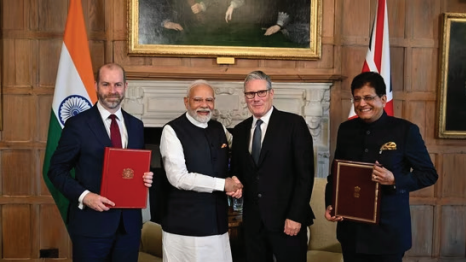
India and UK signed on July 24 what is commonly known as a free trade agreement (FTA). Ideally a free trade agreement could be extremely simple one liner — we hereby scrap all tariffs for movement of goods and services between our two countries.
In somewhat of a trade jargon, India will have duty free access for 99% of the tariff lines, covering almost most of its exports. Britain on the other hand will enjoy elimination or lowering of 90% of tariff lines covering 85% of exports.
Thus, to begin with British cars and whiskies would be cheaper for Indian buyers, while British consumers would be paying less on a variety of India items including marine foods, to processed foods and even pharmaceuticals.
In practice, a trade agreement is a much more complex. A free trade agreement provides for regulated entry of goods and services, which have finer details for every sector of the economy. The trade negotiators do their jobs extremely diligently seeking to protect their national interest while seeking maximum entry for their own products and goods.
Both sides are aware of the other’s trade diplomacy and only with respect for each other can a really effective and fair trade agreement could be concluded. It is hoped that the Indo-British trade agreement has done its job competently, as foreign minister S. Jaishankar had observed time and gain
Elementary, but economists have always maintained that trade between countries increases overall benefits. Trade takes places following the underlying principal of a country’s comparative advantages. It can presumably be accepted that a single country could not be good or best in everything it does.
It might be comparatively good in one, and less so in others. Classical economists had often used the model of trade between Britain and Portugal. While Britain was good in woollens, Portugal produced excellent port wine. So they traded manufactured woollens with port wine. One can multiply these many times for other pairs.
At least for the two countries, India and Britain, the former empire and the colonial master, have now entered into a trade agreement which frees up movements of most of the goods and services. On the preliminary estimates almost 99% of the traded value of have now been freed for tariff free entry or at least minimal tariff of 10%. In many cases, astronomical tariff rates would be pared down severely to make these affordable to consumers in the two countries.
On the face of it, the agreed trade agreement between UK and India should immediately provide greater access to certain products for each other. Thus, as of now, British cars —most frequently cited are Jaguar and Land Rovers— should have easier entry into the Indian market, while Indian teas and many other farm products shall have more advantage in the British markets given the tariff adjustments that should start immediately.
Given the dynamic of development of the two countries, the market composition and demands should be chaining and in future these changes would determine how each will gain and lose.
It is possible to imagine that given the faster growth rate of India and its rising affluence, the demand for luxury cars would be raising faster in India than demand for Indian teas or farm products in the UK. The fact is you cannot go consuming more teas and farm goods, than your overall demand for cars as a country grows in its overall income.
Surely for the future, Britain would gain lower tariffs for a range of goods the demand for which should be booming.
That does not mean India should lose. As it grows in economic heft, India’s manufacturing base and capacity should increase substantially in the future. Its manufacturing and value addition must be getting larger and more sophisticated, These should find comparatively easier entry into the British market of the future.
At the same time, it will always remain true that Britain has a run smaller market and in future it should be far smaller compared to India. It is this attraction of India’s future that most other nations, including America, is eyeing trade agreements with India.
It is the future economic prospects of India that is inhibiting even the mercurial Donald Trump from announcing large tariffs against India which might interfere with on-going trade negotiations with India. Hopefully, India will keep growing and a cynosure of the traders from all over the world as it was historically. (IPA Service)