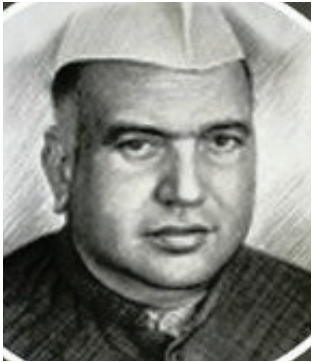
By Ravi Rohmetra
The Duggar land holds a rich and unique history, having produced eminent political leaders, academicians, social workers, and statesmen. Among them, Girdhari Lal Dogra stands tall as a legendary figure who worked selflessly for the people of Jammu and Kashmir. A friend, guide, and tireless social worker, he is remembered as one of Jammu’s most respected personalities.
His life was dedicated to sharing the joys and sorrows of the common people. Deeply committed to the upliftment of the underprivileged, his heart beat for those living below the poverty line. He never hesitated to face adversity if it meant alleviating someone else’s suffering. For him, service to humanity was service to God—a philosophy that earned him the love, respect, and admiration of the masses, who fondly remember him as a Godfather figure.
Girdhari Lal Dogra was born on 17th July 1915 in the village of Bhaiya, Tehsil Hiranagar, District Kathua, during the reign of Maharaja Pratap Singh. He completed his B.A. and L.L.B. from Punjab University, and it was during his student days that he developed a keen interest in politics. He came into contact with Shri Kichloo, a prominent Congress leader, and later became the editor of the weekly newspaper Kissan, published from Jammu, through which he highlighted the issues faced by farmers.
In 1947, during the Emergency Administration, he was appointed Officer-in-Charge of Administration in District Kathua, where he organized resistance against Pakistani-backed “Mujahids.” He also briefly practiced law before entering public service full-time.
Dogra became Finance Minister in Sheikh Mohammad Abdullah’s first cabinet in 1948, a position he held until 1957. He was also Chairman of the Constitution Drafting Committee, Member of the Finance Committee, and Member of the J&K University Council. Following political realignments and the emergence of the Democratic National Conference under G.M. Sadiq, he joined the new party and served as an opposition member in the Legislative Assembly.
From 1951 onwards, he continuously represented the Hiranagar constituency, never losing an election—a testament to the trust and love he enjoyed from the people. He again served as Finance Minister in 1960 and 1964, and was elected to the Lok Sabha in 1980 from the Jammu–Poonch constituency. His parliamentary career, ministerial accomplishments, and clean public life earned him immense respect.
He passed away on 27th November 1987, leaving behind a void in Jammu’s political landscape. He is survived by his wife and two daughters. Like every year, on 28th November, people pay tributes to Dogra Ji and remember his unwavering service to society.
His tenure as the Finance Minister of the state for longest period that remains unparallel. He introduced several landmark initiatives such as Mobile banking, Chenab Industries, and numerous reforms aimed at rural development. Recognizing his calibre,
Dogra Ji played a historic role in 1952 in transferring land ownership to tillers, significantly improving the lives of peasants and agricultural laborers. He also recognized tourism’s economic potential and introduced the concept of building tourist huts at major destinations.
A statue of Girdhari Lal Dogra was installed near the Police Headquarters on the road to Jammu Railway Station by the Girdhari Lal Dogra Memorial Trust and unveiled on 27th November 2011 by Dr. Farooq Abdullah, the then Chief Minister.
Dogra Ji was truly a “people’s man,” admired across political, religious, and social divides. He served as Finance Minister from 1957 to 1975, was elected to Parliament twice, and won five consecutive Assembly elections from Hiranagar. His contributions included providing drinking water to Kandi belt areas through tube wells, a system that still supports many regions in Jammu today.
He was a staunch secularist, a fighter against communal forces, and an epitome of simplicity and dedication. Throughout his life, he stood firmly by the poor and marginalized, becoming a real friend of the people and a symbol of integrity and humility. His ability to rise above personal gain and serve the public good remains a model for present-day politicians.
His son-in-law, Mr. Arun Jaitley, served as Cabinet Minister for Law and Shipping in the Atal Bihari Vajpayee Government, and later as Finance Minister under Prime Minister Narendra Modi, carrying forward Dogra Ji’s legacy of public service.
Girdhari Lal Dogra will always be remembered as one of the tallest leaders of his time, admired for his leadership, selfless service, and deep connection with the masses. Though he is no longer with us, his name and legacy live on in the hearts of the people. An enduring icon of humility and resilience, he devoted his entire life to the welfare of society.
The best tribute we can offer to him is to walk in his footsteps—by serving selflessly, upholding secular values, and working for the betterment of the poor and downtrodden.
(The writer is freelancer and a social activist and can be reached at M.No.9419652999; e-mail:[email protected])