
Dr. Parveen Kumar
Known for its mountainous landscape including conifer forests and snow-capped peaks, Gool sub division of district Ramban lies at an elevation of 1600 meters above mean sea level. Lying west of the district, the area is also part of the Gool-Gulabgarh area in the Chenab Valley. A notable ancient site called ‘Gora-Gali’ in Gool, featuring ruins and sculptures believed to be from the era of Pandavas is also located here. Located at a distance of about five kilometers is a village Parthmulla inhabited by about 200 families. Agriculture is the major source of livelihood for the farming community of the region. As with the whole of district, the size of holdings of farmers’ is mostly marginal. Maize is the major crop grown in the ‘Kharif’ season. Due to harsh winters, cultivation of wheat is not feasible and if grown is purely for fodder purpose. Village Parthmulla falls under Panchayat Gool ‘B’; I got an opportunity to visit this Panchayat during the Viksit Krishi Sankalp Yatra (VKSA) and meet Mr. Manzoor Ahmed a young farmer who is rearing silkworm from last 5-6 years. Rearing silkworm has become an important source of livelihood for Manzoor Ahmed who has just 0.4 hectares of land and on which Maize along with some fodder is cultivated. He has also one ‘Desi’ cow from which he gets 1-1.5 litres of milk daily. His traditional practice of cultivating maize and a cow for milk was not a profitable vocation on which he could rely. He thus started looking for some additional income from a different source.
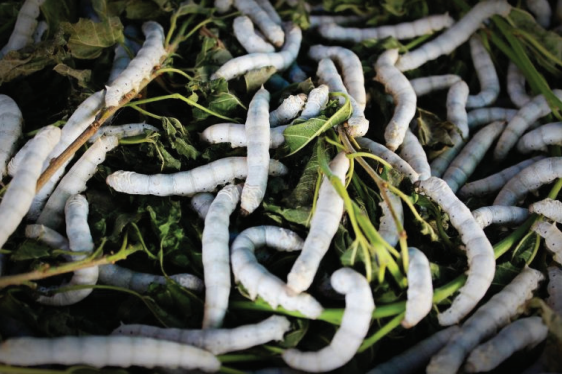
Motivated by Department of Sericulture to go for rearing silkworms, he took 10-12 days training from the sericulture department. In the training he learnt the art and science of rearing silkworms. Along with the necessary training, he is also being provided with the seed (silkworms) by sericulture department. Manzoor Ahmed initially started this enterprise from its own shed. But last year he got an assistance of rupees One lakh fifty seven thousand and five hundred from the sericulture department under Holistic Agriculture Development Programme (HADP) for construction of shed in three installments. HADP is a very prestigious programme of UT of Jammu and Kashmir aimed at revival of agriculture by promotion of diversification, mechanization, skill and entrepreneurship development, mobilization and sustainable practices.
Manzoor further says that about 15 kilogram of cocoon (Khutti) is produced within 2 months by rearing silkworms and which he sells at the rate of 1000-1200 per kilogram thereby earning rupees 15,000-20,000 within two months. Regarding marketing of the cocoons, he sells them at Ramban/Udhampur/Sangaldan where marketing platform is provided by the sericulture department. Department usually facilitates marketing through contractors. Mr. Mohammad Farooq working as Mulberry Man in the sericulture department in Gool circle further told that under HADP, Manzoor will also be provided with equipments worth rupees forty thousand. The equipments will include stands, spray pump, thermometer and other related tools.
For him, it has turned out to be a zero investment enterprise, because it does not costs him anything. For Mulberry leaves he has its own grown plants and sometimes he brings them from some others place. It is also free of cost, but he has to pay for transportation. Manzoor duly acknowledges the training and financial support received which has enabled him to go for enterprise diversification.


