

India has two primary stock exchanges: the National Stock Exchange (NSE) and the Bombay Stock Exchange (BSE). Many investors wonder which one matters more. Understanding both is crucial for anyone trading or investing in the Indian markets. This guide explains the differences, uses, and advantages of each exchange—so you can make sharper decisions and choose the right platform for your needs.
What Sets NSE Apart
The NSE status as India’s largest exchange by trading volume speaks for itself. With over 90% of the equity and derivative market, it supports a huge base of active traders and institutional investors
● Founded: 1992, began electronic trading in 1994
● Market share: Commands over 90% of daily transactions
● Key index: Nifty 50, covering 50 large-cap companies across sectors
● Lot size: Standardised; for example, Nifty futures contracts carry a lot size of 75 units NSE is renowned for its transparent electronic platform and efficient order-driven system, making it the preferred choice for many active traders
What Makes BSE Unique
The BSE is Asia’s oldest exchange, founded in 1875, and houses over 5,600 listed companies, including many small and mid-cap firms.
● Key index: Sensex, tracking 30 key companies since 1986
● Historical legacy: Longstanding reputation, still trusted by many investors
● Product range: Equities, derivatives, bonds, mutual funds, SME listings While its market share is smaller compared to NSE, BSE keeps pace with new initiatives, such as its push to grow derivatives trading by retaining its mid‑week expiry window
Where They Differ
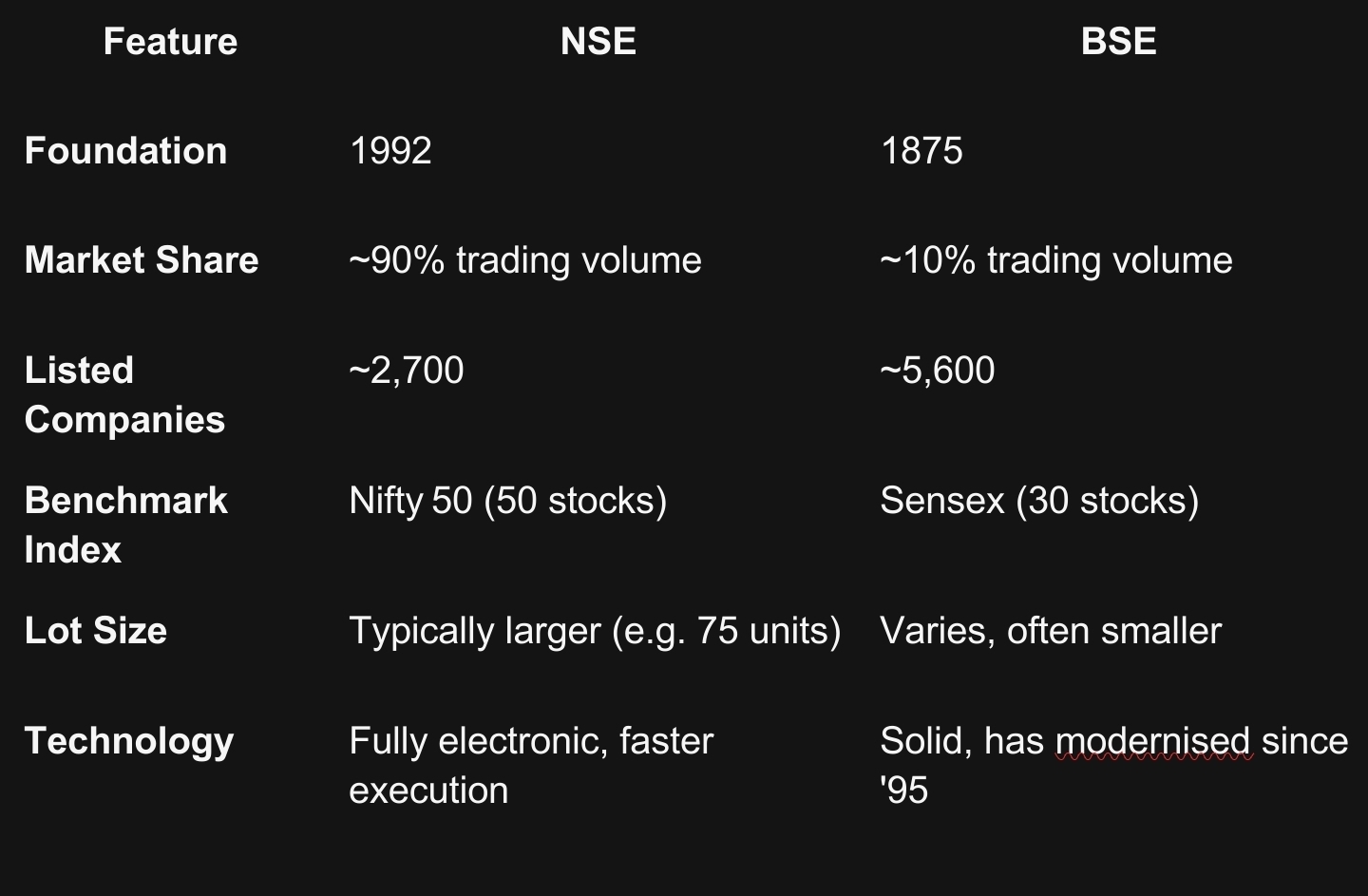
Investor Impact by Exchange
● Liquidity: NSE usually offers tighter spreads and better execution—ideal for high-volume traders.
● Pricing: Most actively traded stocks are listed on both exchanges, often at almost the same prices. Small price gaps are possible due to liquidity and spread differences. Traders can exploit these through arbitrage.
● Listing Access: BSE has more small and mid-cap companies, giving wider choice for investors seeking bargains or early-stage exposure.
● Derivative Markets: NSE leads in futures and options, but BSE is growing in response to new SEBI regulations—this could boost its relevance in near future
Why NSE Is Often Favoured
1. High volumes and liquid market—better price discovery.
2. Broad product offering—equities, currency, commodity derivatives, mutual funds, bonds.
3. Strong tech—electronic trading since launch, minimal delays.
4. Ease of use—aligned with retail and institutional needs.
Why BSE Still Matters
1. Legacy and trust—some investors prefer BSE’s deep history.
2. Listing access—SME and small-cap companies often list only on BSE.
3. Nyse vs BSE arbitrage opportunities between the two often emerge.
4. Derivatives potential—BSE’s bid to regain a share of weekly options trading shows intent to innovate.
Real-World Example
In a trading session on 11 June 2025, both Nifty and Sensex were positive—Nifty closing above 25,100 and Sensex crossing 82,500. Stocks rose on both exchanges, showing that they often move in tandem, even if NSE has far higher volume.
Which Should You Use?
● Active/derivatives traders: Prefer NSE—thanks to liquidity, speed, and product depth.
● Beginner investors: BSE is fine for regular buying and holding, especially for lesser-known or SME stocks.
● Arbitrage traders: Look at both exchanges to offset price differences in the same stock.
● Portfolio builders: Use BSE for exposure to smaller firms, NSE for blue-chip core holdings. Common Misconceptions
● Prices differ widely: Not really—most large-cap stocks trade nearly identically on both exchanges.
● You must choose one: You can buy on NSE and sell on BSE, or vice versa—though small timing gaps apply.
● BSE is outdated: Not any more—it’s electronic, regulated, and launching modern offerings.
Tips for Traders and Investors
1. Check liquidity: See where your chosen stock offers better trade volumes.
2. Compare prices: Occasionally small spreads appear—can be good for arbitrage.
3. Choose wisely for F&O: Use NSE for its high liquidity in these contracts.
4. Explore BSE listings: Look for new SME or small-cap stories emerging in your portfolio.
Conclusion: Know Both, Use Smartly
While the NSE status as India’s leading exchange gives it the edge for active traders, the BSE still provides value—especially for investors exploring smaller stocks or niche opportunities. Knowing both exchanges and their differences can help you build better strategies and make smarter decisions. In the end, which one matters more depends on your goals: for speed and depth, go NSE; for choice and smaller-cap access, turn to BSE.

