· Says rooting out terrorism is Govt’s collective commitment
· NIA gets 10-day custody of accused arrested in blast case
· Accused to be brought to Kashmir
· Key conspirator held for providing Tech support to terror plot
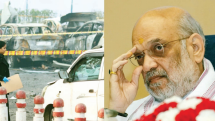
New Delhi, Nov 17: In a strong message, Union Home Minister, Amit Shah on Monday said that the government will hunt down the culprits of the Delhi bomb blast even from the depths of the netherworld and ensure they receive the strictest possible punishment.
Union Home Minister Amit Shah, while addressing the 32nd Northern Zonal Council meeting in Haryana’s Faridabad, issued a strong warning to the perpetrators, declaring that the government would “hunt down the culprits of the Delhi bomb blast even from the depths of the netherworld.” Paying respects to the victims of both the Delhi blast and the Nowgam Police Station explosion in Srinagar, Shah reaffirmed that eliminating terrorism from its roots remains a collective national commitment under the leadership of Prime Minister Narendra Modi.
The suicide blast near the Red Fort last week claimed 13 lives and injured more than 30 people. The bomber, identified as 28-year-old Dr Umar Mohammad (also known as Umar un Nabi) from Pulwama, died at the spot after triggering a vehicle-borne improvised explosive device (VBIED). Investigators believe his plan may have been hastily executed following the arrest of co-conspirator Dr Muzammil Ganaie and the seizure of huge quantities of explosives from a Faridabad safe house.
The Nowgam blast, in which nine persons—including a Naib Tehsildar and a State Investigating Agency officer—lost their lives, occurred when confiscated explosives linked to the same terror module detonated accidentally inside the police station. Shah observed two minutes of silence at the NZC meeting as a tribute to the victims.
The NIA has since widened its investigation, arresting several key players linked to Umar’s terror network that spanned Jammu & Kashmir, Haryana, Uttar Pradesh, and the National Capital Region. On Monday, a Delhi court granted the agency 10-day custody of Amir Rashid Ali, a resident of Pampore, who is alleged to have arranged a safe house in Faridabad, provided logistical support to Umar, and purchased the car used in the VBIED attack. NIA officials said Amir was likely the last person to meet Umar before the blast.
According to the agency, Amir’s custodial interrogation is crucial to unraveling the larger conspiracy that appears to involve a “white-collar” JeM-backed radicalisation and logistics module comprising doctors, students, and technically trained youth. Amir, they said, facilitated the procurement of the vehicle, stayed in the safe house arranged for Umar, and helped acquire materials used to assemble the IED.
In another major breakthrough, the NIA on Monday arrested Jasir Bilal Wani, alias Danish, from Srinagar. A political science graduate from Qazigund, Wani is believed to have been intensely radicalised by Umar over several months. He allegedly provided high-end technical support, modifying drones and attempting to design makeshift projectiles for future attacks. According to investigators, Wani had initially been groomed to become a suicide bomber himself but backed out citing financial hardship and religious inhibitions. He later shifted roles and assisted the network in technical preparations.
Officials said Umar un Nabi and his associates had been planning a large-scale VBIED attack around the Babri Masjid demolition anniversary on December 6. The blast was intended either in Delhi or at a place of religious significance. The plan fell apart after the arrest of Dr Muzammil Ganaie, a faculty member at Al Falah University, and the seizure of around 360 kg of explosive chemicals including ammonium nitrate, potassium nitrate, and sulphur.
Investigators believe the sudden setback in April triggered anxiety within Umar, pushing him to attempt the Red Fort strike prematurely. His radical transformation reportedly began after a 2021 trip to Turkiye with co-accused Muzammil, where they allegedly met operatives of the Jaish-e-Mohammed. Upon returning, the duo began stockpiling chemicals, identifying targets, and recruiting young OGWs across Kashmir.
The first public hint of the interstate network surfaced in October when JeM posters appeared on walls in Bunpora and Nowgam in Srinagar. Police scrutiny led to the arrest of three local youths, whose interrogation exposed the involvement of a Shopian-based Imam, Irfan Ahmad, who allegedly radicalised the doctor-module and facilitated their recruitment into the JeM-linked network.
So far, at least eight individuals have been arrested jointly by the NIA and J&K Police. Multiple NIA teams are conducting searches across states to identify every operative connected to the conspiracy. Authorities emphasised that the precision of the blast and the sophistication of the module indicate the involvement of well-funded handlers and international ideological influences.
Meanwhile, security across Delhi and major cities has been tightened, and surveillance on interstate movement of chemical consignments has been enhanced. Shah stressed during the NZC meeting that all states must work in seamless coordination, noting that zonal councils play a crucial role in strengthening India’s internal security architecture.
The NIA will now transport Amir to Kashmir for further questioning, where investigators expect to reconstruct the final hours leading up to the Red Fort blast. With multiple arrests and hundreds of leads under scrutiny, officials assert that the case is far from closed and that every layer of the terror web will be exposed.
How the ‘Doctor Module’ evolved into a High-Tech Terror Cell
The arrest of several young professionals—especially doctors—has highlighted the alarming evolution of a high-tech terror cell rooted in Kashmir and expanded across multiple states. At the centre of this module was Dr Umar un Nabi, a Pulwama-based medical graduate whose radicalisation journey reportedly accelerated after a 2021 trip to Turkiye. Investigators say Umar returned deeply indoctrinated, soon recruiting fellow doctor Dr Muzammil Ganaie and others into a covert network.
Working out of a rented house near Haryana’s Al Falah University, the module procured massive quantities of chemicals from the open market—around 360 kg in total—using academic research as a cover. Much of it was intended for manufacturing large VBIEDs capable of mass casualties. The cell also explored drone modification, crude rocket fabrication, and remote detonation mechanisms.
The group’s radicalisation pipeline relied heavily on a Shopian-based imam, Irfan Ahmad, who allegedly indoctrinated the doctors and connected them with Jaish-e-Mohammed OGWs. Young recruits such as Jasir Wani were targeted for roles ranging from suicide bombing to technical tasks.
Their plans were blown open after the Srinagar Police, investigating the appearance of JeM posters in October, arrested three youths whose interrogation revealed the doctor network. This led to the arrest of Ganaie, seizure of explosives, and ultimately the premature blast at Red Fort after Umar panicked.
Inside the NIA’s hunt for the Red Fort blast conspiracy
The National Investigation Agency is now piecing together one of the most complex terror investigations in recent years, involving interstate recruitment, cross-border ideological influence, and a multi-tier logistics chain. The blast outside the Red Fort—carried out through a vehicle-borne IED—appears to be the culmination of months of planning by a JeM-inspired module.
The NIA’s first major breakthrough came with the arrest of Amir Rashid Ali from Pampore, who allegedly arranged the safe house, provided shelter to suicide bomber Umar, purchased the blast vehicle, and handled key logistics. Investigators believe Amir was the last person to meet Umar and may hold crucial information about the final execution plan.
Another significant arrest was that of 24-year-old Jasir Bilal Wani, who provided technical expertise—working on drones, improvised projectiles, and explosive enhancements. His radicalisation timeline and his proximity to Umar have offered crucial insights into how the module functioned.
NIA teams are now conducting raids across Delhi, Faridabad, Srinagar, Pulwama, Qazigund, and other locations. Forensic material from the blast site—shrapnel, chemical traces, and circuitry—has been sent for advanced analysis, as investigators attempt to map both the supply chain and technological sophistication of the device.
The agency is also tracing international digital footprints, encrypted communication, and possible funding routes. With eight arrests already made, the NIA believes the conspiracy may extend further, involving ideological handlers abroad, local OGWs, and logistical enablers across multiple states.