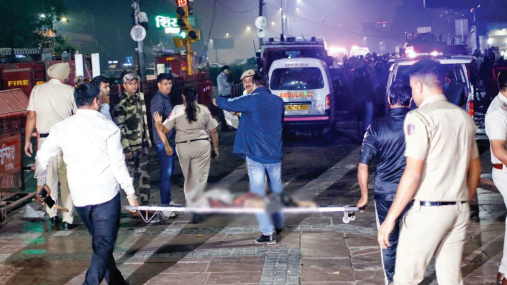
The past few weeks have revealed a series of chilling terror plots across India, many of them thwarted due to the vigilance of security agencies. Yet amid these developments came a horrific strike at the heart of the national capital — a car explosion near Delhi’s Red Fort, killing at least 13 people and injuring many others. The blast was executed by Dr. Mohammad Umar un Nabi, a Kashmiri doctor and an active member of a Jaish-e-Mohammed (JeM) module.
This module, which spanned multiple states, had been under surveillance after the recovery of nearly 2,900 kg of explosives, assault rifles and ammunition. Investigations led to the arrest of several accused, including doctors Adeel Ahmed Bhat, Muzammil Shakeel (also known as Musaib Ganaie), Mohammad Arif and Dr. Shaheen Saeed — all allegedly linked to the group’s operations and radicalisation networks.
Given the magnitude of the case, public attention has understandably focused on the scale of indoctrination, the infiltration of radical networks into universities, and the implications for national security.
Yet, in a deeply troubling development, a section of the media has chosen to redirect this focus — not toward the victims or the threat of extremism, but toward humanising the accused terrorists and casting suspicion on the investigative process itself.
The Wire’s “Sob Story” Narrative
On 13 November, The Wire published an article titled “We Are Doomed, What More Can Be Said: Families of Kashmiri Doctors Linked to ‘Terror Module’ Case.” The piece, authored by Jehangir Ali, attempts to portray the accused — particularly Umar Nabi — as sympathetic figures wronged by state action.
The narrative strategy follows a familiar pattern:
- Emphasising the accused’s academic excellence
- Highlighting poverty and familial struggles
- Suggesting ambiguity in evidence
- Implying state excesses
- Carefully sidestepping confirmed facts
This formula, critics argue, sanitises heinous actions while undermining the legitimacy of counter-terror operations.
Humanising the Perpetrator, Erasing the Crime
The Wire’s profile of Umar Nabi dwells at length on his achievements — a NEET-PG topper, an assistant professor of medicine at Al Falah University, and the primary financial support for his family in Pulwama.
It quotes his father reminiscing over his academic journey, while the article dwells on financial hardships, tattered slippers, and crowded book-filled rooms. It describes his relatives’ grief, presenting an emotional tableau meant to evoke sympathy.
But what it glosses over — or casts doubt upon — is the confirmed reality:
- His car explosion killed 13 people.
- DNA analysis matched his remains with samples from his mother.
- He was identified as the “most radicalised” member of the JeM module.
- He acted in panic after the module’s exposure.
Instead, The Wire repeatedly describes him as “missing”, suggesting uncertainty when none remains. The bias is not subtle — it is constructed.
The article’s focus shifts to household poverty and disrupted dreams, as though socioeconomic backdrop negates the conscious choices of an educated radical who deliberately aligned with a terror organisation.
Education Is Not Immunity to Extremism
One of the most disturbing lessons from this case is that education does not shield individuals from extremist ideology. In fact, as Indian and global experience show, highly educated radicals often play specialised roles in terror networks — from logistics to recruitment to medical support.
Yet The Wire’s narrative repeatedly underscores the accused’s academic brilliance, implying that intelligence itself absolves guilt or casts doubt on involvement. This framing is dangerous.
Umar Nabi had:
- Opportunity, given his medical career
- Earning capacity, given his job
- Responsibility, given his family circumstances
Despite all this, he chose jihad over profession, ideology over family, destruction over service.
That stark moral reality cannot be diluted by sentimental storytelling.
Other Accused, Same Whitewashing Template
The article extends similar treatment to other arrested doctors, Dr. Adeel Ahmed Bhat and Dr. Muzzamil Shakeel Ganie. It highlights the wealth of one family, the religiosity of another, and the misfortune of cancelled weddings — again diverting focus from the actual conspiracy.
Particularly revealing is the effort to discredit media reporting about their involvement while ignoring key details, such as:
- The accused were linked to the same module.
- They were associated with the same university network.
- Their communications revealed ideological alignment.
- Searches and seizures confirmed participation.
The article even devotes space to lamenting the postponement of a sister’s wedding — as though such personal inconvenience outweighs the 13 lives lost or the potential hundreds saved by foiling the larger plot.
A Pattern of Apologia
The Wire’s treatment of this case is not an aberration. For years, the portal has been criticised for:
- downplaying Islamist extremism,
- amplifying narratives of victimhood for those facing terror charges,
- demonising Hindu groups by contrast,
- and weaponising ambiguity to cast doubt on counter-terror operations.
Its past coverage includes sympathetic portrayals of accused in:
- the Delhi riots,
- anti-CAA conspiracies,
- Pahalgam terror killings,
- and multiple Kashmir-related cases.
This editorial pattern aligns with a broader ideological project: to present radical Islamists as misunderstood youth, to frame counter-terror operations as oppressive, and to sow doubt in the public mind about factual security assessments.
The Real Issue: Media Responsibility in Times of Terror
The ethical question that emerges is not about the rights of families to mourn — that is natural and expected. It is about the responsibility of the media to:
- uphold facts,
- avoid manufacturing sympathy for perpetrators,
- and prioritise the safety and truth owed to the public.
By selectively omitting confirmed information — such as the DNA match — and repeatedly describing the bomber as “missing,” The Wire’s narrative crosses from emotional reportage into deliberate distortion.
Such framing does not merely mislead; it can hamper counter-terror efforts, encourage radical networks, and weaken public trust in lawful enforcement.
A Dangerous False Equivalence
Equally alarming is the implicit moral equivalence often constructed by such narratives — portraying radicalised individuals as misguided prodigies while state agencies appear as oppressors.
This inversion of victim and perpetrator is ethically indefensible.
The 13 people killed near Red Fort, the numerous injured, and the unknown number saved from further blasts deserve public focus — not the sanitised biographies of those who plotted mass murder.
Conclusion: Sympathy Misplaced, Lessons Ignored
The Red Fort blast underscores a disturbing truth: highly educated professionals can become deeply radicalised and participate in sophisticated terror networks. Countering such threats requires public vigilance, honest reporting and resistance to ideological whitewashing.
By attempting to humanise extremists and question established facts, media platforms like The Wire risk enabling the very forces that imperil civilians and destabilise society.
The families’ grief is real. But grief cannot distort truth. And truth cannot bow to propaganda.
(Source: Adapted from an opinion piece published in OpIndia)