UNITED NATIONS, Apr 15: India has asserted that reform of the United Nations Security Council without expansion in the permanent category with veto would perpetuate existing imbalances and inequities in the global body.
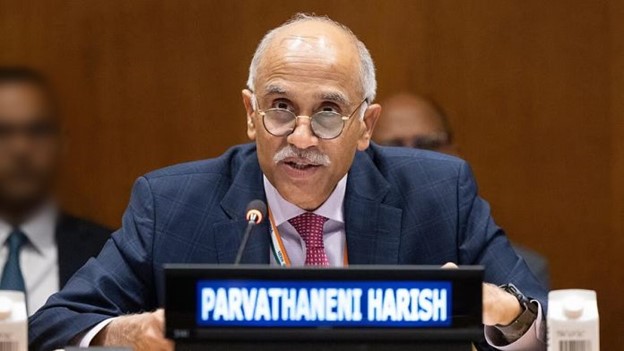
Addressing the Inter-Governmental Negotiations (IGN) on Security Council reforms, India’s Permanent Representative to the UN Parvathaneni Harish cautioned that creating a new category, with or without veto, would complicate already wide-ranging discussions.
He underlined that the Council’s lack of legitimacy and representativeness stems from two core issues — membership and veto — noting broad agreement on the urgent need for reform as the current structure, designed over 80 years ago, no longer reflects present geopolitical realities.
Harish recalled that the only reform in the 1960s expanded the non-permanent category, increasing the relative power of veto-wielding members. The ratio of permanent to non-permanent members shifted from 5:6 to 5:10, benefiting those with veto powers.
“Any reform not accompanied by expansion in the permanent category with veto would worsen this imbalance,” he said, stressing that such expansion is critical for meaningful reform.
He also warned that introducing a new category would further complicate negotiations and emphasised the need to stay within the existing framework to fast-track progress.
India, which has long advocated reforms, reiterated that the 15-member Council, established in 1945, is outdated and does not reflect contemporary geopolitical realities, asserting its rightful claim to a permanent seat.
The country also raised concerns over the “effective veto” exercised by both permanent and non-permanent members on Council outcomes such as presidential and press statements, and sanctions committee decisions.
Harish pointed to instances where elected members have blocked outcomes to serve narrow interests and referred to a 2022 United Nations General Assembly resolution mandating debates within 10 days of a veto being used, noting it has failed to deter veto use.
Since its adoption, 24 vetoes have been cast on 20 draft resolutions, with seven vetoes recorded in 2024 — the highest since 1986.
He added that while some permanent members have refrained from using veto for decades, its continued use based on national interests remains a challenge, and any limitation would require amendments to the UN Charter, which itself is subject to veto. (Agencies)