
Dr. Parveen Kumar*
Whenever we think of ATM, the first thing that comes in our mind is the cash which it dispenses while responding to the instructions of the account holder. Infact, the Automated Teller Machine (ATM) works as a self service electronic device that allows customers for cash withdrawals and deposits using a debit or credit card with a 24*7 access. Now, imagine a field which is an ATM for a farmer. The farmer is harvesting different commodities which include food grains, vegetables, fruits, pulses, flowers, millets, mushroom, raising livestock, rearing goats, raising fishes and poultry year round. This makes his fields a regular source of income for him. The Integrated Farming system model adopted by him in his farm ensures that he gets an assured income from one or the other enterprise whenever needed i. e 24*7
Lying on the banks of river Chenab and placed in the lap of Pir Panjal range, District Ramban in the Union Territory of Jammu and Kashmir was carved out of the erstwhile Doda district in the year 2007. The district is roughly halfway between Jammu and Kashmir; two capital cities of Union Territory. Also known as the valley of Anardana (Punica Granatum), district is characterized by varied climate ranging from subtropical at lower heights to temperate in the upper reaches. The Pir Panjal range is considered to be a biodiversity hotspot with the distinction of having evergreen forests, broadleaved mix forests, scrub land and grassy pastures. The district is predominantly rural and rainfed with about 95% of the cultivable area dependent upon timely availability of rainfall. In the lower regions farmers usually go for double cropping, but in the upper reaches where temperature drops to sub zero during winter, only one crop is taken. Wheat grown in rabi season is largely for fodder purposes. This is because due to snowfall and negative temperature wheat does not ripens properly and thus farmer have no other option other than to use it for fodder purposes. Maize is the staple crop grown in Kharif season. Vegetables, fruits are also produced in this district. Livestock is another important activity contributing to the livelihood of the farming community of the district.
In block Batote of district Ramban is a village Gandhri; situated at a distance of about 10 kilometers from district headquarters. In the village as per 2011 census, the no. of households was 338 with a population of 1,591 persons comprising of 837 (53%) males and 754 (47%) females. About 7 per cent of the population belongs to Schedule Tribes. Agriculture in this village is a vital component of livelihood security and earning a decent living. The cultivation of crops which until a few years ago was limited to Maize, Wheat and Paddy is witnessing a transformation in the form of diversification. More and more farmers are now diversifying their farms with high value crops like exotic vegetables, marigold and taking up allied agricultural activities like mushroom cultivation, apiculture, fisheries, goatry and poultry. With the technical advisory and input support from Krishi Vigyan Kendra-Ramban, Department of agriculture and other line departments the village is now setting new examples.
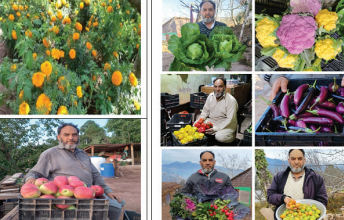
In this village is a farmer Abdul Majeed Rounyal, a young progressive cum innovative farmer who by dint of his hard work, commitment and passion towards farming has transformed his field into an Automated Teller machine (ATM). By blending his traditional wisdom with modern technologies and sustainable practices, he has proved that farming is a remunerative enterprise and size of land does not matter much. He has become a role model for the farming community of the region as well as earned a name at the national level.
Mr. Abdul Majeed Rounyal is a marginal farmer with less than one hectare of land. This small piece of land was inherited by him along with the traditional cultivation methods. These crude methods did not fetch him any substantial income from his fields. With no other source of livelihood for him, Abdul Majeed decided to do things in a different way. The cost of cultivation was a big trouble for him. He had to spend a lot on purchase of inputs like seeds, fertilizers and other plant protection chemicals. KVK-Ramban trained him on various microbial preparations under Natural Farming like Beejamrit, Jeevamrit, Agniastra, Brahmastra and others. His farm which was earlier organic is now completely under Natural Farming with an Integrated Farming system approach. He produces a variety of different exotic vegetables both on season and off season. As his produce is totally free of any chemical, it is in greater demand in local market and this also fetches him a remunerative price. Along with exotic vegetables, he also cultivates various local varieties. He has an orchard with different fruit plants like Apple, Pear, Walnut, Quince, Plum and Pomegranate on 0.25 ha. He grows vegetables on 0.10 ha of land. A polyhouse with financial support from department of Agriculture helps him in production of off season vegetables as well as raise seedlings of different vegetables. From the different enterprises he has in his fields, he earns handsome income and a decent living for himself as well as his family members. Hs annual income from his farm is about five lakhs. Moreover his farm is no less than an ATM for him. Whenever he needs urgent money, his fields have something for him. He turns to his fields, just picks up the produce; be it fruits, vegetables or any other product and sells it either at its own shop or takes them to local market for sale.
For his efforts in promotion of sustainable technologies in the region, he has been recognized at the UT as well as national level. He has got innovative farmer award from ICAR-ATARI, Ludhiana, various appreciation awards and certificates from SKUAST-Jammu, agriculture and other allied departments and also from district administration. Today he is actively promoting Natural Farming and other sustainable agricultural practices in this region.
(The author writes on agriculture and social issues; can be reached at [email protected])


