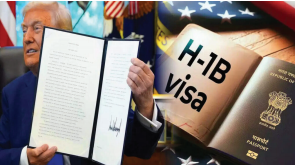
Indian Industry may get benefits out of reverse brain drain by a section of high tech
By Anjan Roy
The blow on India has now landed. Donald Trump has, in effect, slapped a very steep hike in services exports through movement of professionals from India to the United States.
Until now, the fees from H-1B fee application fees used to vary from $1700 to $4500 for each application. This has been jacked up to $100,000 per new applicant. The US commerce secretary has said that the companies will have to decide if it would be worth paying that price to retain an overseas worker for the work or employ an educated American.
The new charges have taken effect into effect from September 21, according to reports. With such immediate effect, the measure could create a kind of mayhem in the technology sector which primarily used this facility. Apart from them, even small time American-owned businesses and start up ventures could also get directly hit.
But, most immediately, the new move would directly impact India companies which have extensive service contracts with leading American corporations for computer software to operational contracts. It is well known that over 70% of the H-1B visas were issued to Indian professionals working for both American corporations as well as Indian service providers to these majors.
The new requirement will call for the Indian services companies, mainly, TCS, WIPRO, Tech Mahindra, Infosys and numerous others to immediately re-shore their activities in India. This apart, many of the American technology giants will similarly have to ramp up their operations in India, where their work was being done by professionals from India and other countries.
This new requirement is, in its practical impact, a direct tax on India’s services exports to USA. They have been talking about it for some time now, without actually imposing tax on such services. Now that the Americans have done this in an indirect way, India should also slap taxes on Indian imports of American services.
It is time, that instead of not acting, India might as well impose tariffs on imports from America and also shift away from importing hugely costly imports such as aircraft to rival sources. Thus, instead of Boeing aircraft, Indian airline operators should be asked to move over to the European rival of Boeing, that is, Airbus Industries.
On the other hand, the move should be taken as a cue for permanently restructuring India’s IT sector and the knowledge based activities. Instead of seeking to operate in overseas locations, Indians should be reoriented to working in the mother country.
The difficulties in the way of Indian professionals working in America should be taken as an opportunity to attract the talents to work in the country. For this purpose the eco-system for these high tech and knowledge based industries should be created within the country at the fastest to attract these talents.
In a way, this is bound to happen as the displaced professionals from America will have to find their ways into some fruitful and satisfying jobs and opportunities. They would provide the necessary “animal spirit” for growth and development of these innovation based industries in India.
The brightest products of the best universities and institutions of this country who used to migrate to USA until now have to rethink their life and wonder about how they could strike on their career from the domestic soil. On the other hand, the government would have to provide a suitable environment and facilities for these bright minds to flourish as well if not better on their domestic turf.
The other side effect should be for India to emerge as the global innovation hub. Already, according to an index prepared by the World Intellectual Property Organisation (WIPO), India is one of the countries being marked for innovation. For this to further grow and develop, the required facilities and environment will have to be created.
The new impost will have, above all, heavy personal blow to Indian workers who have been working in America for years and have settled down, though not yet American citizens. Their entire life would be uprooted and they would have to get resettled. (IPA Service)