By Shivanand Pandit
On September 25, 2025, US President Donald Trump announced sweeping new tariffs, including a 100% duty on imports of branded or patented pharmaceutical products, effective October 1, 2025, unless the company is actively constructing a manufacturing facility within the United States. The announcement also extended to other sectors, with 50% tariffs on kitchen cabinets, 30% on upholstered furniture, and 25% on heavy trucks.
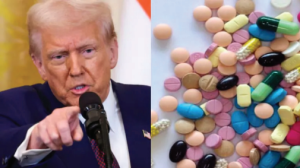
The move follows a series of investigations launched by the US Department of Commerce under Section 232 of the Trade Expansion Act of 1962, which allows the President to impose tariffs on national security grounds. Trump clarified that the exemption for drugmakers would apply only if a plant is “breaking ground” or already “under construction.” He did not clarify whether these new levies would be in addition to existing tariffs imposed on various trading partners.
A 100% tariff effectively means the price of imported pharmaceuticals will double for US importers and consumers. While the measure mainly targets multinational firms producing branded and patented medicines, it raises concerns for Indian pharmaceutical exporters, given the country’s deep reliance on the US market. In 2024, India shipped $3.6 billion (₹31,626 crore) worth of pharmaceuticals to the US, a figure that rose to $3.7 billion (₹32,505 crore) in just the first half of 2025. Companies such as Dr. Reddy’s, Sun Pharma, Lupin, and Aurobindo have benefited significantly from American demand for affordable generic drugs. Although generics are not directly in the crosshairs of the new policy, uncertainty remains over whether complex generics and specialty medicines from India could also fall within its scope.
Tariffs support giants, strain small drugmakers
Trump’s measure appears to spare many of the wealthiest firms. Most large drugmakers, including those behind Botox and popular weight-loss drugs, already produce a majority of their medicines in the United States or Europe. Medicines imported from the European Union will face tariffs of up to 15 percent under a prior trade deal. The steep 100 percent tariffs will primarily target drugs manufactured in countries like Switzerland, Britain, Singapore, China, and India. The administration clarified that exemptions will be granted for drugs manufactured in U.S. factories or for companies actively building plants in America. For example, a firm producing a drug in Ireland but constructing a facility in North Carolina could apply for tariff relief during the transition. This policy allows major players such as Roche, Novartis, AstraZeneca, Johnson & Johnson, Merck, and Eli Lilly to avoid the harshest penalties. Many of these companies are already investing billions into U.S. plants. As a result, the immediate impact of the tariffs on blockbuster medicines may be limited.
Generic drugs, which make up the bulk of prescriptions in the United States, will not be affected by the tariffs. However, modest price increases are expected for some brand-name products imported from Europe. While raw ingredients often come from China and India, the tariffs are targeted at the final stages of manufacturing. This approach spares most generics, which are primarily produced in Asia, from new costs. Still, some U.S. patients may see higher out-of-pocket expenses for brand-name medicines depending on how the policy is implemented.
The tariffs pose greater risks for smaller drugmakers that lack the resources of multinational giants. Many of these lesser-known firms manufacture in places like Canada, Mexico, or the Middle East. They depend heavily on niche products with slim profit margins. Facing 100 percent tariffs, these companies may be forced to raise prices, scale back supply, or exit the U.S. market altogether. Such disruptions could hit patients who rely on specialized therapies and lead to shortages of certain drugs. Smaller American biotech companies, unable to compete with global multinationals, may also face a disadvantage.
Although the pharmaceutical industry has secured favourable exemptions through its powerful lobbying presence in Washington, it still faces other challenges from the Trump administration. Plans are underway to pressure drugmakers to align U.S. prices with lower European levels. The administration also wants to explore restrictions on drug advertising on television. For now, the world’s largest companies have avoided the worst-case scenario of blanket 100 percent tariffs. This has saved billions of dollars they feared losing. Despite expanding U.S. operations, they are unlikely to abandon European production, given its importance as a market. Ultimately, Trump’s tariffs appear more likely to pressure smaller players while leaving industry titans largely unscathed.
Indian pharma must navigate policy ambiguity
The Trump administration’s move is poised to create significant turbulence for Indian pharmaceutical exports, which account for nearly 40% of the generic drugs sold in the US. While generic drugs are technically not covered under this directive, some generics are marketed in branded form, leaving them vulnerable to administrative interpretation of applicable duties. Complicating matters further, many Indian generic manufacturers also serve as contract manufacturers for components of patented drugs. This line of business, already sensitive to domestic manufacturing conditions, now faces potential disruption. Offshore contract manufacturing, previously a strategic advantage for Indian firms, may be rendered less competitive due to these tariffs. Relocating production to the US, while theoretically an option, is economically unattractive, given the higher cost structures there.
Beyond the immediate ambiguity of the policy, the announcement signals a clear intent. If the Trump administration is determined to promote domestic drug production in the US, Indian pharmaceutical companies must urgently diversify their export destinations. China has already indicated support in this regard by reducing its 30% duty on imported generics to zero. This is consistent with China’s strategic shift from being primarily a generics manufacturer to becoming a leader in drug discovery. Such developments present a significant opportunity for India to expand its global footprint and could potentially alter international alliances in the pharmaceutical sector, challenging US dominance in research-driven medicine.
The timing of these policy changes is critical. The global pharmaceutical industry faces a wave of patent expirations, which makes strategic transitions urgent. There is growing interest in alternative drug discovery engines, and India has the potential to capitalize on this trend. By moving up the value chain—from efficient production of off-patent medicines to development of high-value treatments in immunology, oncology, and metabolic diseases—the Indian pharmaceutical industry could create commercially viable drugs for global markets.
The immediate market reaction underscored the seriousness of the announcement. The US remains the largest market for Indian pharmaceuticals, accounting for nearly 40% of exports. Previously, pharmaceutical products were exempt from the 50% tariffs that Trump’s administration had imposed on other Indian goods. As a result, Indian pharma stocks experienced a sharp decline on September 26, 2025. The Nifty Pharma index, designed to reflect sectoral performance, fell more than 2%. Individual stocks fared worse: Sun Pharma declined 4.9%, Biocon 3.8%, Abbott India Ltd 3.5%, and Zydus Lifesciences 3.4%.
The new tariffs come on the heels of investigations initiated by the US Department of Commerce under Section 232 of the Trade Expansion Act of 1962. Section 232 tariffs differ from the so-called “reciprocal tariffs” imposed under the International Emergency Economic Powers Act (IEEPA), which have faced judicial challenges and, in some cases, been overturned by US courts. By leaning on Section 232, the Trump administration is seeking a more defensible legal foundation for its tariff strategy. Notably, these tariffs are sector-specific rather than country-specific and are likely targeted primarily at branded and patented medicines rather than off-patent generics. However, greater clarity is required, particularly concerning “branded generics,” which could fall into a gray area. This move aligns with Trump’s broader agenda of reshoring manufacturing and reducing the US trade deficit. Reports suggest that further sectoral tariffs, potentially covering semiconductors, are also in the pipeline, signalling continued pressure on global supply chains.
The new US tariff regime poses a significant challenge for Indian policymakers and businesses, requiring a multi-pronged response. India must expedite trade negotiations with the US to mitigate immediate damage and gain clarity on tariff applicability, while simultaneously diversifying export markets to reduce over-reliance on the US—Opportunities such as China’s favourable import policies for generics could play a key role. At the same time, accelerating domestic reforms is crucial: Indian companies need to enhance operational efficiency, invest in research and development, improve production quality, and strengthen regulatory compliance to remain competitive and attract international partnerships in an increasingly uncertain global environment.
The Trump administration’s tariffs have sent shockwaves through India’s pharmaceutical sector, highlighting vulnerabilities in export dependence on a single market. At the same time, these developments present a critical opportunity for Indian pharma to rethink its global strategy, move up the value chain, and explore new markets. By navigating policy uncertainty intelligently and proactively, India can not only protect its existing export base but also position itself as a key player in high-value global drug markets.