Trade data shows India’s growing dependence on imported walnuts and almonds, exposing the productivity and value-chain gaps in J&K’s key dry fruit sector.
Rohini Singh, Media Researcher, IIMC Jammu
When Prime Minister Narendra Modi and US President Donald Trump announced the interim trade deal in February of this year, the focus was on “reciprocal and balanced trade” that promised wider access for American goods in India’s vast consumer market. Among the key provisions was an agreement to slash or eliminate tariffs on a range of US agricultural products, including tree nuts such as almonds, walnuts and pecans. The move promises cheaper imported nuts on supermarket shelves for the Indian consumer, making these health foods more affordable for middle-class families across the country.
But in Jammu and Kashmir, the cradle of India’s walnut and almond cultivation, the deal has stirred unease among orchardists, processors and policymakers. For years, local growers have experienced domestic production struggle to keep pace with rising demand. Now, with easier and cheaper access to American nuts, the pressure on the UT’s traditional horticulture economy is set to intensify. According to a report from NITI Aayog on Horticulture Development in Jammu and Kashmir, the trends are worrying for a region where horticulture remains the backbone of rural incomes.
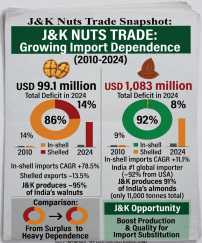
In 2010, India enjoyed a small surplus in in-shell walnuts, with exports outpacing imports. By 2024, the picture had flipped dramatically. While exports saw only limited growth, imports surged dramatically, pushing the trade account into a steep deficit. Just a decade ago, what used to be a tiny positive cushion has widened into a deep trade gap.
The story for shelled walnuts , the higher-value and processed form, is even more concerning. In 2010, exports stood at over 7,100 tonnes worth $39 million, while imports were almost negligible, leaving the country with a comfortable surplus. By 2024, exports had fallen sharply to just 932 tonnes valued at $5.1 million, even as imports rose to nearly 3,800 tonnes worth $19.3 million. The result was a reversal from a $39 million surplus to a $14 million deficit.
Jammu and Kashmir produces over 90 per cent of India’s walnuts. Yet processors in the state are increasingly turning to imported raw material because quality consistency or pricing of the local supply does not always match market needs. Over the past 14 years, in-shell walnut imports expanded at an average annual rate of nearly 79 per cent, far outpacing the barely 2 per cent yearly growth in export value. For shelled walnuts, exports actually declined by more than 13 per cent every year on average. It is clear that Jammu and Kashmir is losing ground in the global market even as domestic demand surges.
Almonds is another crop where J&K holds a commanding 91 per cent share of national production. The dependence on imports has been pronounced from the start, but the scale of that reliance has grown even further. In 2010, India imported 62,053 tonnes of in-shell almonds worth $244.5 million while exporting a negligible eight tonnes. The trade deficit stood at $244.5 million. By 2024, imports had surged to nearly 270,000 tonnes valued at over $1 billion, cementing India’s position as one of the world’s largest buyers in this segment. Exports remained tiny at 89 tonnes. The deficit crossed $1 billion.
Shelled almonds followed a similar pattern. Since 2010, imports from other countries have nearly doubled, while exports have only seen marginal growth. This had widened the trade deficit from $46.4 million to $82.1 million. A striking feature of this dependence is India’s heavy reliance on the United States, which accounted for nearly 92 per cent of imports in 2024. With the new trade deal removing or reducing tariffs on these very products, that share is likely to rise further.
Walnuts show a story of lost competitiveness for the UT, a once-export-oriented sector that has seen its international markets shrink while processors rely more on foreign raw material. Almonds reveal a deeper structural gap as India’s total domestic production hovers around just 11,000 tonnes. It is far too small to meet exploding consumer demands. In both cases, the volume of in-shell imports far exceeds shelled imports, meaning Indian processors are importing raw nuts, adding value locally and selling within the country rather than exporting finished products.
These national trends have translated into direct economic pain for J&K’s farmers. Walnuts and almonds have traditionally provided steady income in remote hilly areas where other crops struggle. Yet the ageing orchards, erratic weather and competition from more profitable alternatives has caused the local sellers to turn to imports instead of locally grown nuts. Many growers complain that the domestic buyer’s preference for imported nuts, which are larger and competitively priced, is squeezing local prices during harvest season.
The trade deal with the US only sharpens this reality. By lowering duties on US almonds and walnuts, the agreement will likely make American supplies even more attractive for sellers. Industry voices have already noted that landed costs could fall sharply, boosting consumption but also intensifying competition for local produce. While this benefits urban consumers and food processors, it risks further eroding the market share of J&K’s small and marginal orchardists, who form the backbone of the Valley’s rural economy.
These numbers call for urgent policy intervention. For almonds, where the production base is tiny, the NITI Ayog report explicitly recommends “ex-ante assessment of the crop” to plan expansion and reduce uncertainty. For walnuts, the emphasis should be on improving post-harvest handling, grading, branding and value addition so that Kashmiri walnuts can regain their premium position in both domestic and export markets.
The trade deal can also offer a window of opportunity. If J&K can ramp up productivity and quality for the locally grown nuts, the growing national appetite for nuts could be met locally in the next few years. Without targeted support the deal’s benefits may flow disproportionately to foreign suppliers.
As the India-US trade arrangement moves forward, danger looms ahead for one of the valley’s most prized crops. The numbers from 2010 to 2024 represent thousands of farming families whose livelihoods depend on these products.
Without urgent and sustained intervention two of the Valley’s most iconic crops risk sliding from proud symbols of local enterprise into mere entries in an expanding import ledger.