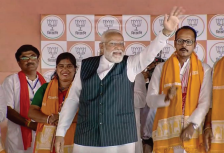
BANKURA (WB), Apr 19: Prime Minister Narendra Modi on Sunday accused the Trinamool Congress of “betraying” women by preventing the passage of the Constitution (131st Amendment) Bill, 2026 in Parliament, and asserted that the women would punish the ruling party in West Bengal in the upcoming assembly polls.
Addressing an election rally at Bishnupur in Bankura district, Modi said the Mamata Banerjee-led TMC, in collusion with the Congress, blocked the passage of the bill, which sought to provide 33 per cent reservation for women in Parliament and state assemblies, as it is “opposed to women’s empowerment”.
“We have seen how the TMC betrayed women in Parliament. The TMC conspired with the Congress to prevent the passage of the bill as it is against women’s empowerment,” he said.
“The BJP’s identity, on the other hand, is tied to women’s empowerment, and their safety and security. That is why women across the country shower the BJP with their blessings.
“We want the role of women to expand in building a developed India and want more and more women to enter politics. But West Bengal has seen once again how the TMC betrayed the state’s sisters and daughters,” the prime minister said.
Alleging that the TMC opposed both women’s reservation and empowerment, Modi said the ruling party would face the wrath of women voters in the state.
“The TMC does not want women’s empowerment and reservation. The women of West Bengal will punish it,” he said.
The prime minister’s remarks came two days after the BJP-led government failed to secure passage of the Constitution (131st Amendment) Bill in the Lok Sabha.
The bill sought to implement 33 per cent reservation for women in Parliament and state assemblies before the 2029 Lok Sabha polls through a delimitation exercise based on the 2011 Census.
Modi accused the TMC of practising politics of appeasement while denying representation to women.
“This is the same TMC which breaks every law and every rule to benefit infiltrators, but opposes women’s empowerment,” he said.
“This is the same TMC which is engaged in providing reservation on the basis of religion. It is strangling the spirit of the Constitution,” Modi alleged.
If voted to power in West Bengal, the BJP will provide up to Rs 1.5 lakh to women under PMAY to build homes, he said.
The prime minister also accused the TMC of insulting President Droupadi Murmu and being indifferent to tribal communities’ concerns.
“The anti-tribal TMC insulted President Droupadi Murmu. Both the TMC and the Congress are anti-tribal. That is why they fielded a candidate against
Droupadi Murmu in the presidential elections,” he said. Modi said this year’s West Bengal polls will be historic as people will end TMC’s ‘bhoy’ (fear) and give mandate to BJP’s ‘bharosa’ (trust).
“I give one last opportunity to TMC’s goons to surrender to police before polls as none would be spared after results on May 4,” he added.
Opp conspired to derail Women’s Reservation Bill: Hardeep
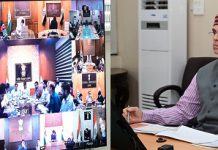
Jammu Tawi, Apr 19: Union Minister Hardeep Singh Puri on Sunday alleged that opposition parties led by Congress “hatched a conspiracy” to derail the Women’s Reservation Bill, warning they have “played with fire” and will face serious consequences.
Addressing a press conference alongside Rajya Sabha MP and former National Commission for Women (NCW) chairperson Rekha Sharma here, Puri said even at the last minute, the government made efforts to accommodate the opposition’s concerns to ensure passage of the bill.
The leaders asserted that the bill is not merely a political issue but a social cause aiming to ensure equitable representation, and maintained that opposition will face the consequences of public backlash.
Puri said Home Minister Amit Shah had appealed in the House for an hour to incorporate suggestions, but the offer was rejected.
“They were not interested in constructive engagement. This was a deliberate attempt to derail the discussion and stall a historic reform,” Puri said.
He said all of this was part of a conspiracy by Congress and its alliance parties, including DMK, TMC and Samajwadi Party, and they do not want this to be implemented before the 2029 elections.
“However, after listening carefully to the address to the nation by the Prime Minister Narendra Modi on Saturday, it is clear that the national mood is still in favour of implementing this before 2029,” the minister added.
Calling the bill a “transformative step” in India’s democratic journey, the minister said the move seeks to transition from women-centric welfare to women-led development.
He reiterated that the government has been committed to 33 per cent reservation for women in legislatures since 2014, when it was clearly outlined in the BJP’s manifesto.
Highlighting the government’s track record, Puri pointed to schemes focused on women’s empowerment, including the construction of around 11 crore toilets and nearly three crore houses under the Pradhan Mantri Awas Yojana, with ownership largely given to women, and plans underway to build an additional four crore houses.
On the contentious issue of delimitation, Puri said it is a necessary precondition for implementing reservation.
Dismissing opposition claims that southern states would be disadvantaged, he cited data presented in the Parliament showing proportional seat increases across states such as Karnataka, Andhra Pradesh, Telangana, Tamil Nadu and Kerala.
Accusing opposition parties of spreading misinformation, the minister said, “There is no north-south divide in the proposed framework.”
He said the government remains determined to push for implementation before the 2029 general elections, reflecting what he described as the “national mood.”
He said if opposition parties continue to block the bill, the government will take the issue directly to the people.
Calling it not just political opposition, but a betrayal of the aspirations of women across the country, he said, “What we saw in Parliament was unprecedented. A bill meant to empower women was defeated, and some members were seen celebrating.”
The former NCW chairperson, echoing similar sentiments, termed the defeat of the bill “shameless” and likened it to a “foeticide of women’s rights.”
Sharma accused opposition parties, particularly the Congress, of consistently blocking the legislation over the past three decades through shifting positions and procedural hurdles.
“They kept changing their stand, first demanding reservation within reservation, then opposing delimitation. The intention was never to pass the bill,” Sharma said.
She noted that women’s representation in Parliament has increased only marginally — from around three per cent to about 14 per cent — over several decades, arguing that without legislative intervention, meaningful participation of women in policymaking would remain limited.