
In the complex architecture of India’s national security and administrative governance, few issues today reflect a deeper structural imbalance than the debate over Non-Functional Upgradation (NFU). What began as a bureaucratic reform to address stagnation has evolved into a defining fault line in India’s civil–military balance. The issue is no longer confined to pay scales—it now touches upon institutional equity, morale, and the long-term credibility of India’s governance framework.
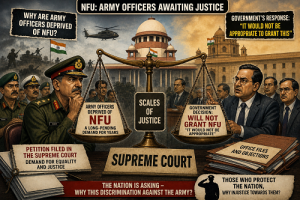
Recent proceedings in 2026 before the Supreme Court have brought this debate to a decisive juncture. The Government of India has taken a firm and unambiguous position: NFU cannot be extended to the Armed Forces. This stance, rooted in arguments of structural incompatibility and financial prudence, stands in direct contrast to the military’s demand for parity and directly relates to a core grievance of the officer cadre regarding their status and career progression. At its core, the issue represents a fundamental question—should the principles of fairness applied across the civil services be selectively denied to the military, despite comparable years of service and responsibility?
The concept of NFU was introduced following the recommendations of the 6th Central Pay Commission in 2008. Its primary objective was to address career stagnation within the “Organised Group A Services.” The mechanism was straightforward: when an officer of the Indian Administrative Service (IAS) from a particular batch was empanelled to a higher grade, officers from other civilian services of the same batch would automatically receive the corresponding pay scale after a two-year lag, irrespective of vacancy or promotion. Crucially, NFU was a financial upgradation without conferring rank, designation, or functional authority.
While designed for civilian services, the principle of NFU soon expanded in scope. In 2019, the Supreme Court extended this benefit to the Central Armed Police Forces (CAPFs), thereby reinforcing the idea of parity across uniformed services—except the Armed Forces. This exclusion has since remained the central grievance of military officers, triggering a prolonged legal and institutional contest.
In its submissions before the Supreme Court, in response to petitions filed by serving and retired Armed Forces officers against the Union of India seeking extension of NFU benefits, the Government has advanced a multi-layered argument against granting NFU to the Armed Forces. The first pillar is structural: the military operates on a strictly hierarchical and pyramidal rank system where pay, authority, and responsibility are intrinsically linked. Granting higher pay without corresponding rank, the Government argues, would dilute the foundational principle of “command and control.” However, this argument reveals an inherent contradiction. Financial upgradation without corresponding authority already exists across civilian services under NFU without causing institutional breakdown, raising questions about why the military alone is seen as uniquely vulnerable to such a disruption.
The second argument pertains to financial implications. Extending NFU to nearly 70,000 officers would impose a significant recurring burden on the defence budget. In an era where military modernization, technological upgrades, and infrastructure development demand substantial investment, the Government fears that such an outlay could strain resources. While fiscal prudence is a legitimate concern, it must be balanced against the intangible yet critical cost of declining morale and institutional dissatisfaction within the officer cadre.
The third argument is legal and definitional. The Government maintains that the Armed Forces do not fall under the category of “Organised Group A Services” as defined by the Department of Personnel and Training. Therefore, NFU, as a scheme, is not automatically applicable to them. Additionally, it is argued that the Armed Forces are already compensated through distinct mechanisms such as Military Service Pay (MSP) and One Rank One Pension (OROP).
This line of reasoning, however, does not withstand scrutiny. MSP is a limited hardship allowance, granted only up to a certain rank, and is not a substitute for career progression. It neither addresses stagnation nor provides parity in pay progression. Similarly, OROP is a post-retirement pension equalisation mechanism and has no bearing on in-service pay, rank, or status. Using MSP and OROP to justify the denial of NFU reflects a conflation of entirely separate policy instruments and fails to address the core issue at hand—career stagnation and parity during active service.
For the military fraternity, the denial of NFU is not merely a financial issue; it is perceived as a matter of institutional status and recognition. The military’s pyramidal structure is significantly steeper than that of civilian services. While a large proportion of IAS officers eventually reach senior administrative grades, only a small percentage of Army officers rise to the level of Major General or equivalent ranks. The majority remain confined to mid-level ranks such as Lieutenant Colonel and Colonel, where they encounter a stagnation ceiling.
This structural reality creates a visible disparity. Civilian counterparts of the same batch continue to receive time-bound financial upgradations under NFU, often reaching pay scales equivalent to or higher than senior military ranks. As a result, it is not uncommon for civilian or police officers to draw salaries comparable to, or exceeding, those of Brigadiers and Major Generals, despite differences in operational responsibility, command roles, and service conditions.
This perceived erosion of relative status has broader implications. It contributes to a growing sense of systemic disadvantage within the Armed Forces, which is increasingly reflected in trends of premature retirement among experienced officers. The loss of trained leadership at mid and senior levels raises serious concerns for long-term force readiness and institutional continuity. In a profession where morale, honour, and recognition are integral to performance, such disparities cannot be dismissed as purely financial grievances.
It is also important to clarify that no rank within the Armed Forces currently benefits from NFU—not even at the highest levels of leadership. Pay progression remains strictly tied to rank and appointment. Unlike civilian services, where financial progression can occur independently of functional promotion, military officers must rely solely on limited vacancies within a steep hierarchy. The only form of time-bound financial progression within the Armed Forces—the Modified Assured Career Progression (MACP) scheme—applies only to Junior Commissioned Officers (JCOs) and Other Ranks (ORs), not to the officer cadre.
At its core, the NFU debate represents a clash between two competing principles: service parity and service peculiarity. The Government argues that the unique nature of military service—its operational demands, rank structure, and ethos—requires a distinct compensation framework. The Armed Forces, on the other hand, argue that uniqueness should not translate into disadvantage, particularly when comparable services benefit from structured financial progression.
The Government’s current stance effectively reinforces a rigid boundary between civilian administrative benefits and military compensation. However, the underlying issue of officer stagnation remains unresolved. Ignoring this concern risks deepening the perception of inequity within one of the nation’s most critical institutions.
The challenge before India’s leadership is not merely administrative—it is strategic. A military that perceives itself as structurally disadvantaged cannot remain insulated indefinitely from the consequences. It is high time the Government takes cognisance of this disparity. While focusing on the modernization and technological advancement of the Armed Forces is undeniably critical, it is equally important to ensure that the officer cadre remains motivated, valued, and protected. Addressing stagnation is not just about financial correction—it is about preserving the moral and institutional strength of the very force entrusted with safeguarding the nation.