- Op Sindoor on going against terror
- Majority of terrorists killed in 2025 were Pakistan-origin
- Development, tourism and peaceful Amarnath Yatra signal positive change in J&K
- No nuclear talks during May 2025 India–Pakistan DGMO engagement
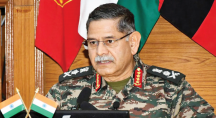
Jammu Tawi, January 13: Indian Army Chief General Upendra Dwivedi on Tuesday said that terrorist recruitment in Jammu and Kashmir is now almost non-existent and that the number of active local terrorists has fallen to single digits, reflecting a significant improvement in the security situation in the Union Territory.
Addressing reporters during his first press conference of 2026, General Dwivedi said that since May 10 last year, the situation along the Western Front and in J&K has remained sensitive but firmly under control. He said that a total of 31 terrorists were eliminated in 2025, of whom nearly 65 per cent were of Pakistan origin. These included the three terrorists involved in the Pahalgam attack, who were neutralised during Operation Mahadev.
“Active local terrorists are now in single digits. Terrorist recruitment is almost non-existent, with only two cases reported in 2025,” the Army Chief said. He added that several indicators point to a positive transformation in Jammu and Kashmir, including robust development activity, revival of tourism, and the peaceful conduct of the Amarnath Yatra. More than four lakh pilgrims participated in the Yatra, exceeding the average of the past five years. “The shift from terrorism to tourism is gradually becoming a reality,” he said.
General Dwivedi stated that Operation Sindoor remains ongoing and warned that any future misadventure would be dealt with firmly. He acknowledged the proactive role played by all stakeholders at the national level, including the Central Armed Police Forces, intelligence agencies, civic bodies, the state administration and other ministries, in maintaining peace and stability.
Describing Operation Sindoor as a landmark example of tri-service synergy, the Army Chief said it was executed under a clear political directive with full operational freedom. “The operation was conceptualised and executed with precision. In just 22 minutes of initiation on May 7, followed by orchestration over 88 hours until May 10, strategic assumptions were reset. Terror infrastructure was struck deep, and the long-standing nuclear rhetoric was punctured,” he said.
He added that the Army successfully destroyed seven out of nine identified targets and was fully prepared for a ground offensive if required. According to him, the operation demonstrated India’s readiness and capability to respond decisively across domains.
General Dwivedi further said that top-level interactions, renewed contacts and confidence-building measures have contributed to the gradual normalisation of the situation along the borders. This has enabled the resumption of activities such as grazing, hydrotherapy camps and other civilian engagements along the Northern Borders.
“With a sustained strategic orientation, our deployment along the Line of Actual Control remains balanced and robust. At the same time, capability development and infrastructure enhancement are progressing through a whole-of-government approach,” he said.
Responding to a query, the Army Chief said that intelligence inputs suggest that eight terrorist camps are still active across the border—two near the International Border and six across the Line of Control. “There is some level of presence or training activity in these camps, which is why they remain under close watch. If similar hostile actions are attempted, they will be dealt with decisively,” he said.
He also noted that forward troop movements undertaken during Operation Sindoor have been gradually reduced by both sides, though vigilance continues to be maintained.
On questions related to nuclear threats during the May 2025 India-Pakistan conflict, General Dwivedi clarified that there was no discussion on nuclear warfare between the Directors General of Military Operations of the two countries. “The nuclear rhetoric came from political or local public elements in Pakistan, not from the military. There is no indication that such messaging originated from the Pakistani armed forces,” he said.