Smt Anupriya Patel
Stronger health systems lead to higher economic productivity, greater workforce participation, and sustained long-term growth. Good health, therefore, is not only a social good but also a national asset – the foundation upon which human potential is built and national strength is measured. Health, therefore, is not only a social good but also a national asset, and every rupee invested in it is an investment in the nation’s people.
Thus, Universal Health Coverage (UHC) – ensuring that all people, regardless of socio-economic status, can access the full range of quality health services they need, when and where they need them, without financial hardship – is not only a Sustainable Development Goal to be achieved by 2030 but also a health priority .
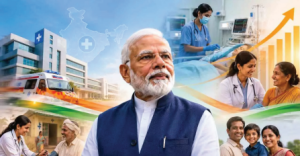
India’s National Health Policy 2017 (NHP 2017) is aligned with the goal of achieving Universal Health Coverage (UHC) and SDG 3, guided by a simple but powerful belief – healthcare should be within reach of every person. Its four pillars – Affordability, Accessibility, Quality, and Availability translate that belief into action, anchoring a comprehensive continuum of care across all stages of life. Aligning with the goals, National Health Mission supports States in delivering an integrated three-tier model of health systems with a two-way referral linkages across rural and urban areas including vulnerable populations.
At the primary level, Ayushman Arogya Mandir (AAM) provides comprehensive preventive, promotive, curative, rehabilitative, and palliative care health care services. eSanjeevani telemedicine platform ensures the availability of specialists connecting the community to the specialist through these AAM. And, a special Tele-MANAS platform, which has reached a cumulative 38.93 lakh contacts as on date.
Connecting from AAM are the secondary facilities at the Community Health Centre (CHC)/ First Referral Unit (FRU) and District Hospital (DH) that serve as the first point of referral to provide in-person specialist and hospitalisation care, with tertiary institutions including medical colleges serving on the top of the apex to more complex and super-specialist service’s needs.
This three-tier system is supported by escalation in Government health budget, with National Health Mission spending growing by 168% over the past decade, reflecting government’s commitment to health as a national priority.
The journey of Ayushman Arogya Mandir represents a significant expansion of comprehensive primary healthcare and the much required transition from a reactive to proactive care. The expansion from 6 to 12 comprehensive health packages is a structural response to India’s changing demographic and epidemiological profile. As we navigate the dual challenge of aging population with a rising tide of non-communicable diseases, the expanded scope covers Non Communicable Diseases (NCDs), mental health, elderly care, emergency services, and eye, ENT, and oral health along with yoga and health promotion — reflecting a system designed for the population India is becoming.
As of May 2026, more than 1.8 lakh AAM are operationalised across country to provide door step healthcare services and the scale of this expansion is visible through more than 120 crore OPD consultations at AAM, more than 70 crore eSanjeevani teleconsultations, and more than 46.1 crore wellness sessions promotion good health and well-being.
At the primary care level, population-based screening for diabetes, hypertension, and common cancers oral, breast, and cervical targets all adults above 30 years, making early detection a routine. This screening is an integral component of service delivery under Ayushman Arogya Mandir, integrating NCD prevention into comprehensive primary healthcare. The expansion of NCD services is a multi-layered approach to early detection, prevention, management, and treatment. Dedicated NCD clinics, Day Care Cancer Centres, Tertiary Care Cancer Centres, and State Cancer Institute’s decentralise advanced oncology services and bring specialist care closer to the patient.
Also, whole-of-government approach is applied for preventive activities. FSSAI promotes healthy eating habits; the Fit India Movement drives physical activity; and the Ministry of AYUSH advances yoga and wellness. Sustained public awareness campaigns and Health Day observances reinforce these efforts. Prime Minister Modi’s personal appeal to reduce edible oil consumption by 10% underscores a simple but powerful conviction: that the fight against NCDs is won as much in households as in hospitals.
To support the primary care expansion, a new cadre of Community Health Officers were introduced at the AAM level, bringing clinical and public health competence closer to the community. This expansion was mirrored at the doorstep, where the frontline network grew to over 10 lakh ASHAs – linking the community with the health systems.
Alongside expansion, India took on the harder challenge of transforming the standard of care itself. The National Quality Assurance Standards, indigenously developed and internationally certified, turned quality from an aspiration into an accountability. Over 65,000 public health facilities, including 54,926 Ayushman Arogya Mandirs, are now NQAS-certified. Further, laboratory standards for IPHLs embed rigour into the system.
What made NQAS work was not the standard alone, but the ecosystem built around it — LaQshya for maternal and newborn care, Kayakalp for cleanliness and infection control, and MusQan for child health. Together, they have made quality a baseline rather than a benchmark. The result is a system that does not just treat more people — it treats them better.
If primary care is the system’s first promise, targeted interventions like National Sickle Cell Anaemia Elimination Mission and Pradhan Mantri National Dialysis Programme further reflects Governments commitment to reducing the OOPE across the country, with a cumulative savings of more than Rs. 10,102 crore to families who would otherwise have borne that burden alone.
Putting people’s health into people’s hands, India strengthened its community platforms — a deliberate, decentralised architecture that puts planning, monitoring, and accountability in local hands. Village Health, Sanitation and Nutrition Committees (VHSNCs), ,Jan Arogya Samitis (JAS), and Rogi Kalyan Samitis (RKS) have made representatives of Panchayati Raj Institutions and Urban Local Bodies active partners in health. In urban areas, Mahila Arogya Samitis (MAS) further deepen the focus by placing women at the centre of community outreach for transparency, accountability, and community voice for the trusted feedback loop.
True health security means being as ready for tomorrow’s threats as for today’s. PM-ABHIM, launched in 2021 with an outlay of Rs. 64,180 crore, draws directly on the lessons of COVID-19 — building surge capacity, strengthening laboratory networks, expanding real-time disease surveillance, and developing One Health research infrastructure. It is, in essence, turning hard lessons into durable public health architecture.
When illness does require hospitalisation, Ayushman Bharat PM-JAY provides the financial cushion that prevents care from becoming catastrophic to the family. As the world’s largest publicly funded health assurance scheme, it covers Rs. 5 lakh per family per year for secondary and tertiary care — a protection extended in 2024 to all senior citizens above 70, regardless of income.
Underlying all of these initiatives is a digital backbone without which a system of this scale cannot function. The Ayushman Bharat Digital Mission ABHA IDs, interoperable health registries, and unified health interfaces has made the records portable, access seamless, and delivery intelligent. Nearly 91 crore ABHA IDs have already been generated with India progressing towards digital health systems.
Taken together, free services, community-level diagnostics, front-line specialists, referral transport, dialysis, hospitalisation cover, and a digital backbone do not add up to a collection of schemes — they add up to a system. The health gains are not accidental. They are what sustained, layered public investment looks like when it works.
The results are no longer abstract; they are visible in India’s public health record. Maternal mortality has fallen from 254 per lakh live births in 2004-06 to 87 in 2022-24, meeting the NHP 2017 target. From 1990 to 2024, India cut MMR by 84% – nearly twice the global decline of 48% – and earned UNFPA recognition for leadership in maternal health and family planning. The broader picture tells the same story: as per the latest NFHS, fertility has reached 2.0, institutional deliveries have risen to 90.6%, and full immunization now stands at 98.6%. These are signs of a system learning to prevent, detect, and respond. That is why India’s elimination milestones matter: maternal and neonatal tetanus in 2015, and trachoma as a public health problem in 2024 – making India only the third country in South-East Asia to do so.
This is the larger lesson. NHP 2017 set the direction, NHM built the delivery infrastructure from Sub-Health Centres to tertiary hospitals, and Ayushman Bharat gave that system its four working pillars: AAMs for primary care, PM-JAY for financial protection, PM-ABHIM for resilience and infrastructure, and ABDM for the digital backbone. Together—with free medicines, diagnostics, transport, and dialysis—they amount to more than a collection of schemes. They form a national health shield for our people, and a reminder that public health, when treated as nation-building, can transform both lives and the future of the country.
(The author is the Minister of State for Health & Family Welfare and Chemicals and Fertilizers)